
tutorial
|
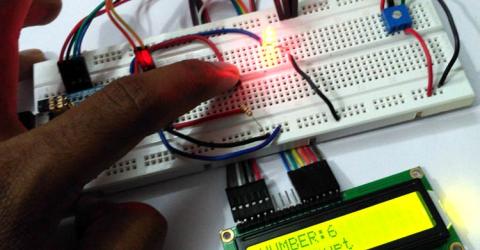
How to Use Interrupts in STM32F103C8 Interrupts is a mechanism by which an I/O or an instruction can suspend the normal execution of processor and gets itself serviced like it has highest priority. Like for example, a processor doing a normal execution can also continuously monitor for some kind of event or an interrupt to happen. That is when an external interrupt is happened (like from some sensor) then the… |
|
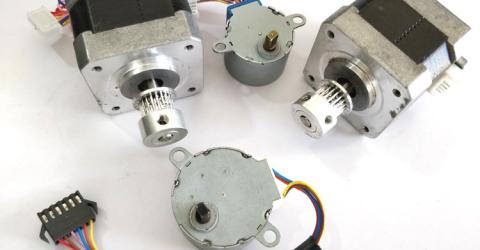
What is Stepper Motor and How it Works From a simple DVD player or printer in your home to a highly sophisticated CNC machine or Robotic Arm, Stepper motors are to be found almost everywhere. Its ability to make electronically controlled precise movements have made these motors find application in many felids like surveillance cameras, Hard disk, CNC machines, 3D Printers, Robotics, Assembly robots, Laser cutters… |

|
DIY Self Balancing Robot using Arduino After being inspired by RYNO motors and other self-balancing scooters from Segway, I always wanted to build something of my own Arduino Segway Robot. Thinking for a while, I decided to build a Self Balancing Robot using Arduino. This way I would be able to grasp the underlying concept behind all these scooters and also learn how the PID algorithm works. … |
|
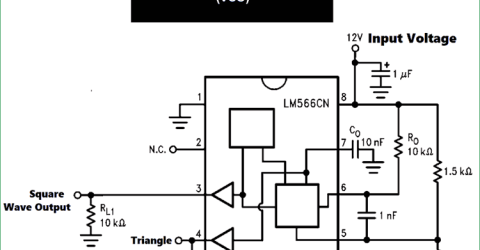
Voltage Controlled Oscillator (VCO) Most of the consumer electronic devices around us, such as mobile phones, TVs, Radios, and MP3 players, are a combination of Digital and Analogue electronics. Wherever wireless transmission/reception, or audio signals are involved in an electronic design, we will need periodic oscillating electronic signals. These signals are called Oscillating signals and are very useful in… |
|
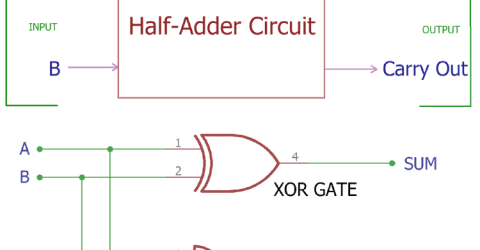
Half Adder Circuit and its Construction Computers use binary numbers 0 and 1. An adder circuit uses these binary numbers and calculates the addition. A binary adder circuit can be made using EX-OR and AND gates. The summation output provides two elements: the first one is the SUM, and the second one is the Carry Out. When we use the arithmetic summation process in our base 10 mathematics… |
|
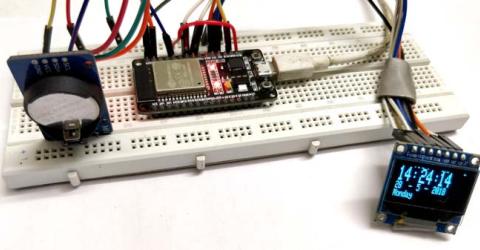
ESP32 Real Time Clock using DS3231 Module In this tutorial, we will learn about Real Time Clock (RTC) and its interfacing with the ESP32 and OLED display. We will use the DS3231 RTC module to keep track of the correct time and display it on the SPI OLED by using ESP32 as our microcontroller. ESP32 is more than a microcontroller. It has a Wi-Fi and Bluetooth chip inside it and 39 GPIO pins.… |

|
Automatic Pet Feeder using Arduino We're building an Arduino automatic pet feeder today that feeds your pet automatically at scheduled times. This complete automatic pet feeder project incorporates a DS3231 RTC (Real Time Clock) Module, allowing you to keep track of your pet's eating schedule and properly schedule feeding at specific times. Our tested design is one of the best pet feeders for DIY makers that… |

|
Getting started with MATLAB: A Quick Introduction MATLAB (Matrix Laboratory) is a programming platform developed by MathWorks, which uses it's proprietary MATLAB programming language. The MATLAB programming language is a matrix-based language which allows matrix manipulations, plotting of functions and data, implementation of algorithms, creation of user interfaces, and interfacing with programs written… |
|
Generate Pulse Width Modulation (PWM) Signal using 555 Timer IC Pulse Width Modulation using 555 timer is an important feature of today’s microcontroller due to its requirement for controlling many devices in almost every field of Electronics. PWM is widely used for motor control, lighting control, etc. Sometimes we do not use a microcontroller in our applications, and if we need to generate PWM without a microcontroller, then we prefer… |
|
Arduino Timer Tutorial The Arduino Development Platform, at the beginning in 2005, was conceived to be a simple programmable device to be used specifically for art design work. The goal was to create an interface to support the design and use of simple electronics, working with Arduino timer functions without requiring deep programming expertise. This simplicity led to fast adoption by electronic… |
|
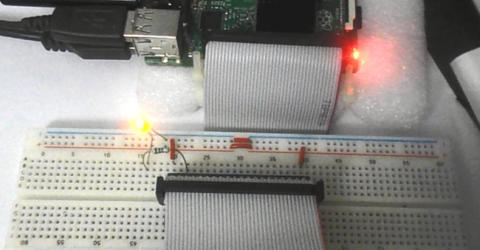
Raspberry Pi PWM Tutorial Raspberry Pi is an ARM architecture processor-based board designed for electronic engineers and hobbyists. The PI is one of the most trusted project development platforms available today. With a higher processor speed and 1 GB of RAM, the PI can be used for many high-profile projects, such as image processing and the Internet of Things. To do… |
|
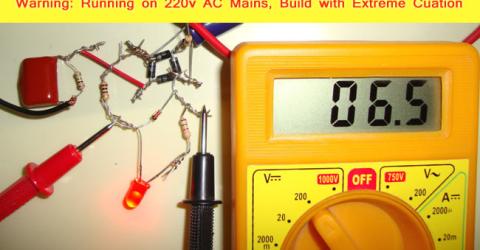
Transformerless Power Supply Generating low-voltage DC from the 220V or 110V AC mains is very useful and necessary in the field of electronics. Low voltage DC, like 5v, 6v, 9v, 12v, is used in electronics circuits, LED bulbs, toys and many household electronics items. Generally, batteries are used to power them, but they need to be replaced from time to time, which is not cost-effective and also takes… |
