

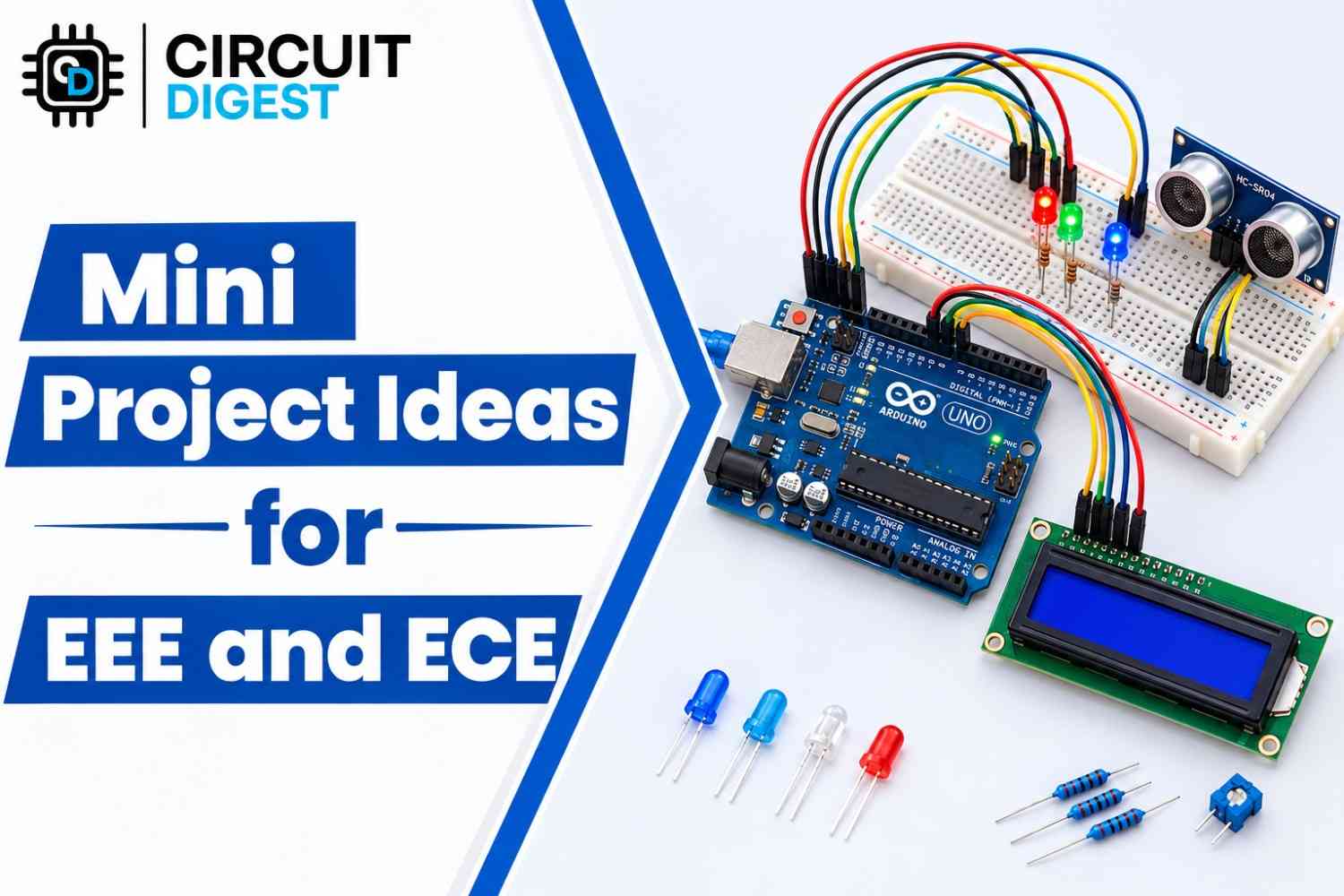
For students in Electronics and Communication Engineering (ECE), a mini-project is more than just a submission; it’s an opportunity to turn concepts like sensors, microcontrollers, embedded systems, communication, automation, digital electronics, and IoT into a working prototype.
That’s where Circuit Digest can be a practical resource for electronics students. Our project resources are available for free, with GitHub code, circuit schematics, and detailed project walkthroughs, including mini projects that cover the basics of electronics. We help students explore a wide range of electronics and communication topics through academic projects, experimentation, and hands-on learning.
Whether you’re looking for beginner-friendly ECE/EEE mini projects for Electronics, an Arduino project, an embedded systems idea, an IoT prototype, a communication project, or a more advanced electronics concept, Circuit Digest can help you explore your options, narrow down your choices, and find a project that fits your interests and goals.
Learn by Building: Hands-On Electronics Mini Projects to Turn Ideas into Reality
The best way to learn electronics is to build something yourself. Each project includes a working circuit, source code, and a simple explanation of how everything works together. So, instead of just following the steps, you get to understand what’s happening in the circuit and why it works. These projects give you a practical way to take what you’ve learned in the classroom and turn it into a working prototype that you can test, improve, and confidently demonstrate.
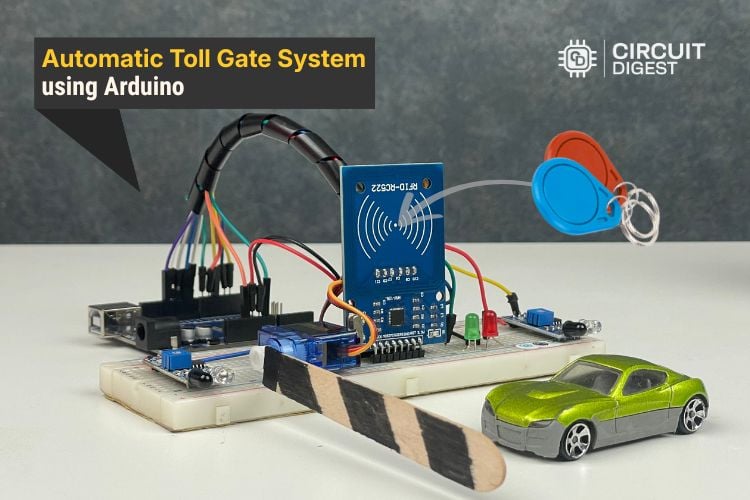
Automatic Toll Gate System Using Arduino
The “automatic toll gate system project” shows how simple sensors and a microcontroller can automate a real-life process like toll collection, making it an ideal project for anyone just starting in electronics.
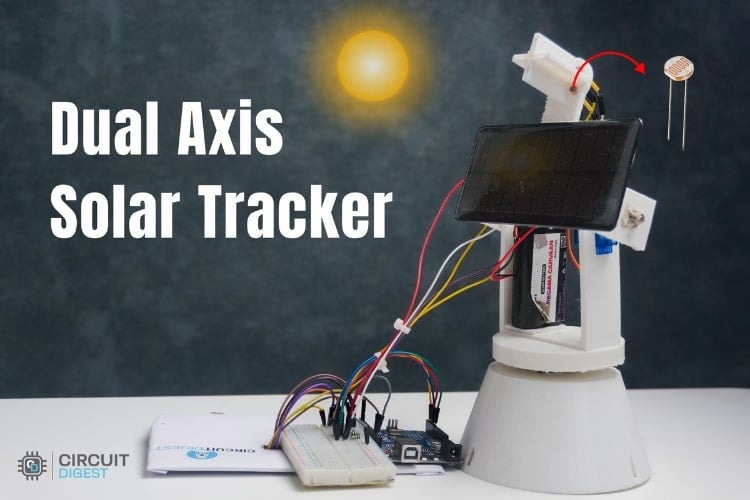
Dual Axis Solar Tracker System
This dual-axis solar tracking system uses Arduino to move the solar panel horizontally and vertically based on the sun's location. This project, using LDR and servo motors, can increase energy output by up to 40% compared to fixed solar installations.
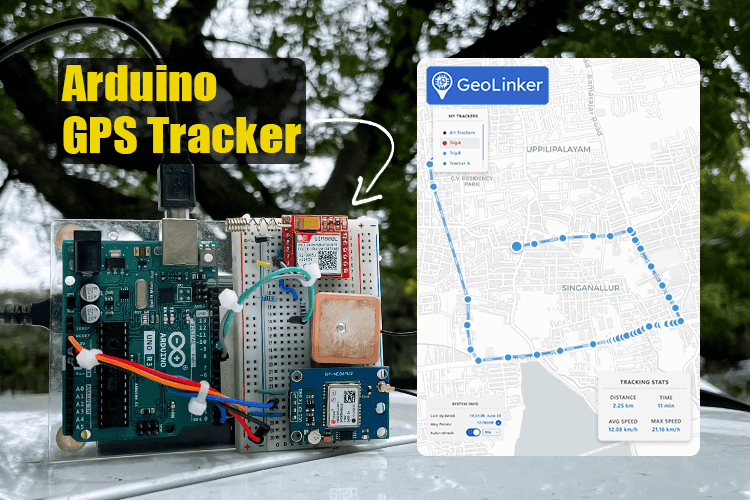
Arduino Location Tracker
This comprehensive project creates a fully functional GPS tracking system using Arduino UNO R3, SIM800L GSM module, and NEO-6M GPS module, a perfect low-cost DIY combination for vehicle monitoring, asset protection, or personal safety applications.
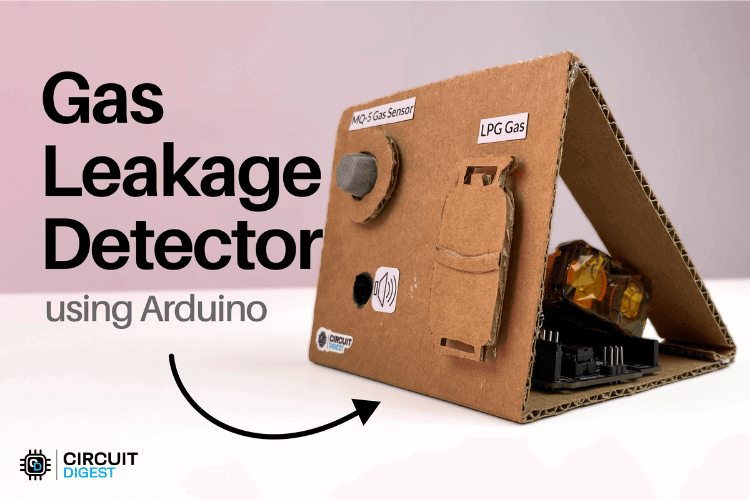
Gas Leakage Detector
In this project, you'll learn how to build a simple and budget-friendly gas leakage detector using Arduino. This LPG gas leak detector uses an Arduino Uno and MQ-5 gas sensor to detect gas levels in the air and activates a buzzer and LED to alert users when a leak is present.
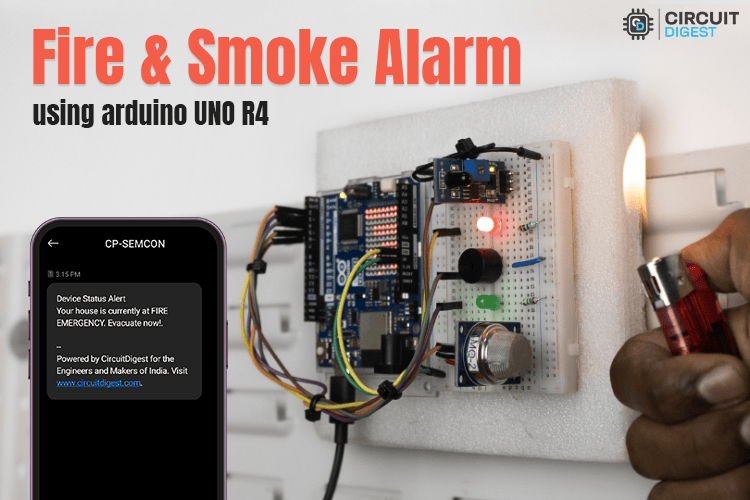
Smoke and Fire Alarm System
In this project, you will also learn how to build an Arduino smoke alarm that sends SMS Alerts without needing to rely on the GSM module. A fire and smoke alarm system using Arduino UNO R4 that sends real-time SMS notifications.
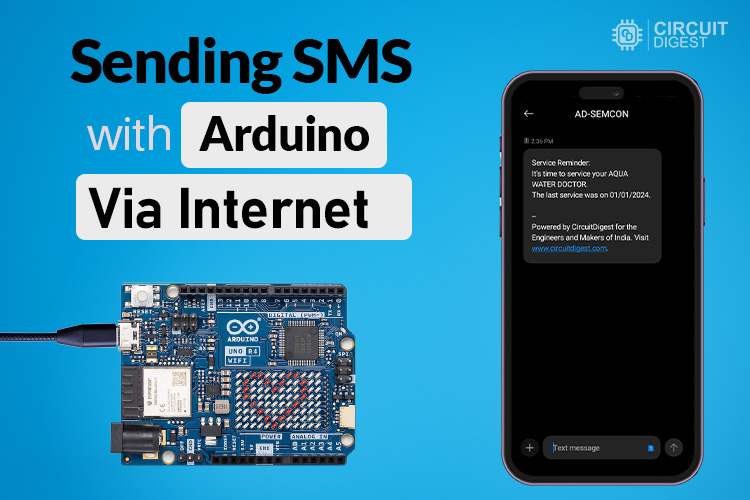
Send SMS with Arduino UNO R4 via Internet
In this tutorial, I’ll show you how to send SMS using Arduino UNO R4 and the free CircuitDigest Cloud SMS API. Whether it’s fire detection, motion sensing, or home automation, this setup has you covered.

Speed Sensor using Arduino
In this article, we will learn how to calculate speed using Arduino and an IR sensor. By setting up the two IR sensors at a fixed distance from each other, we can track the time it takes for the object to travel between them.

Detect the Direction of Sound
In this tutorial, let's learn how to find the direction of sound using Arduino and a few microphones. With the recorded time and the known distance between them, we can accurately calculate the object's speed using a formula.

RFID Door Lock System
In this article, we will learn how to build an RFID door lock system using Arduino. It’s a fun and secure way to unlock the door. By integrating an RFID reader with an Arduino, this system will automatically open the door when an authorised RFID card or tag is scanned.

Smart Home Using Arduino Uno R4 WiFi
Our Smart Home Using Arduino Uno R4 WiFi project is designed for home safety and convenience, integrating temperature, humidity, light, and gas monitoring. This project is perfect for anyone who wants to make their home or office a little smarter.
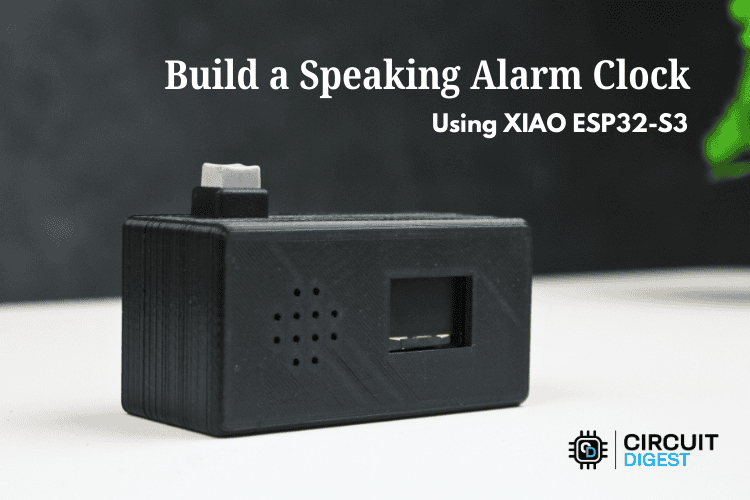
Speaking Alarm Clock Using the XIAO ESP32-S3
The ESP32 speaking alarm clock built in this tutorial replaces the beep at a scheduled time and expects the user to interpret the reason for the beep. This DIY Speaking Alarm Clock is developed using the XIAO ESP32-S3 microcontroller and a cloud-based Text-to-Speech (TTS) engine.

Noise Pollution Monitoring System
Noise Pollution Monitor tracks, analyses, and alerts on rising noise levels in real time. The noise pollution monitoring project continuously measures ambient sound and vibration, displays the readings locally, and pushes data to CircuitDigest Cloud to access the data from anywhere.
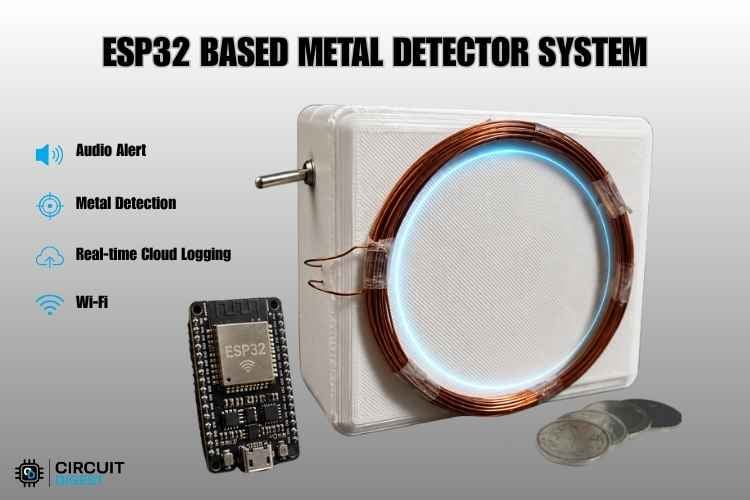
Metal Detector System
This metal detector uses an affordable Wi-Fi-enabled microcontroller, a handful of available components, and a simple, hand-wound copper coil. We’ll guide you through winding the induction coil, assembling the pulse circuit, and flashing the code for this DIY PI metal detector.

Helmet Detection with Raspberry Pi
This project is a compact, traffic monitoring device that uses a USB camera, Python, OpenCV, and the CircuitDigest Cloud API to automatically detect whether two-wheeler riders are wearing helmets in real time, without the need for on-device machine learning training or manual dataset labelling.

Raspberry Pi Waste Segregation System
This project captures an image of waste using a USB camera and can be sent to an Image Processing API located in the Cloud for classification as either biodegradable or non-biodegradable. No trained machine learning model is required for classification, which is done using an API call.

Raspberry Pi Parking Space Detection System
We have built a parking space detection system without any complex setup. We only need a Raspberry Pi board, a USB camera, and an account in CircuitDigest Cloud. The Requests library then sends the image to the CircuitDigest Cloud API using an HTTPS POST request with the API key.
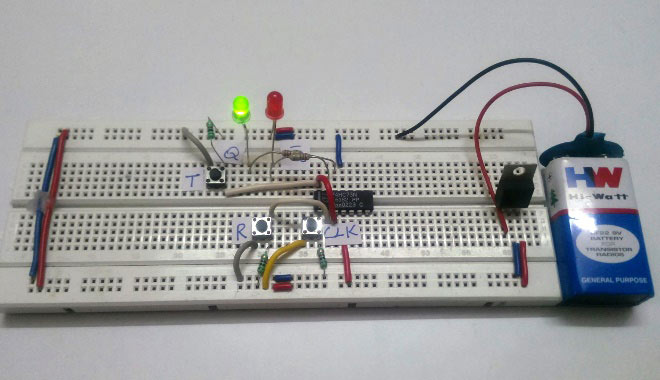
T Flip-Flop
The flip-flop, aka latch, can also be understood as Bistable Multivibrator as two stable states. Generally, these latch circuits can be either active-high or active-low, and they can be triggered by HIGH or LOW signals, respectively.
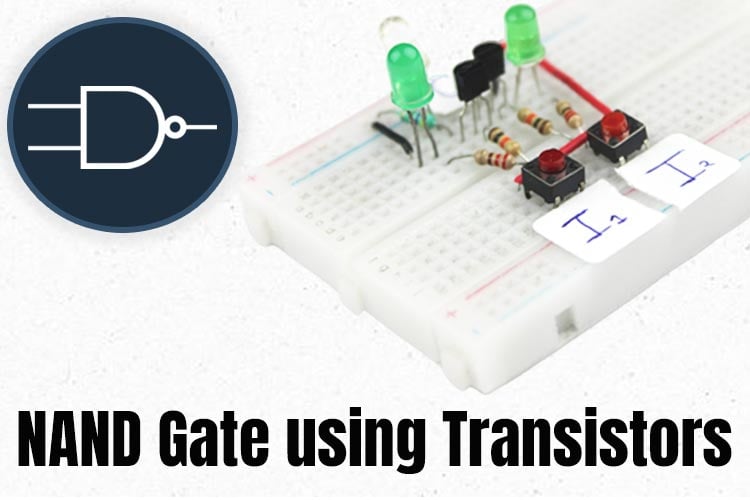
NAND Gate with Transistors
In this article, we will go over how to build a NAND gate circuit with transistors. Transistors serve as the building blocks of logic gates, such as AND gates, NAND gates, OR gates, XOR gates, and other gates that are integral to integrated circuits.

XOR Gate with Transistors
In this article, we will explore the inner workings of the XOR gate, including its truth table, logical symbol representation, circuit diagram, and practical construction using transistors. The XOR gate an essential component in various applications, from binary arithmetic to complex data encryption algorithms.
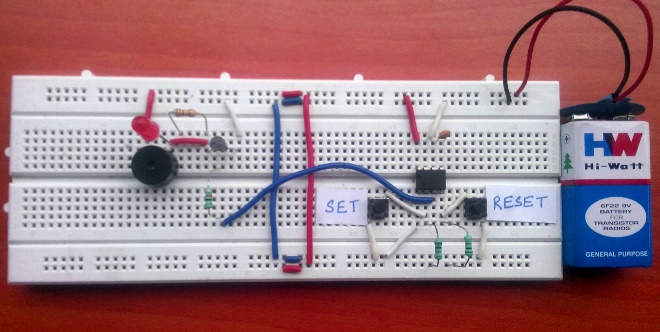
Panic Alarm Button Circuit
A Panic Alarm Circuit is used to send an emergency signal immediately to people in nearby locations to call for help or to alert them. The indication of an emergency can either be in the form of a visible or audible signal, which can be fixed a few meters away through wire.
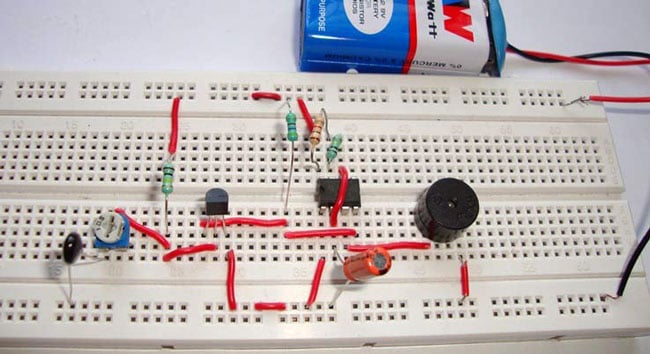
Fire Alarm Circuit
Building a simple fire alarm system using a 555 Timer IC that will sense a fire (temperature rise in the surrounding area) and trigger the alarm. The key component of the circuit is a thermistor, which has been used as a fire detector or a fire sensor
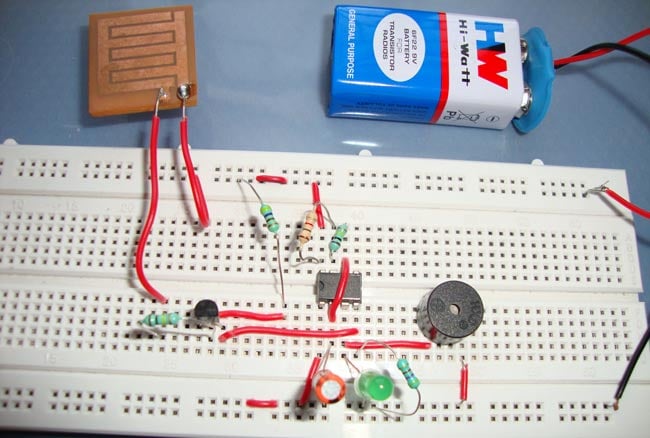
Rain Alarm
A rain alarm is an application which detects rainwater and blows an alarm. They are useful device and plays an important role in various industries such as automobile, irrigation, and wireless communication.
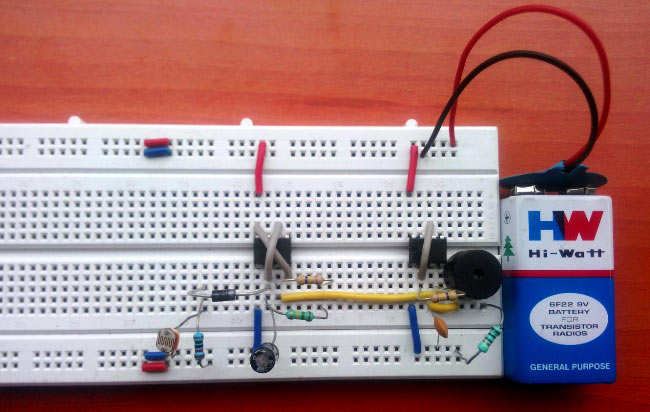
Fridge Door Alarm Circuit
This circuit triggers the alarm if the door of the fridge is left open for a long time. When the door of the refrigerator is left open, the temperature inside the cabin will increase. This rise in temperature will be sensed by the thermostat, which will try to cool down the cabin.
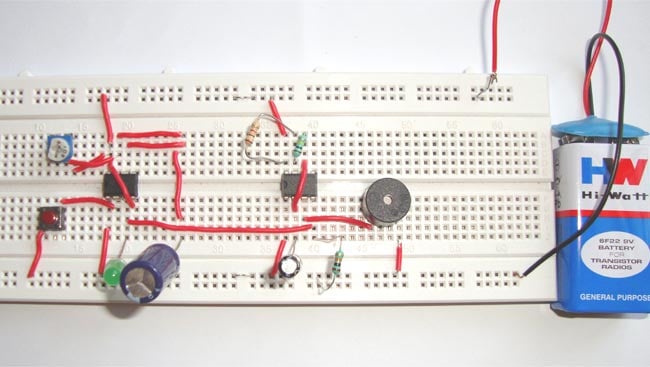
Doorbell using IC 555
The main feature of this doorbell is that we can control the time duration for which it keeps ringing upon pressing the switch. Also, we can control the oscillation frequency of the “doorbell sound” produced by the Doorbell (Here we are using a buzzer as a bell to illustrate).
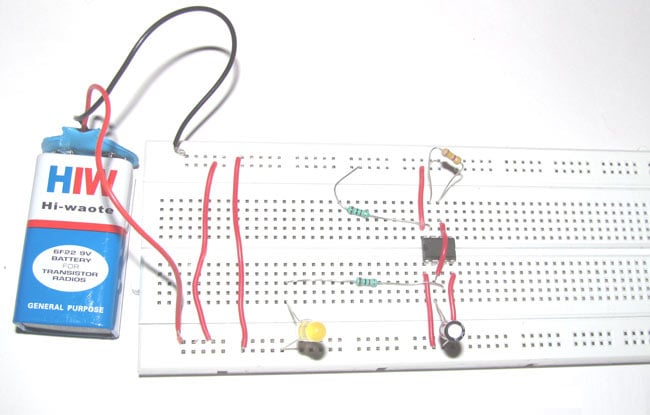
Simple Flashing LED
An LED Flasher Circuit project is done with available electronic components and an easy-to-understand schematic. This tutorial will show you how to make an LED glow and fade at a certain interval

LED Dimmer Circuit
Building an LED ON and OFF circuit using a 555 timer IC and BC557 is very simple. In this circuit, the 555 timer IC is configured as an astable multivibrator, which means that it produces a continuous square wave output with a fixed frequency and duty cycle.
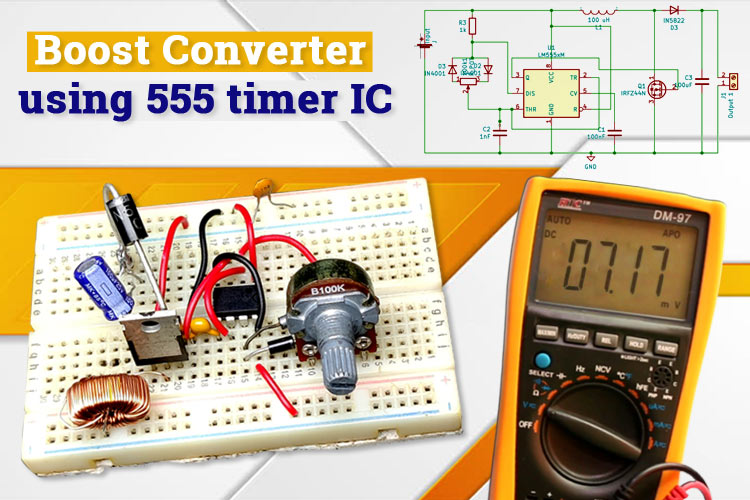
DC-DC Boost Converter
In this article, we will learn about buck converters and design a very simple boost converter using a 555 timer and IRFZ44N, an N-channel MOSFET. A boost converter is a non-isolated type of switch-mode power supply that is used to step up the voltage.

555 Timer-Based Buck Regulator
This circuit is basically a simple power electronics DC-DC Buck converter which can be used to step down voltage; its efficiency results in better battery life due to reduced heat generation, making it a lucrative option for smaller gadgets.
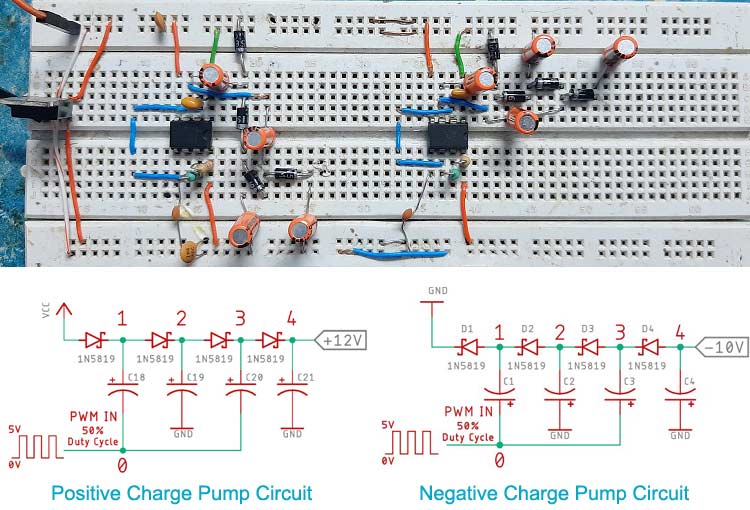
Positive and Negative Charge Pump Circuit
A charge pump is a type of circuit that is made out of diodes and capacitors configured in a specific configuration to get the output voltage higher than the input voltage or lower than the input voltage. By lower, I mean a negative voltage with respect to ground.
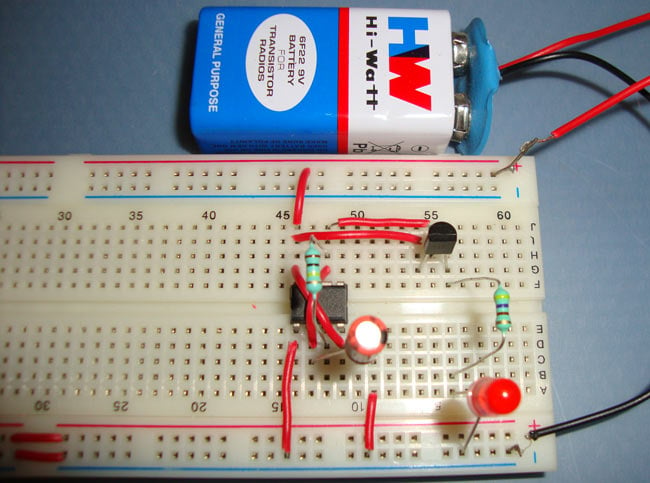
Simple Fading LED Light
The slow fade LED circuit is very simple; the 555 has been used in Astable mode, and a transistor is used to amplify the current. In Astable mode, the 555 IC oscillate at a particular frequency (depending on RC components), meaning the output at PIN 3 goes HIGH and LOW periodically.
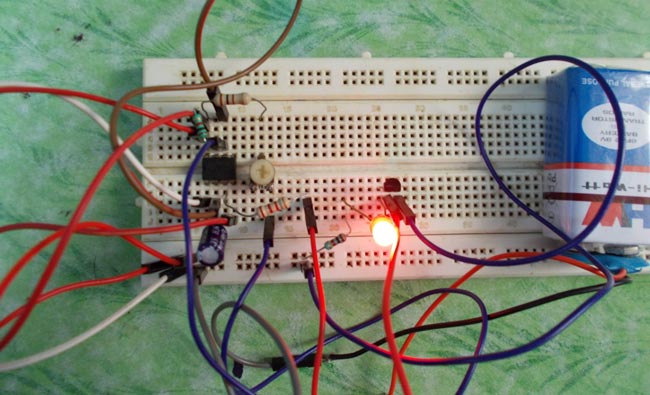
Transistor Tester using 555 Timer IC
In this tutorial, we will design a simple 555 TIMER-based circuit which will test the working of the transistor in seconds. This circuit is a convenient way to check the working of a transistor for newbies.

Audio Amplifier using 555 Timer IC
In this tutorial, we are going to see how a 555 IC can be used as an audio amplifier. A low-power audio signal can be amplified using a 555 Timer IC. We can test this circuit by blowing some air from the mouth towards the Mic; the speaker will generate sound.
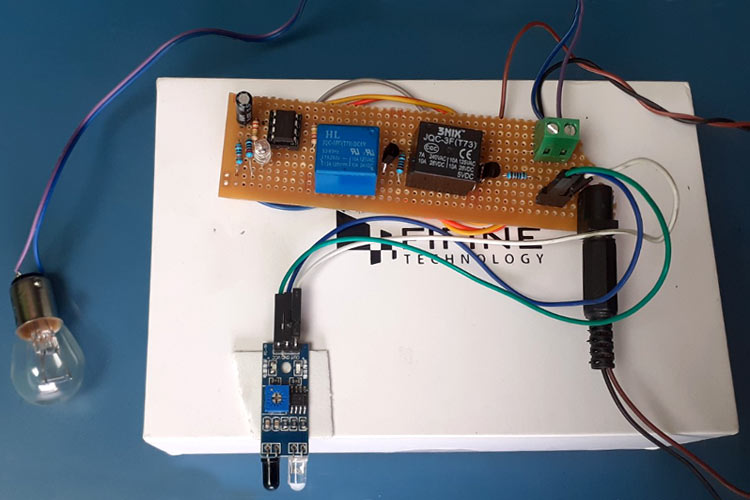
Current Detector Circuit with 555 Timer
In this article, we build a simple current detector circuit with a 555 Timer and some passive components, which can help you to detect open live lines with ease. Before starting work on an electrical box and AC mains, one needs to verify that there is no AC leakage voltage.
Motion Detector Circuit using 555 Timer
In this tutorial, we are going to use an IR sensor with a NE555 Timer IC to detect motion and switch the AC load according to that. The 555 timer IC is used as a switch here. This circuit uses a digital timer IC; the operation of the circuit is fast and accurate, with even faster detection speeds.
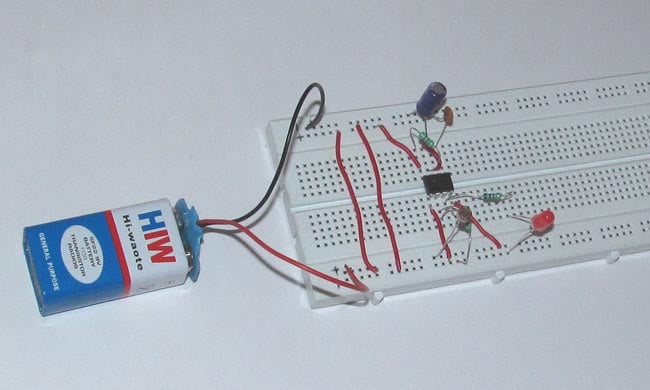
Simple LDR Circuit
This dark detector circuit uses a 555 timer IC and an LDR (Light Dependent Resistor), which senses the light in the surroundings, and if it does not find light, it triggers the IC and turns on an LED attached to the circuit.
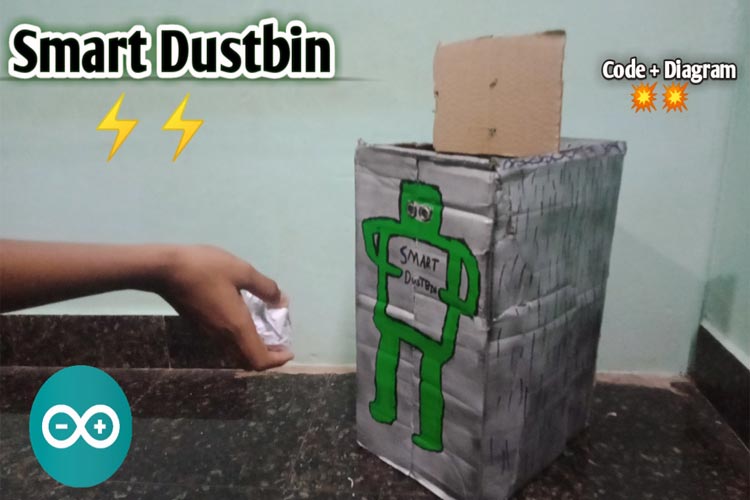
Smart Dustbin Using Arduino
This automatic smart dustbin is a decent gadget to make your home clean and attractive. Kids spread trash to a great extent with paper, wrappers, and numerous other things at home. It opens automatically without touching to throw all trash and waste into this smart dustbin
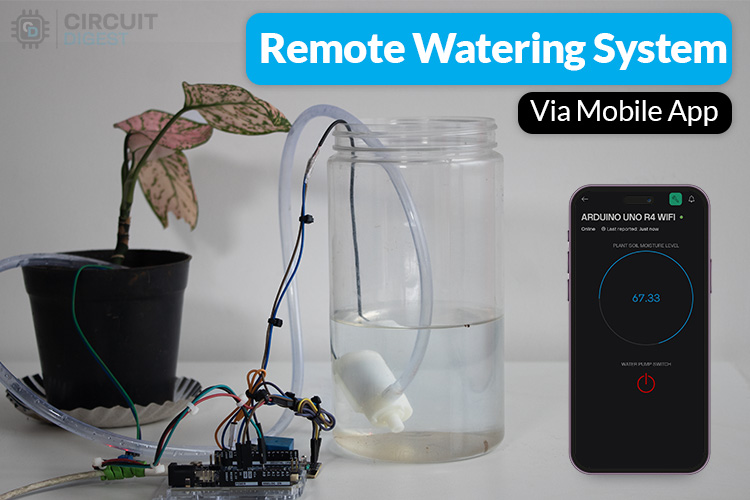
Automatic Plant Watering System Using Arduino
This DIY automatic plant watering system project helps solve the common problem of forgetting to water plants while away from home. In this complete guide, we'll show you how to make an automatic plant watering system with soil moisture sensing and mobile app control capabilities.
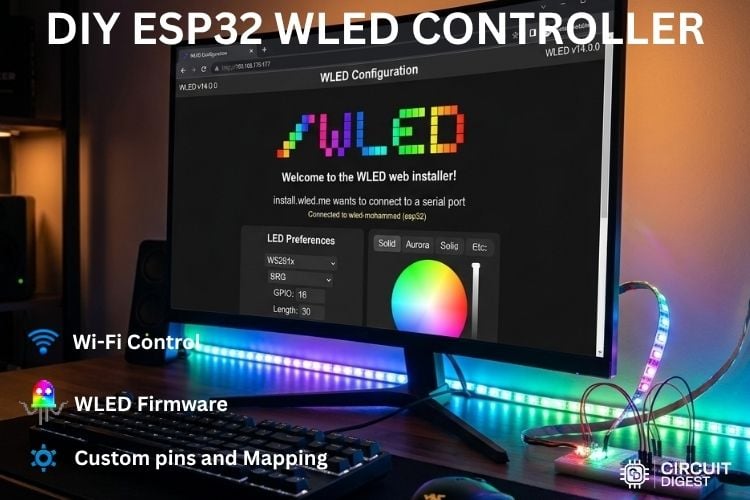
ESP32 WLED Controller
DIY tutorial is all about making our home lighting smart and fun without any complicated steps. We can connect a standard 12V LED strip to a tiny wi-fi chip and build our own ESP32 WLED controller.
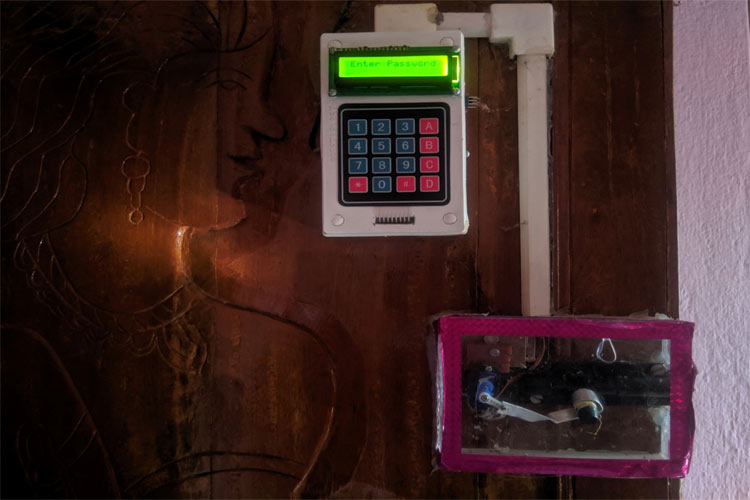
Digital Keypad Security Door Lock
In this project, I have built an Arduino Keypad Door Lock which can be mounted to any of your existing doors to secure them with a digital password. Of all the solutions, the low-cost one is to use a password- or PIN-based system.

Automatic Pet Feeder
Arduino automatic pet feeder that feeds your pet automatically at scheduled times. This project incorporates a DS3231 RTC (Real Time Clock) Module, allowing you to keep track of your pet's eating schedule and properly schedule feeding at specific times.
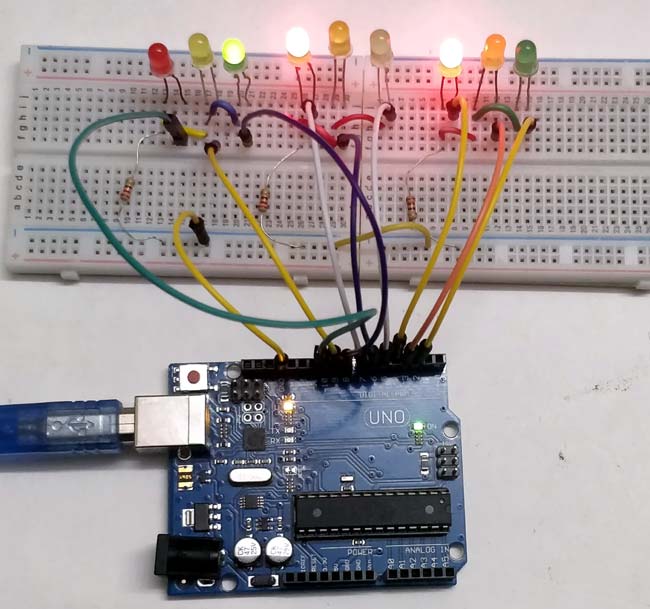
3-Way Traffic Light Controller
This Arduino-based 3-Way Traffic Light Controller is a simple project which is useful for understanding how traffic lights work, which we see around us. It’s pretty simple and can be easily built on a breadboard
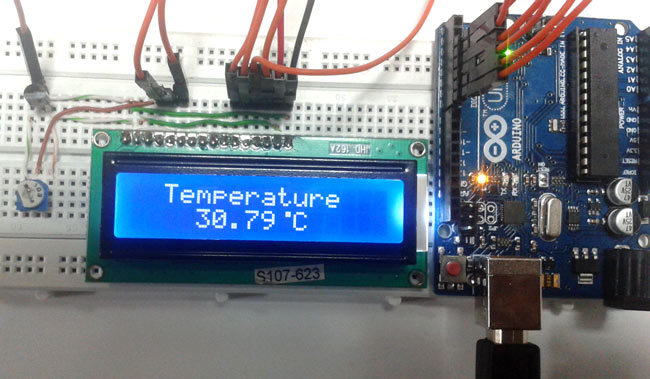
Digital Thermometer Using Arduino
In this project, we have made an Arduino-based digital thermometer to display the current ambient temperature on a 16x2 LCD unit in real time. It can be deployed in houses, offices, industries, etc., to measure the temperature.

Voice Controlled Home Automation
This model of a Modern Smart Home. These features demonstrate what a Smart Home would be like. It improves automation, control and monitoring of household devices and connects via standard means of communication for its operation.
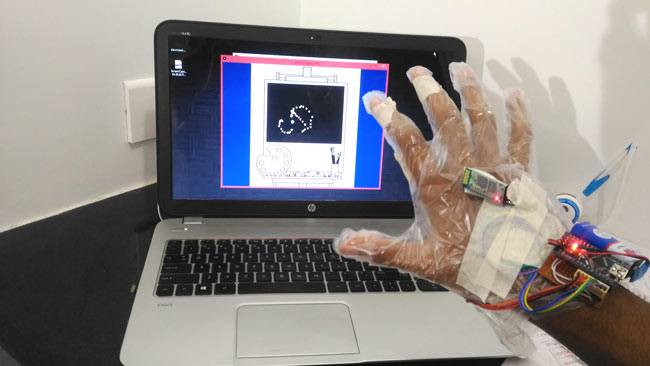
Virtual Reality Interface with Gesture-Control
This is a very interesting project in which we are going to learn how to implement virtual reality using Arduino and Processing. We will show you how you can simply wave your hand in front of a webcam and draw something on your computer.

Arduino RFID Door Lock
This RFID Door Lock can be made easily at home, and you can install it on any door. This door lock is just an electrically operated door lock which gets open when you apply some voltage (typically 12v) to it.
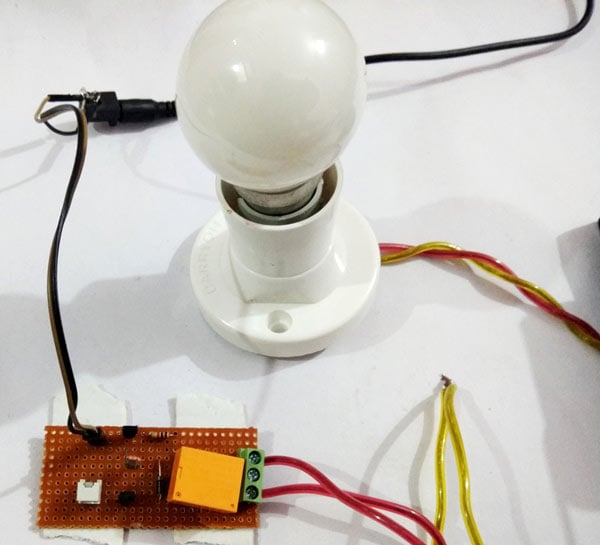
Automatic Street Light Controller
This Simple Automatic Street Light Circuit, using an LDR and a relay, will turn the light bulb on and off based on the lights in the surroundings. This circuit is quite simple and can be built with Transistors and an LDR; you don’t need any op-amp or 555 IC to trigger the AC load.
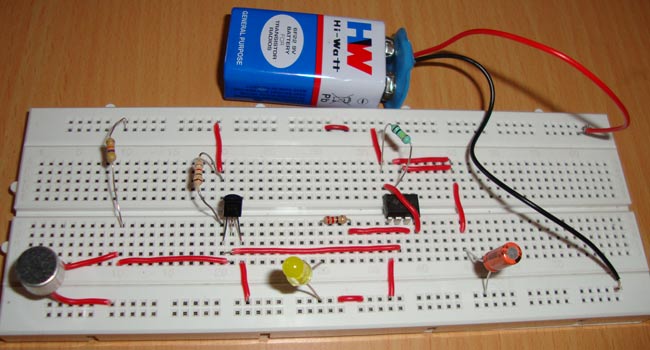
Clap Switch
A clap switch, it can be turned ON by any sound of approximately the same pitch as a clap. Here, we are using an Electric Condenser Mic for sensing the sound, a transistor to trigger the 555 timer IC, and a 555 IC to turn ON the LED through a low-voltage trigger.

Handheld Arduino Game Console
This Arduino handheld game console is lightweight, easy to carry, and simple to build, making it perfect for hobbyists, electronics engineers, and young tech enthusiasts alike. It’s beginner-friendly, and it is enough to spark creativity and deeper learning.
BLE-based Proximity Control
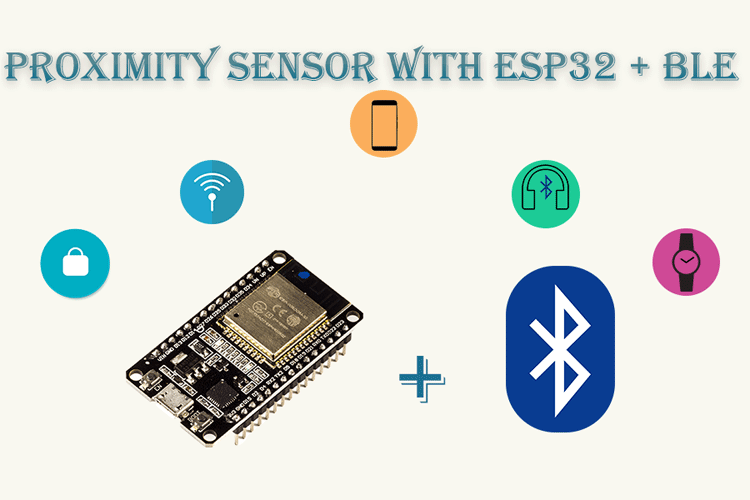
In this article, I am going to show you how to make a simple BLE presence detector with the help of an ESP32 and Arduino, and in the end, we will test these devices using BLE on my smartphone and a smartwatch.
ESP32-Based Webserver
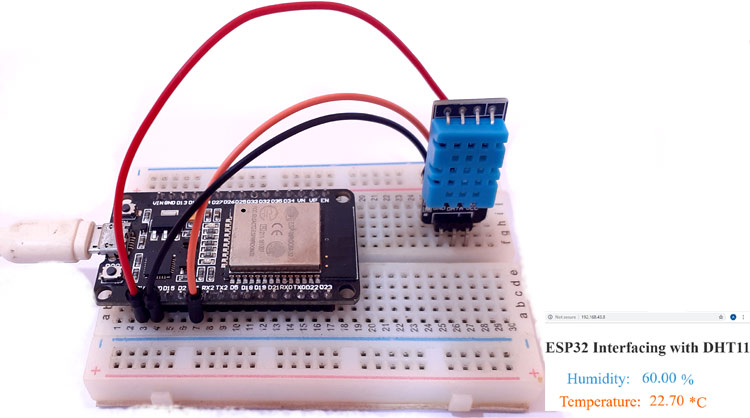
An ESP32-based web server is used to display the temperature and humidity values from the DHT11 sensor. ESP32 board will read the temperature and humidity data from the DHT11 sensor and display it on the Webpage. Here, IFTTT is also used to send email notifications when the temperature goes beyond a particular limit.
What Makes a Good Mini Project for ECE/EEE?
A good project has to fit your budget, available components, semester timeline, technical skill level, and, most importantly, give you something meaningful to explain during a viva or interview.
Finding an electronics and communication engineering mini-project topic is often the first challenge. Finding a project that matches your skill level, syllabus, budget and available components is the harder part.
Before choosing a topic, consider five things:
» Technical relevance- Does the project demonstrate something you have learned?
» Buildability - Can you obtain the components and complete the prototype within your deadline?
» Budget - Can you build it without spending unnecessarily on specialised hardware?
» Demonstration value - Can you clearly show the input, processing and output?
» Learning value - Will you be able to explain the circuit, code, limitations and future improvements?
These factors are particularly important for a low-cost electronics engineering mini project. Existing engineering project resources frequently emphasise that cost, time and resource availability strongly influence project selection.
Why use Circuit Digest for Mini Projects for Electronics?
- Ready-to-use code: Many projects include source code and GitHub resources that students can study, modify, and experiment with.
- Practical orientation: Focus on projects that can help connect classroom concepts with working electronics.
- Technology exploration: Compare traditional circuit approaches with modern microcontroller, wireless and IoT-based implementations.
- Learning before building: Understanding the circuit and technology behind a project makes it easier to troubleshoot and explain.
- Useful for academic work: Project ideas can help students move from topic selection to prototyping, documentation and demonstration.
Circuit Digest helps make your journey easier by bringing electronics engineering mini project ideas and practical technical knowledge together in one place.
Explore Related Project Hubs: Artificial Intelligence | Electronics | IoT | Robotics | ESP32 | Raspberry Pi | Arduino Projects | Drone Projects | Electronic Circuit
Get Help Along the Way
Circuit Digest’s community is active and always ready to help. If you get stuck while building a project or simply want feedback on your work, you can connect with us and get guidance from our community. Join us on our WhatsAppand Instagram channelto ask questions, share your projects, and get the support you need.

Add a comment
No account needed. Your comment appears once a moderator has reviewed it.