

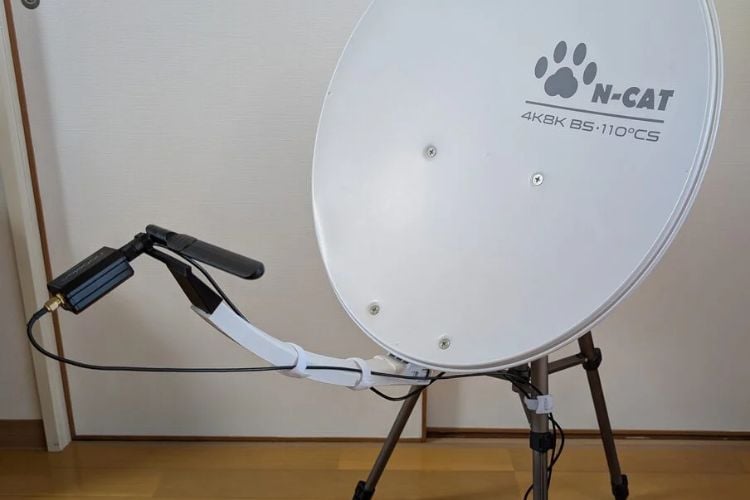
The open-source snappnt project, developed by h-shiono, explores whether an affordable ESP32 board can detect signals from India’s NavIC satellite navigation system. NavIC is used for satellite-based navigation, but this project does not work like a normal GPS tracker. Instead, it captures very short samples of radio signals and uses software to search for a known satellite signal pattern. This helps researchers and electronics developers study how satellite signals can be detected using low-cost hardware.
The project uses a Seeed Studio XIAO ESP32-C5 board running ESP-SDR firmware, a 45 cm satellite dish, a 2.4 GHz rod antenna and a low-noise amplifier (LNA) to help receive weak signals. Its software processes the captured data and checks for NavIC signal patterns. In a preliminary test reported on October 6, 2026, the developer detected a NavIC S-band signal identified as PRN 10 using a single 4.1-millisecond capture. The project also includes tools to simulate satellite signals and test whether the software can detect them correctly. These features make it useful for learning about satellite navigation, radio signal processing and low-cost receiver design.
One of the project’s main differences is that it uses the ESP32-C5’s existing 2.4 GHz radio hardware to capture short samples, rather than depending entirely on a dedicated satellite receiver. This could help developers experiment with new ways to study satellite signals and test signal-processing software on affordable hardware. However, snappnt is still experimental. The ESP32-C5 setup has not demonstrated a complete location fix, so it cannot yet be used as a replacement for a GPS or NavIC navigation device. Its short capture time, weak-signal reception and interference also create challenges. For now, the project is most useful for research, learning and testing ideas in satellite signal detection, rather than everyday navigation.

Add a comment
No account needed. Your comment appears once a moderator has reviewed it.