
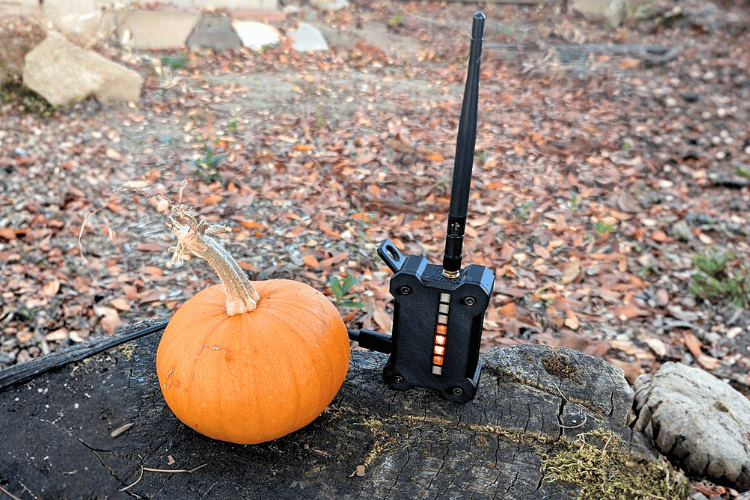
SignalSweep, an open-source project published on GitHub by a developer using the handle B0z0dcl0wn, turns a Seeed Studio XIAO ESP32-C5 into a pocket-sized scanner for trackers, surveillance hardware and drones. It is licensed GPL-3.0-or-later. The C5 is the main target because it can listen to both 2.4 GHz and 5 GHz Wi-Fi alongside Bluetooth LE, and the developer argues that more cameras and access points are moving to 5 GHz. An ESP32-S3 build is also supported, but it covers 2.4 GHz only. At the time of writing, the README lists the C5 at about $13 and marks assembled units and kits as coming soon, so building from a bare board is the only option today.
According to the documentation, the firmware decodes ASTM F3411 Remote ID broadcasts over Bluetooth, Wi-Fi beacons and Wi-Fi NAN, reporting a drone’s ID, altitude, speed, heading and pilot position. It recognizes trackers from Apple, Google, Samsung and Tile, and it collapses a flood of spoofed tags into a single entry instead of alarming continuously. Surveillance gear such as Flock Safety devices, Axon body cameras and smart glasses is matched against a signature list that can be edited from the app by OUI, company ID, name, service UUID or SSID, without recompiling. Detection of attack tools, including BLE spam and deauth bursts, is available as an opt-in. Each threat category is assigned its own buzzer and LED pattern, so the device can run without a screen from a battery bank or a car USB port, and a hunt mode raises the beep rate as the user nears a locked target. A Chrome or Edge browser app and an Android APK handle configuration over Bluetooth or USB.
The project describes itself as a receiver, with no jamming, deauthentication, injection or spoofing. It is not strictly passive, though: it sends scan requests to fetch device names, can advertise over Bluetooth unless receive-only mode is on, and can send one fixed alert write to keyfob-style trackers that support it. There is no cloud component or telemetry, and logging is off by default. Because detection relies on a device transmitting a recognizable signature, wired or radio-silent cameras and drones without Remote ID would presumably not appear. Capabilities described here come from the project’s documentation and were not independently tested.

Add a comment
No account needed. Your comment appears once a moderator has reviewed it.