

A maker from Electo Youtube channel has transformed Super Mario Bros. into a playable real-world electronics project that combines microcontrollers, pressure sensors, wireless transmitters, Raspberry Pi, motor control, FPV video, distance sensing and 3D-printed mechanisms. Instead of controlling Mario with a conventional game controller, the player walks and runs on a motorized treadmill while…

What if a tiny electronic device could look at the sky without a camera or telescope and tell you which planets are currently above the horizon? That is the idea behind Whats Up V2, a compact GPS-based circuit built around an STM32G031K8 microcontroller. The device uses a u-blox SAM-M10Q GPS module to obtain its location and precise UTC time, while nine SK6812-EC20 addressable RGB LEDs provide…

A maker built a miniature soccer environment for Sesame, a small quadruped robot, and demonstrated the system at the 2026 Open Sauce maker event. The build includes a scaled down soccer pitch sized for the robot, along with 3D printed goals and structural components. Multiple Sesame units are controlled wirelessly using the ESP-NOW protocol, with ESP32 chips on each robot communicating with a…

Hugging Face and Pollen Robotics just launched a tiny robot that could change how people learn robotics at home. Called Microduck, this 25cm tall, 780 gram biped robot is built specifically for reinforcement learning and physical AI and it costs just $399. Unlike Reachy Mini, which was designed primarily around interaction and conversational AI, Microduck focuses on physical movement and…
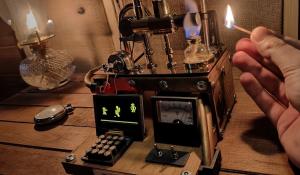
A maker from the Youtube channel PickentCode has built a working steampunk computer powered entirely by a Stirling engine, combining a 19th-century mechanical invention with modern electronics and retro computing. The Stirling engine was developed by Robert Stirling in 1816 as an alternative to the high-pressure steam engines of the time. Unlike a conventional internal-combustion engine, it…

A simple candle flame can be used as a small thermal power source when combined with a thermoelectric generator (TEG), a solid-state device that converts a temperature difference directly into electrical energy. A maker from the YouTube channel The Action Lab recently demonstrated this concept by using a candle to heat one side of a thermoelectric module while continuously circulating water…

In 1991, Mazda built one of the strangest vehicles ever made, a car that could fold into a suitcase. Only three promotional prototypes were created, and just one is believed to have survived. Instead of trying to find the original, a maker from the YouTube channel Bucket decided to build a working replica from scratch. The original Mazda Suitcase Car used a square tube chassis, solid rear axle…

YouTuber Zachary McCune from Corridor Crew has turned a simple fire spinning hobby into an ambitious engineering project that can create images in the air while spinning. The project uses the principle of persistence of vision (POV), where rapidly changing lights appear to form a continuous image when moved quickly through space. Instead of using a conventional screen, the device displays an…

Naz Louis has upgraded his open-source robot Pixel, giving the walking desk robot a new AI system that can see, remember, and reason about its surroundings in real time. The new build runs on Gemini Robotics ER2, an embodied-reasoning model built by Google DeepMind for near real-time robotics applications. The model receives a continuous stream of camera and microphone input and has direct…

TICKEY is a compact clip-on gadget that combines a 3.7-inch, 720 × 480 color e-paper display with an ESP32-S3 microcontroller, Wi-Fi, Bluetooth and NFC. Instead of behaving like a normal LCD or OLED screen, its e-paper display is designed to keep a static image visible without continuously consuming display power. Users can show pixel art, photos, digital badges, QR codes, notes or personal…

An open source project called Meowtion packs two on device AI models onto a single microcontroller with only 256KB of RAM, using a scheduling trick rather than model compression to make it fit. Built by Jerome Graves and documented on Hackaday.io, the wearable collar tracks a cat's eating, drinking, and resting behaviour to flag early changes that can precede illness.
The collar runs on…
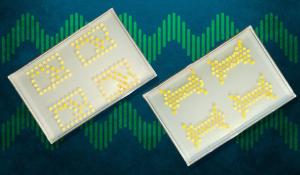
MIT researchers have built working logic circuits using engineered bacteria, creating biological versions of components that electronics engineers would normally associate with transistors, relays and digital logic. The work uses Pantoea agglomerans, a bacterium that commonly grows on surfaces, including plants. The researchers modified the cells so they could function as two types of…
