

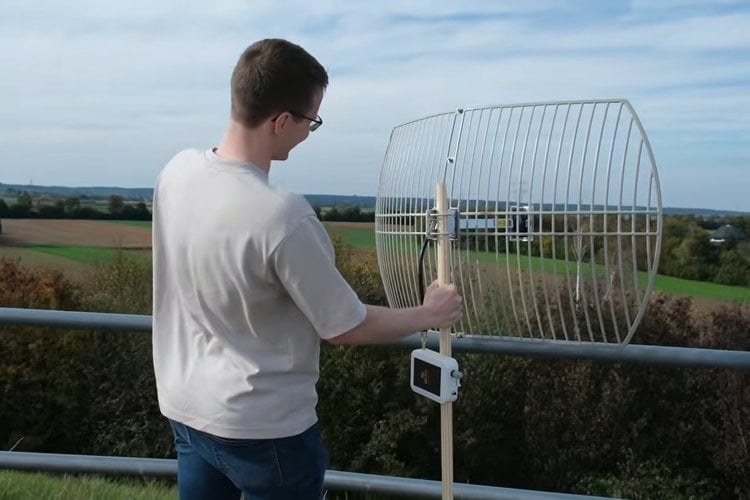
Most of us give up on Bluetooth once we walk into the next room, so this result is worth a second look. The team behind the YouTube channel nktbuilds set out to make an ordinary coin-sized Bluetooth tag reach a receiver 12 km away, about 1,200 times the 10 m or so where a normal Bluetooth link gives up. They did it without adding a single milliwatt of transmit power. A 60-euro grid dish, a very sensitive receiver and some careful link-budget maths got three packets through from about 13 km, across a hilltop path lined with trees.
The maths that said 12 km should work
The team started with a link budget (a simple sum of every gain and loss between transmitter and receiver, in decibels, that tells you whether the signal will still be strong enough to decode). Their tag transmits at +8 dBm (dBm is power on a log scale where 0 dBm is 1 mW, so +8 dBm is about 6 mW) and its tiny antenna adds 3 dBi (dBi is antenna gain compared with an ideal antenna that radiates equally in all directions). The 24 dBi grid dish adds 24 dB on the receiving end, and the feed and adapters lose about 2 dB. That puts +33 dB on the plus side.
The tag is built on Nordic's nRF54L15 and uses Bluetooth LE Coded PHY (a long-range Bluetooth mode that sends each bit slowly and with repetition, so a receiver can still decode it when it is buried close to the noise). With it, the receiver can hear signals down to about -104 dBm. The team compares that with about -94 dBm for a classic ESP32, which has no long-range mode, so the link can afford to lose up to 137 dB. Free-space path loss (the loss from the signal simply spreading out as it travels) at 2.44 GHz is about 100 dB over the first kilometre and reaches about 122 dB at 12 km. That left a 15 dB margin, and on paper the budget would not run out until nearly 70 km.
What actually happened
Reality bit first. On a 500 m road behind their office, with both antennas only 1.6 m above the ground, the free-space maths predicted -61 dBm. The log showed a median of -89 dBm with dips to -99 dBm, so the ground had taken about 28 dB. The culprit is the Fresnel zone (the football-shaped region around the straight line between two antennas that must stay clear for the signal to arrive at full strength). At 500 m it is almost 8 m across in the middle, and the road was cutting straight through it. At 12 km it is about 38 m across, and the curve of the earth adds roughly 3 m between the two hills, so both ends had to go high.
For the long shot, one end went up a lookout tower and the other to a hilltop on the far side of town, aimed at each other with a digital compass. After several minutes of silence, the dish picked up a packet at -102 dBm, only 2 dB above the receiver's floor. In 13 minutes, three packets came through. Free space had promised -89 dBm, so the trees in the middle of the path took about 13 dB of the 15 dB margin, and the link held on the last two.
Key details
- Distance: goal 12 km; the team estimates the final link at about 13 km
- Tag: coin-sized, Nordic nRF54L15, +8 dBm, Bluetooth LE Coded PHY, stock transmit power
- Receiving antenna: 24 dBi parabolic grid, about 60 euros shipped, mounted on a pole from a hardware store
- Budget: 137 dB allowed, 122 dB of free-space loss at 12 km, 15 dB margin
- Result: 3 packets in 13 minutes, first at -102 dBm against a -104 dBm floor
Our take
The most useful lesson is about the law, not the antenna. The team never transmitted through the dish. A 24 dBi antenna multiplies transmitted power about 250 times, so feeding it the tag's 8 dBm would radiate around 1.6 W, which they point out is 16 times the 100 mW limit in Europe. Receiving has no such limit, so the tag did all the talking and the dish only listened. Anyone copying this should follow the same rule, and since power limits differ from country to country, check your local rules before transmitting through a high-gain antenna.
Some time back we at CircuitDigest built a temperature and humidity monitor on Nordic's nRF52 development kit that sends its readings over Bluetooth Low Energy. That link was good for a room. This one shows what the same family of radios can do when the antenna and receiver do the heavy lifting. The team's own conclusion is that, at least in some scenarios, Bluetooth with Coded PHY now holds its own against LoRa, while needing less energy because it moves data faster. It is not practical every day, since a reliable link would need fixed high mounts and a clear line of sight. Still, for remote sensors where every milliwatt counts, it is worth running the numbers before reaching for another radio.
Image credit: nktbuilds, frame from the YouTube video, cropped and resized.
About the author: Aswinth Raj is an electronics engineer and the editor of CircuitDigest, where he has published more than 150 hands-on projects and tutorials across Arduino, PIC, ESP32, Raspberry Pi and EV battery systems. He selects the stories on this page for what engineers and makers can actually learn or build from. Connect on LinkedIn

Add a comment
No account needed. Your comment appears once a moderator has reviewed it.