
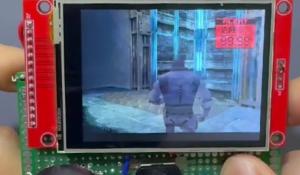
David Montero Crespo, creator of Velxio.dev, has managed to run the classic 1998 PlayStation game Metal Gear Solid on the tiny, low-cost microcontroller board - the Seeed Studio XIAO ESP32S3 Sense. Instead of emulating the old PlayStation hardware, the project rebuilds the game from its reversed C source code and compiles it directly to run on the ESP32-S3’s processor. The game data is stored…

CPSdrone is building a DIY autonomous submarine to explore shipwrecks without needing GPS while underwater. Since GPS signals cannot reach the submarine underwater, the team added a Doppler Velocity Log (DVL) to help it navigate. The DVL sends sound waves toward the seafloor and listens for the signals that bounce back. By measuring how the sound changes as the submarine moves, it can…
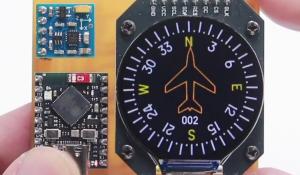
LazyDays Creation built a compact, portable digital compass based on an ESP32-S3 Super Mini and a three-axis magnetometer. He chooses an ESP32-S3 Super Mini because it is capable enough for the project while also including a built-in lithium-battery charging circuit. A round colour display gives the finished device a distinctive watch-like appearance, while the rechargeable battery allows it…
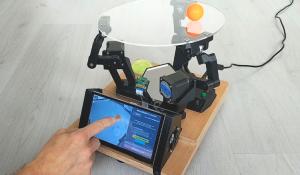
MirrorBallBot, an open-source ball-balancing robot from a maker using the GitHub handle AndreaFavero71, looks at its platform through a mirror rather than from above. The camera sits to the side and points at a mirror inclined at 27 degrees beneath the platform. The author says that, for the same camera and robot height, this widens the field of view by 58%, which allows a larger platform…
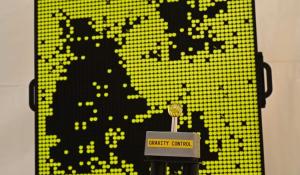
Maker Tim Alex Jacobs has turned nearly 3,000 old electromechanical flip dots into an unusual real-time fluid simulation display. Instead of using an LCD or LED panel, the project uses eight salvaged flip-dot panels, where every pixel is a small magnetic disk that physically flips between two positions. which is black and yellow. The result is a display that not only shows the movement of the…
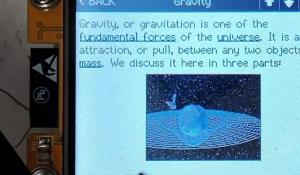
Alun Morris’s Offline-Wikipedia using ESP32 is an open-source project that turns the inexpensive ESP32-2432S028, commonly called the “Cheap Yellow Display” or CYD, into a standalone Wikipedia reader. The hardware combines an ESP32 microcontroller with a 320×240 ILI9341 color display, an XPT2046 touchscreen, and a microSD card interface. Instead of depending on Wi-Fi or cloud services, the…
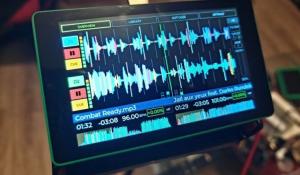
A maker has built a standalone DJ system using the ESP32-P4, allowing a Pioneer DDJ-FLX4 DJ controller to work without a laptop running DJ software. The open-source Pajoniiir project uses a Guition JC4880P443C_I_W board with an ESP32-P4 and 4.3-inch touchscreen. It reads music from a USB drive exported from Rekordbox and supports MP3, WAV and FLAC files. The system can run two DJ decks at the…
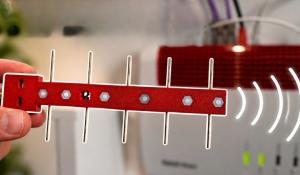
A maker has built and tested a DIY 2.4-GHz directional Wi-Fi antenna using a 3D-printed frame and simple brass rods, showing how antenna geometry can significantly change the performance of an ESP32 wireless link. The experiment uses two ESP32 boards, with one acting as a Wi-Fi transmitter powered by a power bank and the other connected to a computer as the receiver. The receiver measures RSSI…
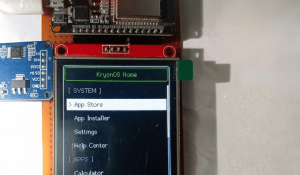
An open-source project called KryonOS is a GUI operating system for ESP32 microcontroller boards, built for use with a touch display and an SD card module. Built by a single developer who goes by Haris (GitHub handle Haris16-code) and released under the GPL-3.0 license, it adds a real touchscreen interface, a file explorer, and an app store to hardware that normally runs just one fixed program…
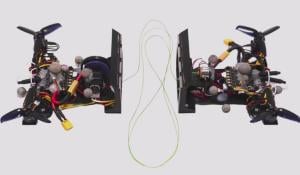
Researchers led by R.Wang have developed a transformable aerial robot made from two small bicopters connected by a cable, allowing the system to change its shape and interact with objects without using a conventional robotic gripper. Each bicopter uses two brushless motors with tilting propellers, while the cable itself acts as the key mechanical component. One aircraft carries a motorized…

The project documents a fully automated smart mailbox built by Re-Crafting DIY. It integrates advanced electronics to solve practical issues like package theft, weather damage, and inadequate storage space. By repurposing an old car’s wiper motor for the door mechanism, the mailbox features a heavy-duty, motorized front door controlled by a central brain. It might have been a little too much…
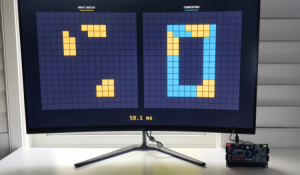
A YouTube creator running the channel "traffic in the brain" has published a detailed walkthrough of building a small-scale AI accelerator from scratch on a budget FPGA board, recreating the core architectural ideas behind Google's Tensor Processing Unit (TPU).
The project, released September 17, 2026, implements a two-layer attention model, the same…