
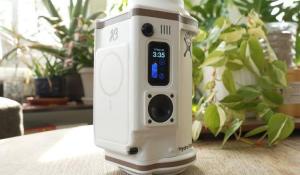
The maker, Alex from Hobby Built, created a really interesting smart bottle that goes far beyond just holding water. This bottle can play your favorite songs, charge your phone wirelessly, display customizable LED lighting, and even indicate the water level inside in real time. What makes it even more impressive is how thoughtfully the entire structure is designed. The outer body is built…

A hobbyist maker has taken Nerf modding to the next level by integrating machine learning into a custom-built blaster called the Stinger. High-performance "flywheel" blasters usually suffer from a slight delay while the motors spin up to full speed, which can be the difference between a hit or a miss in a fast-paced game. To solve this, creator "stingernerf" bypassed traditional hardware…

Yesterday, Espressif announced the release of ESP-IDF v6.0, which is now easier to set up with the new ESP-IDF Installation Manager. For a smaller memory footprint and to improve performance on resource-limited devices, the new version switches from Newlib to Picolibc as the default C library.
ESP-IDF v6.0 includes an upgrade to the security layer, moving to MbedTLS version 4.x and…
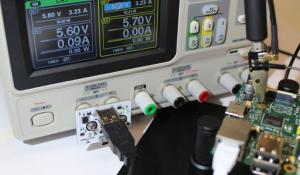
KS Elektronikdesign is soon to launch the USBpwrMe on Crowd Supply, an adapter that can be used to power USB devices directly from a bench power supply. It supports USB Type-A and Type-C ports, operates from 3 V–20 V, and can perform charge negotiation at 5 V. Both ports can be used simultaneously; however, the campaign notes that only one USB output should be used at max load.
To…
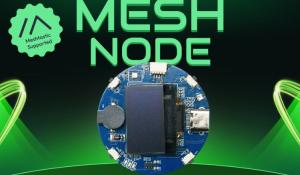
Not being able to locate a friend who got separated from the group during a trek led to the development of Mesh Node, a device designed for connectivity in areas where traditional infrastructure does not exist. It uses LoRa tech to support messaging over distances of up to 4–5 kilometres in open areas. The range of communication extends even longer by forming a mesh network, where devices…
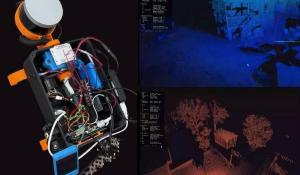
A YouTube channel named 9nl has developed an open-source project on GitHub that is gaining attention for its approach to 3D reconstruction using point cloud data. The system combines both hardware and software elements, where a compact embedded platform such as the Raspberry Pi can be used for capturing spatial data through connected sensors like cameras or LiDAR. This data, consisting of…
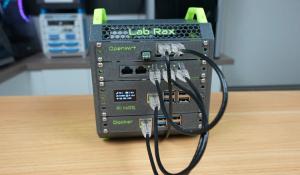
Michael Klements built this 5-inch Raspberry Pi based lab rack by scaling down his actual lab rack by 50%, making it eight times smaller while preserving full rack-mount functionality. 3D printed using just 220g of filament with precision M3 brass inserts and screws, this portable homelab fits in your backpack yet powers a complete network stack. The setup includes an OpenWrt router running on…

A maker recently documented the development of ESP-BLAST, a custom aerodynamic “rocket drone” designed for high-speed flight. Unlike typical quadcopters with exposed frames, this drone uses a streamlined bullet-shaped body to reduce drag while four small 1104 brushless motors drive 2.5-inch propellers. At the center of the system is an ESP32-S3, which acts as the…
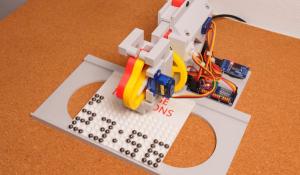
A neatly designed electromechanical clock shared on YouTube is drawing interest from hobbyists and electronics enthusiasts alike. The project is inspired by the marble clock concept originally created by Ivan Miranda, but the creator redesigned it into a smaller version that can easily fit on a desk. Instead of simply copying the original build, the maker simplified the structure while keeping…
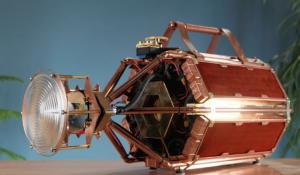
A maker recently engineered an extreme, portable lighting system built around one of the brightest LEDs available, capable of producing more than 120,000 lumens while consuming roughly 1.5 kW of power. Because such an LED generates enormous heat, traditional cooling methods quickly fail. To prevent thermal damage, the project focuses heavily on a liquid-cooling system designed to dissipate…
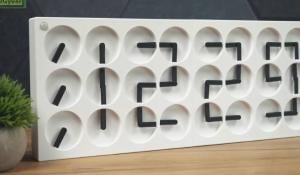
Russian DIY creator AlexGyver has completed his latest “Challenge Accepted” project: a big, good-looking wall clock made using 24 small stepper motors called BKA30D-R5. These are the same kind of tiny motors you find inside car dashboards to move speedometer or fuel gauge needles. Each motor has two shafts, but he only uses one to control a custom pointer. With 24 of…
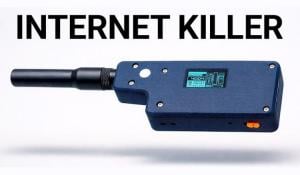
A recent project showcases Reticulum, a cryptography-based networking stack designed to build a decentralized, infrastructure-independent communication network. Unlike traditional mesh systems that depend on specific radios sharing the same frequency, Reticulum abstracts hardware into interchangeable “interfaces.” Whether the link is LoRa, Wi-Fi, Ethernet, or packet radio, the protocol…
