

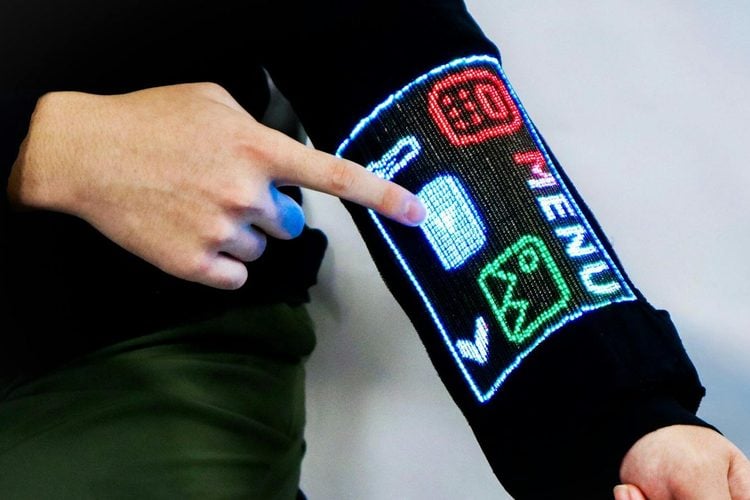
Touchscreens are on phones, watches, fridges and car dashboards, but never on clothes, because a display has to bend, breathe and survive a washing machine. Researchers at the National University of Singapore say they have now cracked it. A team led by Assistant Professor Tural Khudiyev at the NUS College of Design and Engineering has built a fibre that is both a line of pixels and a touch sensor, and wove 54 of them into a sleeve. NUS calls it the world's first touchscreen built into a garment. The work was published in Nature on 21 October 2026.
How the fibre is made
A fibre is basically one-dimensional, so there is almost no room to route connections the way a flat PCB does. The team's answer is a programmable interconnect method: a laser exposes tiny insulated wires exactly where each microchip needs a connection, and controlled surface wetting makes molten solder bond only at those points. That let them join more than 5,000 chips through over 20,000 electrical connections.
The strip of connected digital LEDs is then built into a multilayer fibre by thermal drawing, the same basic process used to make optical fibre. The finished thread is about 1 mm thick and can be up to 10 m long. A layer under the LEDs senses touch: pressing the fibre completes a circuit, and the signal shows where the finger landed so the nearest pixel lights up.
Key numbers
- Display: 54 pixel fibres with 96 LEDs each, giving 96 x 54 pixels over 168 mm x 105 mm
- Refresh and colour: 30 frames per second with 8-bit colour, multi-touch
- Reliability: each fibre has its own control channel, so one faulty line does not take down its neighbours
- Durability: light output and touch response nearly unchanged after 50 detergent washes in a normal washing machine and 1,000 bends around a 5 mm radius
- Comfort: as breathable as cotton, polyester and denim, and within safety limits for skin contact
What it can run
Extra fibres made the same way carry a microphone, a speaker and sensors for motion, magnetic north, temperature and ambient light. Together, the sleeve can run a calculator, show a photo gallery, play video (25 fps with synchronised audio), act as a compass, respond to voice commands, receive images over Bluetooth, and rotate and dim its screen automatically. Placed under the arm, the temperature fibre reads and displays body temperature.
Our take
96 x 54 pixels is roughly the level of an early feature phone, and NUS itself compares it to the first generations of smartphones. The real achievement is the interconnect process, because it can scale to smaller chips and thinner fibres that standard industrial machines can knit, weave and embroider. The team's next steps are higher resolution, more sensing and on-device AI, with healthcare monitoring as the most likely first use.
Image credit: National University of Singapore, press photo, cropped and resized.
About the author: Aswinth Raj is an electronics engineer and the editor of CircuitDigest, where he has published more than 150 hands-on projects and tutorials across Arduino, PIC, ESP32, Raspberry Pi and EV battery systems. He selects the stories on this page for what engineers and makers can actually learn or build from. Connect on LinkedIn

Add a comment
No account needed. Your comment appears once a moderator has reviewed it.