

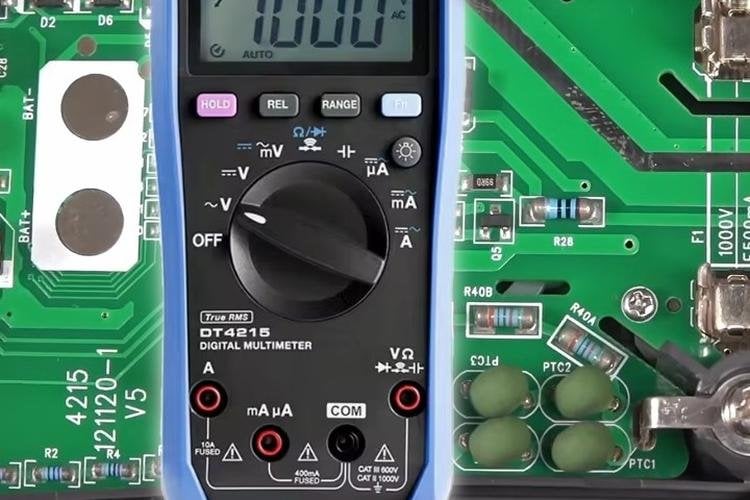
Hioki is one of those Japanese test-equipment names that engineers associate with quality and with a high price, so a Hioki multimeter for 95 US dollars sounds like a fake. It isn't. The DT4215 is a genuine, Hioki-approved meter made in China and sold only for the Chinese market, and Dave Jones of EEVblog just bought one from AliExpress to tear it down. Inside he found input protection that is a clear step above typical budget meters, and a microcontroller he had never seen in a multimeter before. Then he switched it to continuity mode and called it the world's worst continuity tester.
Why a Hioki is made in China
Dave points out that Hioki is not the first big brand to do this. Fluke's first try was the Fluke 19, a low-cost meter made in China for the Asia-Pacific market about 25 years ago. Dave's reading is that the DT4215 follows the same idea: a lower-cost Hioki for buyers in China who can't afford the made-in-Japan models. It is rated CAT III 600 V and CAT II 1000 V (CAT ratings tell you which parts of an electrical installation a meter can safely be used on, and how big a voltage spike it can survive), has true RMS (it reads AC correctly even when the waveform is not a clean sine wave), and the manual is not in English.
What is inside
The teardown is where the meter earns respect. The mA range is protected by a proper branded HRC fuse (a high rupture capacity fuse, which can safely break a very large fault current without exploding) rated 500 mA, 1000 V, although the 10 A fuse hidden inside is a no-name part. Across the mA fuse sits something Dave had not seen before: an 18 V MOV (metal oxide varistor, a part that clamps voltage spikes) in parallel with a TVS diode (transient voltage suppressor, a fast-clamping diode). The input also has four PTC thermistors (self-resetting resistors that heat up and limit current during an overload) and three more MOVs, along with isolation slots cut into the PCB.
The other surprise is the main processor, a Silicon Labs EFM32 Tiny Gecko, which Dave calls a first for a multimeter. The measurement chipset has its markings blank. Overall, he says it looks like a genuine Hioki design that has been built down to a price. To prove the protection, he fed 240 V mains into the meter on every range, including current, and it survived.
Key details
- Model: Hioki DT4215, about 95 US dollars, China market only (bought on AliExpress)
- Safety rating: CAT III 600 V, CAT II 1000 V, true RMS
- Protection: branded HRC fuse on the mA range, 18 V MOV plus TVS diode across that fuse, four PTCs and three MOVs on the inputs
- Processor: Silicon Labs EFM32 Tiny Gecko
- Accuracy: within spec on the DC, AC, resistance and capacitance checks Dave ran
- Missing: no temperature, no min/max, no auto-hold, lowest current range 40 mA
Our take
The verdict comes down to one mode. The continuity beeper has to auto-range before it triggers, so it lags badly behind the probes. Dave stepped his continuity-tester test rig from 100 ms up to its slowest setting, and the meter still could not keep up, which is how it earned its new title. Diode mode does have a beeper, but as a daily meter for fault-finding, Dave's verdict is "yeah, nah". There is better value for 95 US dollars, unless you specifically want a Hioki.
For students, the teardown is a good lesson in what to look for in any meter: proper HRC fuses, MOVs and PTCs on the input, and slots in the PCB between the high-voltage parts. If you are just starting out, our guide on how to use a digital multimeter explains each of these measurement modes, including the continuity test that let this one down.
Image credit: EEVblog, YouTube thumbnail, cropped and resized.
About the author: Aswinth Raj is an electronics engineer and the editor of CircuitDigest, where he has published more than 150 hands-on projects and tutorials across Arduino, PIC, ESP32, Raspberry Pi and EV battery systems. He selects the stories on this page for what engineers and makers can actually learn or build from. Connect on LinkedIn

Add a comment
No account needed. Your comment appears once a moderator has reviewed it.