

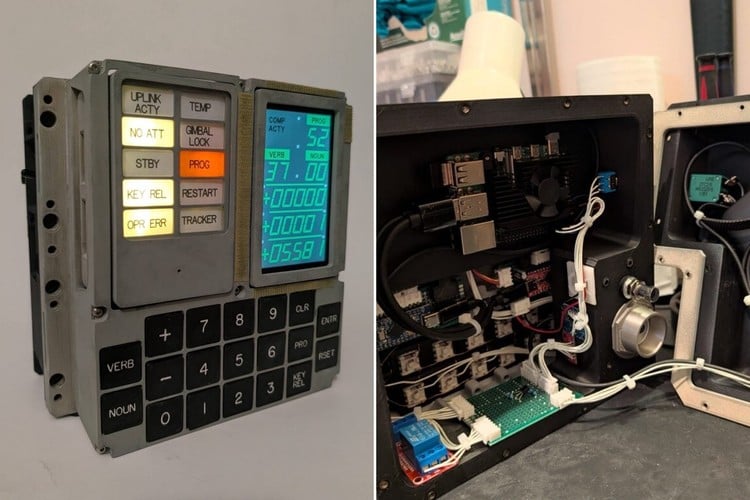
The DSKY was the keypad and display Apollo astronauts used to talk to the Apollo Guidance Computer, and Michael Newton has rebuilt one at 1:1 scale from archived NASA and MIT drawings. Inside the 3D-printed case, a Raspberry Pi 4B runs yaAGC, the Virtual AGC project's emulator of the original computer, so the keypad, the green VERB/NOUN/PROG readout and the warning lights all behave as they did in the spacecraft. Michael, an avionics engineer on commercial aircraft in Calgary, has published the whole build as a free guide of more than 100 pages, and the project was featured by Raspberry Pi Official Magazine this week.
What is inside the replica
Michael says the DSKY is about 90% physically authentic. The outside follows the original drawings, which Apollo enthusiasts turned into CAD files during the pandemic. He gathered and fixed the remaining files and modelled the missing ones himself. Inside, the mounting points were changed to fit modern parts:
- Computer: Raspberry Pi 4B running yaAGC from Virtual AGC
- Display and lights: a Nextion smart display stands in for the electroluminescent readout, and LED annunciators (UPLINK ACTY, NO ATT, PROG, OPR ERR and others) are driven by one Arduino Pro Micro
- Keypad: a second Pro Micro scans the key matrix. The keys are Kailh Box Navy switches, picked for the heaviest, clickiest feel he could find
- Power: a phone-charger battery bank with relays and current sensors, so the Pi can be powered safely and shut down properly without a wall cable
- Software: the prebuilt Raspberry Pi OS image starts Comanche 055, the Command Module software that flew on Apollo 11, and the guide explains how to load other programs
- Licence: GPL-3.0 on GitHub
A long press on one key switches the DSKY into a peripheral mode. It can then drive Project Apollo NASSP, the Apollo add-on for the Orbiter spaceflight simulator, over the local network, so you can fly a simulated mission from a physical DSKY.
Why the emulator matters
The real AGC ran at 1.024 MHz with 15-bit words plus a parity bit, and it had less than 100 kB of memory. The software was woven into core rope ROM. Michael points out that the whole computer was built from one type of logic gate, the 3-input NOR. yaAGC keeps that word length and timing, including the interrupt behaviour behind the famous Apollo 11 1201 and 1202 alarms, which is why Michael calls it "a real Apollo Guidance Computer that borrows your processor."
Our take
The best part of this project is the documentation. The guide starts with how core rope memory and the AGC's registers worked, then goes through printing, painting, wiring and software step by step, so it doubles as a computer-history course for students. The design choices are also a good example of mixing parts: a Pi for the heavy emulation, and two cheap USB microcontrollers for the time-sensitive LED and keyboard I/O. Michael is already planning a more premium version with a full aluminium body, better annunciators and possibly a real electroluminescent display, and the repository says a v2 is coming with PCBWay's sponsorship. Files and the build guide are on GitHub and RecreateApollo.com.
Image credit: Michael Newton / Raspberry Pi Official Magazine; composite of two photos, resized.
About the author: Aswinth Raj is an electronics engineer and the editor of CircuitDigest, where he has published more than 150 hands-on projects and tutorials across Arduino, PIC, ESP32, Raspberry Pi and EV battery systems. He selects the stories on this page for what engineers and makers can actually learn or build from. Connect on LinkedIn

Add a comment
No account needed. Your comment appears once a moderator has reviewed it.