
Electronics circuits and projects based on op-amp IC LM358. These interesting circuits and DIY projects are explained throughly with the help of schematics, working diagrams and videos.
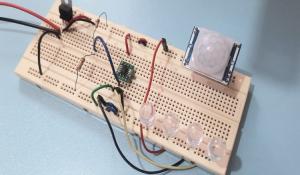
The main aim of this mini-project is to demonstrate the working of a PIR motion-based light bulbs. This is to mainly minimize energy consumption and save electricity bills.
Sometimes people forget to turn off the light bulbs, this leads to a small waste of electricity. What if a few people around the world did the same thing and…

In this project, we are going to build an audio bug using Arduino and NRF24L01. This audio spy bug is highly customizable and can be easily integrated with other devices and systems. The NRF24L01 module allows transmission over specific channel, ensuring that our transmissions remain private up to a level. This device is perfect for…
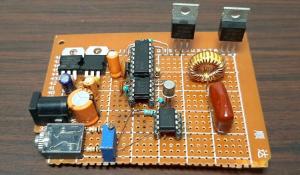
Audio content has come a long way over the past decades, from a classic tube amp to modern-day media players, technological advancements have changed the way digital media is consumed. Among all these innovations, portable media players have become one of the first choices among consumers, because of their vibrant sound quality and long battery life. So how does it work, and…
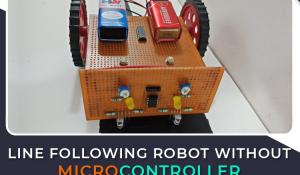
Line follower Robot (LFR) is a machine that follows a line, it may be a black line or a white line. The line following bot is beginner-friendly and interesting to understand and build. While Line follower bots are popular and common to be built with Arduino or other microcontrollers, let’s try to build the same without a microcontroller and actually understand the logic…
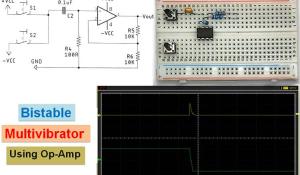
The bistable multivibrator is one of those basic circuits which you might have learnt about in your high school or college, and you probably have built one with 555 timers or with discrete components like OP-amp, transistors, or resistors. These circuits are often viewed as simple educational circuits, but not so surprising they are also used in practical designs…
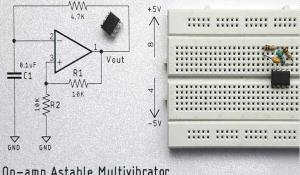
The multivibrator circuit is very popular and useful in the field of electronics, and it’s the most basic circuit that you will know about while learning basic electronics. The multivibrator circuit can be divided into two categories: the first one is known as the monostable multivibrator, and the second one is known as the astable multivibrator. But in this project, we will…
Almost all types of sensors and transducers convert real world parameters like light, temperature, weight etc into voltage values for our electronic systems to understand it. The variation in this voltage level will help us in analyzing/measuring the real world parameters, but in some applications like biomedical sensors this variation is very small (low-level signals) and…
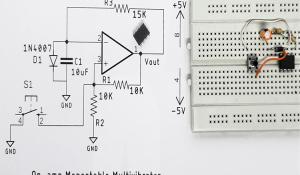
An operational amplifier or Op-amp is one of the most commonly used components in any electronic design. It’s a very versatile device that can be used for a wide variety of applications. In our previous projects, we put the op-amps capabilities to the test by making a ton of projects with it, you can check those out if you want to explore more on the topic. We have also…

In the measurement industry, a very crucial functional block is a Programmable Gain Amplifier (PGA). If you are an electronic enthusiast or a college student, you have probably seen a multimeter or oscilloscope measuring very small voltages very preciously because the circuit has a built-in PGA alongside a powerful ADC that helps with the precise measurement process.
…
A rectifier is a circuit that converts alternating current (AC) to Direct current (DC). An alternating current always changes its direction over time, but a direct current flows continuously in one direction. In a typical rectifier circuit, we use diodes to rectify AC to DC. But this rectification method can only be used if the input voltage to the circuit is greater than…

Function generator or waveform generator is an integral part of electronics and used to produce various kinds of waveforms like a sine wave, square wave, Sawtooth wave, etc. We have already designed sine wave generator circuit, square wave generator circuit, and sawtooth wave generator circuit. Now in this tutorial, we will show you, how to design a…

Current Source and Current sink are two major terms used in electronics design, these two terms dictate how much current can leave or enter a terminal. For example, the sink and source current of a typical 8051 Microcontroller digital output pin is 1.6mA and 60uA respectively. Meaning the pin can deliver (source) up to 60uA when made High and can receive (sink) up to 1.6mA…
