

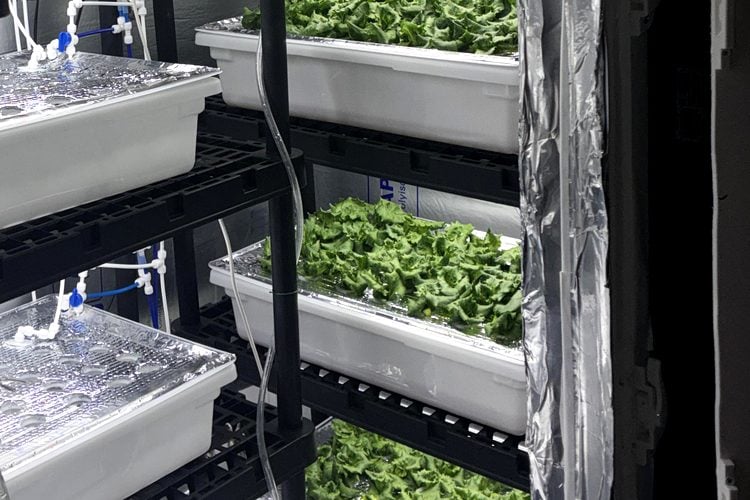
Most ESP32 garden projects stop at a soil moisture sensor and a pump. Reddit user Repulsive_Ant_7167 went much further: an indoor aeroponic lettuce grow room where every job, from misting the roots to dosing nutrients, is handled by its own ESP32. There are 12 of them, driving 8 four-channel MOSFET boards, and they all report into one "Garden Manager" spreadsheet. The post became one of the top r/esp32 posts of the day, with about 400 upvotes.
One ESP32 per job
Instead of one big controller with a tangle of wires running across the room, the system is split by function. Each board sits next to the hardware it controls:
- ESP 1 to 4: environmental "sensor clusters" logging temperature, relative humidity and light level to the spreadsheet
- ESP 5: four 12 V solenoids on the pressurised mist lines of the aeroponic system
- ESP 6: reads float switches and opens two 24 V solenoids on the water main to refill the reservoirs
- ESP 7: intake and exhaust fans plus the humidity machine fans
- ESP 8 to 11: "rack brains", one per rack, running each grow bin's 12 V waste pump from a float switch
- ESP 12: reads pH and EC sensors and runs three 12 V peristaltic pumps that dose nutrient liquids
In aeroponics the roots hang in air and are misted with nutrient solution rather than sitting in soil or water, so a stuck mist valve or a failed pump can hurt the crop within hours. Splitting the system means one failed board takes out one function, not the whole room.
The 3.3 V MOSFET board fix
The ESP32s switch all those 12 V and 24 V loads through cheap four-channel MOSFET boards, and the maker says his first boards were almost thrown away because they would not switch from the ESP32's 3.3 V outputs. The fix was to short the blue channel indicator LEDs. A likely reason it works: on many low-cost modules the indicator LED is wired in series with the input optocoupler, and the two forward voltages together leave too little headroom for a 3.3 V pin. Removing one drop let the boards switch, at the cost of the indicator lights on each channel.
Our take
This is a practical blueprint for anyone automating a greenhouse, aquarium or workshop: give each subsystem its own cheap Wi-Fi board, keep high-current wiring short and local, and centralise only the data. A spreadsheet is not a usual choice for a control dashboard, but for a single grower it is easy to read, easy to graph and easy to change. If you are just starting with plant automation, our smart plant monitoring system shows the basic sensor-and-pump loop on a smaller scale.
Image credit: Repulsive_Ant_7167 (Reddit), cropped and resized.
About the author: Aswinth Raj is an electronics engineer and the editor of CircuitDigest, where he has published more than 150 hands-on projects and tutorials across Arduino, PIC, ESP32, Raspberry Pi and EV battery systems. He selects the stories on this page for what engineers and makers can actually learn or build from. Connect on LinkedIn

Add a comment
No account needed. Your comment appears once a moderator has reviewed it.