

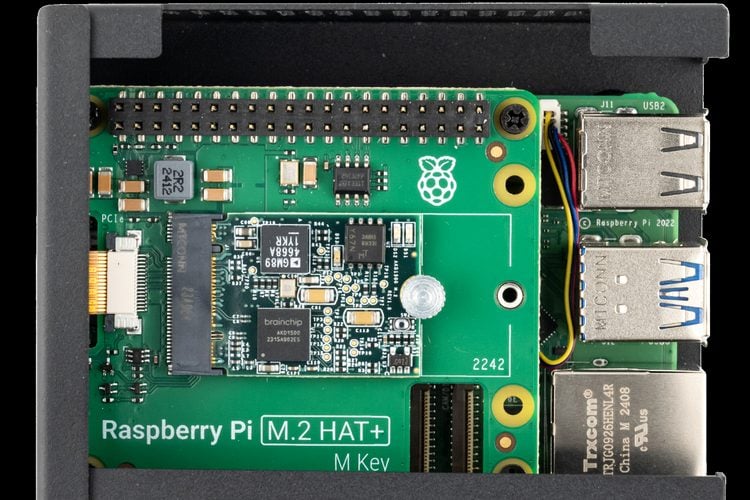
BrainChip has launched the AKD1500 Raspberry Pi 5 Dev Kit, a ready-to-run box for trying its Akida neuromorphic AI accelerator, priced at $1,295. Inside the metal case is a Raspberry Pi 5 with 8 GB of RAM, the official Raspberry Pi M.2 HAT+ and an AKD1500 M.2 card. Neuromorphic chips process data as sparse events, closer to how neurons fire, instead of crunching every value in every frame, which is how they aim for very low power at the edge.
What you get
- Raspberry Pi 5 (8 GB) with the Akida AKD1500 on an M.2 B+M key card, pre-installed
- Pre-configured 32 GB microSD card with the Akida demos and BrainChip's MetaTF development environment
- USB-C power supply and metal case, with Ethernet, USB, both HDMI ports and the power button exposed
Setup is simple: power it up, join the kit's own "akida-devkit" Wi-Fi network or plug in Ethernet, and open the demo launcher in a browser. The demos include visual wake-word person detection, YOLO object detection, MobileNet classification and face recognition, all running locally with no cloud. A USB camera is needed, as the kit does not use the Pi's MIPI camera connector. BrainChip also highlights on-chip learning, where the model can learn new classes on the device without retraining in the cloud, and support for deploying models from Edge Impulse.
The price question
The $1,295 tag is the catch. All the main parts are sold separately: a Raspberry Pi 5 8GB, the official M.2 HAT+, the AKD1500 M.2 card on its own, a metal Pi 5 case and a microSD card. CNX Software's tally of those list prices comes to roughly $340, so you are paying close to $950 for the assembly, the pre-loaded software image and the convenience of a box that works on first boot.
Who it suits
For a company evaluating Akida for a product, a known-good kit that saves an engineer a day of setup can be worth the money. For students and makers who just want to try neuromorphic inference, buying the AKD1500 M.2 card and fitting it to a Pi 5 is the far cheaper route to the same hardware.
Image credit: BrainChip.
About the author: Aswinth Raj is an electronics engineer and the editor of CircuitDigest, where he has published more than 150 hands-on projects and tutorials across Arduino, PIC, ESP32, Raspberry Pi and EV battery systems. He selects the stories on this page for what engineers and makers can actually learn or build from. Connect on LinkedIn

Add a comment
No account needed. Your comment appears once a moderator has reviewed it.