

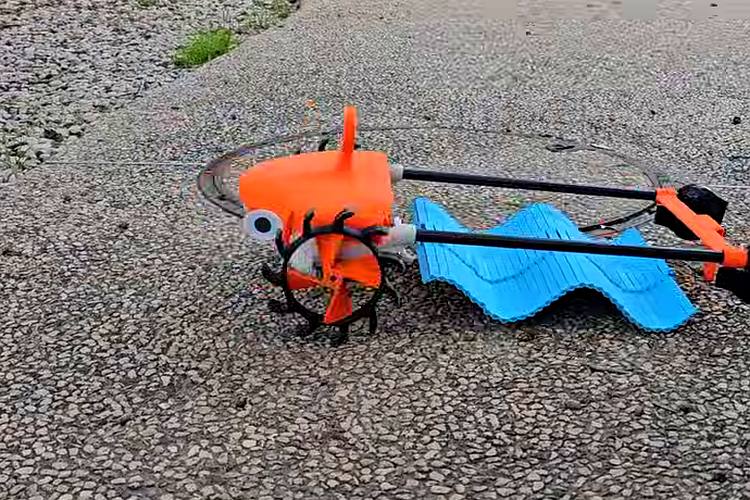
Robots that work both in water and on land usually carry two propulsion systems, such as propellers for swimming and wheels or legs for land, and pay for it in weight, power and complexity. SAWbot, built by researchers at the Bio-Inspired and Medical Robotics Lab (Zarrouk Lab) at Ben-Gurion University of the Negev, swims with a continuous travelling wave along a flexible fin, the way an eel moves, and the whole wave comes from a single motor. In tests it reached 34 cm per second in water, then drove out over grass, gravel and steps without any change to its hardware.
How one motor makes a wave
The blue fin is a flexible membrane stretched between two supports that run back from the robot's body. Inside, the motor turns a rotating member that pushes and pulls the membrane so that a smooth, near-sinusoidal wave runs continuously from front to back. As the wave travels, it pushes water backwards and the robot forwards. Because the wave shape comes from the mechanism itself, there is no need for several synchronised actuators or a complex controller to coordinate them.
The front chassis is a sealed box holding the electronics, control board and battery. Large treaded wheels on either side handle land, and two floats at the back support the wave assembly in water.
The numbers
The team reports the results in IEEE Robotics and Automation Letters:
- Top swimming speed: 34 cm/s
- Advance ratio: 0.73, meaning the robot moves at 73 percent of the speed of the wave it creates, a level comparable to efficient biological swimmers
- Mechanical cost of transport: 0.13 at low speed to 0.37 at top speed, which places it among the most energy-efficient swimming robots reported so far
- Field tests: water, grass, gravel, wooden decks, slopes, step obstacles and land-water transitions
Cost of transport is the energy needed to move a given weight over a given distance, so a lower number means longer runs from the same battery.
Our take
The lesson for robot builders is that a clever mechanism can replace a lot of electronics and code. One motor and one driver are easier to seal, cheaper to build and simpler to keep running than a row of servos, which matters for a robot meant to work in ponds and wetlands for long periods. The team also says it creates minimal disturbance to aquatic life, which makes the design interesting for environmental monitoring.
Image credit: Zarrouk Lab, Ben-Gurion University (YouTube), cropped and resized.
About the author: Aswinth Raj is an electronics engineer and the editor of CircuitDigest, where he has published more than 150 hands-on projects and tutorials across Arduino, PIC, ESP32, Raspberry Pi and EV battery systems. He selects the stories on this page for what engineers and makers can actually learn or build from. Connect on LinkedIn

Add a comment
No account needed. Your comment appears once a moderator has reviewed it.