

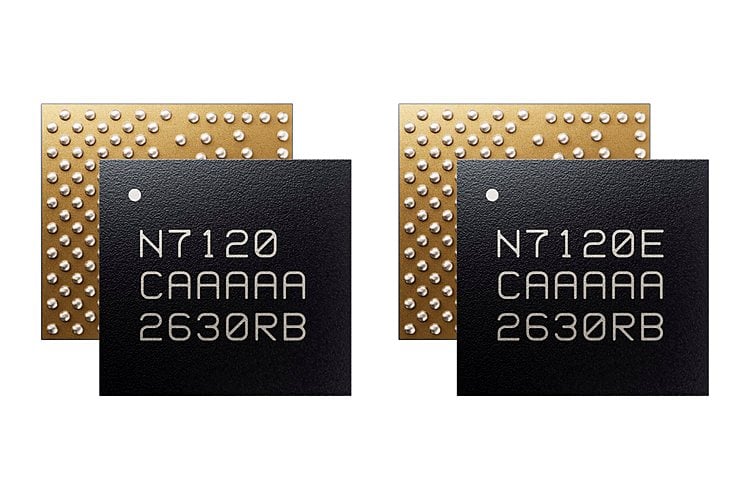
Wi-Fi is usually the first thing to drain a battery-powered gadget, which is why most low-power sensors use Bluetooth LE or Thread instead. Nordic Semiconductor wants to change that with the nRF71 Series, a single chip that combines Wi-Fi 6, Bluetooth LE and Thread with its own processors and, on one version, an NPU for edge AI. Nordic claims up to 20 times lower standby power than its current nRF70 Wi-Fi companion chips, aimed at devices that run for years on a battery.
Two chips to start
- nRF7120: dual-band Wi-Fi 6 (2.4 and 5 GHz)
- nRF7120E: tri-band Wi-Fi 6E (2.4, 5 and 6 GHz) plus the Axon NPU, which Nordic says runs ML models 10 to 17 times faster than the CPU alone
Key specs
- CPU: Arm Cortex-M33 at up to 256 MHz, plus a RISC-V coprocessor that can emulate peripherals such as CAN 2.0B and SDIO
- Memory: 1 MB RAM and 4 MB non-volatile memory on chip
- Radio: Wi-Fi station and SoftAP, +22 dBm Wi-Fi output; Bluetooth LE and Thread at +10 dBm, -99 dBm BLE sensitivity; NFC tag
- Power: average 14 uA at 2.4 GHz and 8 uA at 5 GHz while connected (DTIM 10), using Wi-Fi 6 Target Wake Time
- I/O: high-speed USB with PHY, up to 65 GPIOs, SPI, UART, ADC, PDM and more
- Security: TrustZone, tamper detection, CRACEN crypto accelerator, designed for PSA Certified Level 3
- Package: 4.9 x 4.6 mm WLCSP, 2.8 to 5.5 V supply, -40 to +85 deg C
Software support is in the nRF Connect SDK. Nordic is also preparing a 14 x 10 mm module and an nRF7120-DK development kit.
Who it suits
The nRF71 is for designers of smart home sensors, wearables and industrial IoT nodes who want direct Wi-Fi to the cloud or a Matter network without the battery penalty, and without a second chip for Bluetooth. The microamp-level connected current is the number to watch; real battery life will depend on how often the device wakes and sends data. Pricing and availability dates were not given in the announcement.
Image credit: Nordic Semiconductor (via CNX Software), resized.
About the author: Aswinth Raj is an electronics engineer and the editor of CircuitDigest, where he has published more than 150 hands-on projects and tutorials across Arduino, PIC, ESP32, Raspberry Pi and EV battery systems. He selects the stories on this page for what engineers and makers can actually learn or build from. Connect on LinkedIn

Add a comment
No account needed. Your comment appears once a moderator has reviewed it.