
ESP32 is a tiny cheap 8$ module with a dual core 32-bit CPU and built in Wi-Fi and dual-mode Bluetooth with sufficient amount of 30 I/O pins for all basic electronics projects. All these features are very easy to use, since it can be programmed directly from the Arduino IDE. Explore below the list of ESP32 projects to start with ESP32 based IoT projects.
If you want more electronics projects, you can also check out our collection at Arduino IoT Projects | Arduino Robotics Projects | Arduino AI Projects | Arduino Home Automation Projects | Raspberry Pi Projects | ESP32 Projects
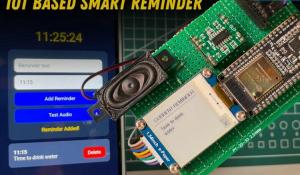
Have you ever set an important reminder on your phone only to miss it because the device was in silent mode, left in another room, or buried under tons of notifications? While smartphones have made reminders convenient, they are not always used in every situation, especially for elderly people, students, or professionals with busy schedules.To solve this problem, we…

Most of us are familiar with the Python programming language. Python is a very powerful programming language and used to build many applications from the Internet of Things to Artificial Intelligence (AI). By seeing the popularity of python, this community developed the reimplementation of Python which is called MicroPython.
So in this tutorial, we…

ESP32 series microcontrollers are low-cost, low-power system-on-chip microcontrollers that come with integrated Wi-Fi and dual-mode Bluetooth. The ESP32 series comes with Tensilica Xtensa LX6 microprocessor in both (dual-core and single-core) variations, and it has inbuilt antenna switches, RF balun, power amplifier, low-noise receive amplifier, filters, and power management…

There are many human identification systems that use signatures, fingerprints, voice, hand geometry, face recognition, etc. to identify persons but none of them can detect and recognize the persons in public areas such as airports, retail stores, and railway stations except the Face Recognition System.
Face recognition systems can, not only be…

MicroPython is a lightweight version of the Python programming language developed for programming microcontrollers, SOCs, and other embedded system devices. It was created to enable developers to leverage the “easy to learn and use” nature of python for embedded systems development. With Python now the major introductory language in most schools and with it being one of the…

How cool it be to turn on the lights automatically as soon as you enter in your home and turn it off again when you leave! Yes, a simple application can do this for you. Here in this project, we will use ESP32 as BLE client and fitness band as BLE server, so whenever a person wearing the fitness band comes in the range of ESP32 Bluetooth, the ESP32 detects it and turn on the…

Wireless Headphones, Fitness bands, Bluetooth Speakers, In-Ear headphones, Mobile phones, Laptops... there are so many Bluetooth devices around us and most of these devices are battery operated. Have you ever wondered that, when you connect a Bluetooth device to your mobile phone how it automatically understands that the connected device is a computer or audio device or a…

Bluetooth modules like HC-05 and HC-06 are easy to set-up and quick to use with Arduino IDE, but they have their own limitation like high power consumption and they operate on the old Bluetooth V2.0. Also, recently I got myself a new ESP32 DEV kit, these modules has a punch of features like in-built Wi-Fi and Bluetooth, ample ADC and DAC pins, Audio Support, SD Card Support…

Note: This tutorial was written after Arduino has officially launched its support for ESP32 boards. So if you have followed the old method of using GIT to install the boards then you would have to follow these steps again (highly recommended) if you need support for new libraries. If you are working with ESP32 for first time you do not have to worry about this.
…
In previous tutorial, OLED is interfaced with ESP32 using SPI communication which uses 5 pins. In this tutorial, we interface 16x2 LCD with ESP32, using only 2 pins, with the help of I2C communication. It reduces number of pins used by ESP32 so that more number of ESP32 pins remain free for interfacing different sensors.
What is I2C…

In the previous tutorial, we have made RTC clock using DS3231 and ESP32. To minimize hardware requirements we will make Internet clock without using RTC module. This is more accurate as compare to RTC clock. ESP32 is a Wi-Fi module and can be easily connected to the internet so we will use NTP (Network Time Protocol) and UDP (User Datagram Protocol) to fetch Time from the…

In this tutorial, we will learn about Real Time Clock (RTC) and its interfacing with the ESP32 and OLED display.
We will use the DS3231 RTC module to keep track of the correct time and display it on the SPI OLED by using ESP32 as our microcontroller. ESP32 is more than a microcontroller. It has a Wi-Fi and Bluetooth chip inside it and 39 GPIO pins.…