

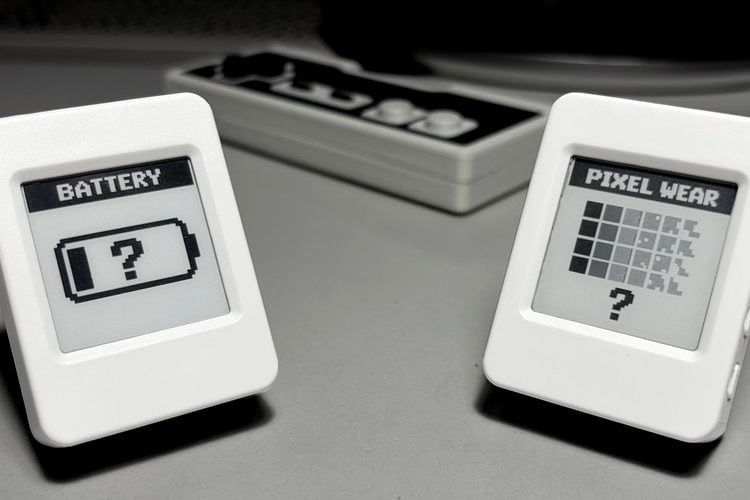
E-paper is supposed to be slow: great for shelf labels and e-readers, terrible for games. So when makers started running Game Boy games at 30 frames per second on cheap e-paper boards, two questions came up fast. Does the display eat the battery, and does it wear out? Bo Made It, who wrote the fast driver in the first place, measured both on a Waveshare ESP32-S3-ePaper board. The answer to the first question surprised us.
Where the power actually goes
Running the Game Boy emulator at 30 FPS, the whole board drew about 115 mA on average, enough to drain its 400 mAh battery in roughly 3.5 hours. Bo then split that number up. The system without any display updates used about 90 mA, and calculating the greyscale frames without drawing them pushed it to 107.6 mA. That leaves only about 7.4 mA for the e-paper panel itself, even at 30 FPS. The battery drain comes from the ESP32-S3 doing the work, not from the screen.
Does it wear out?
One panel datasheet rates e-paper at about one million updates, which at 30 FPS would be just 9.3 hours if every frame were a full refresh. Bo's driver only updates the pixels that change, so real wear should be lower, but by how much? He ran a custom endurance pattern for about 20 hours, a total of 2.16 million frames. Some ghosting appeared, faint traces of earlier images that e-paper can leave when pixels are switched quickly without a full clean refresh, but repeated refreshing removed it. No permanent damage showed up within the test.
Key details
- Board: Waveshare ESP32-S3-ePaper with a 400 mAh battery
- Average draw at 30 FPS: about 115 mA (about 3.5 hours of play)
- E-paper panel's share: about 7.4 mA
- Endurance test: about 20 hours, 2.16 million frames, ghosting cleared by refreshing
- Code: InkBoy driver and emulator on GitHub
Our take
This is a useful result for anyone designing low-power e-paper devices: the panel is rarely the power problem, the processor is. Note that Waveshare itself advises against high-FPS use, so anyone copying this is running their own longevity experiment, outside warranty.
Image credit: Bo Made It, YouTube video thumbnail, cropped and resized.
About the author: Aswinth Raj is an electronics engineer and the editor of CircuitDigest, where he has published more than 150 hands-on projects and tutorials across Arduino, PIC, ESP32, Raspberry Pi and EV battery systems. He selects the stories on this page for what engineers and makers can actually learn or build from. Connect on LinkedIn

Add a comment
No account needed. Your comment appears once a moderator has reviewed it.