

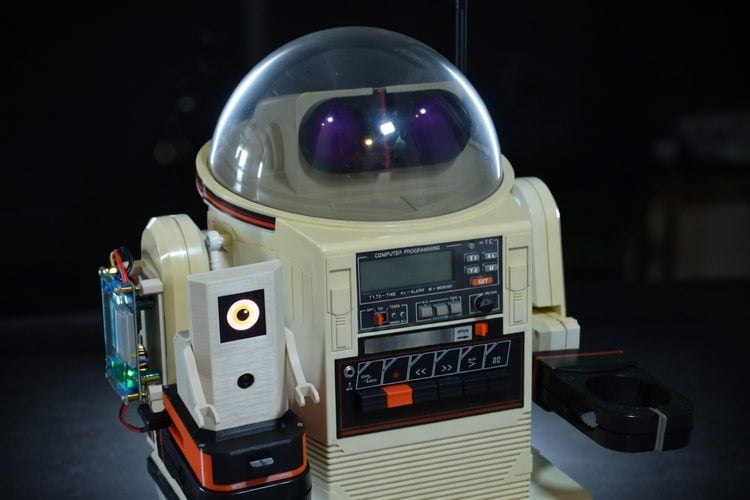
In 1984, Tomy sold the Omnibot as the robot butler of the future. It could roll around, play cassette tapes and carry drinks on a tray, but it had no real intelligence: everything came from a remote or a pre-recorded tape. Forty-two years later, maker Mario Cruz has given a donated Omnibot at Moonlighter FabLab in Miami the brain it was promised, using a Raspberry Pi 5, the Raspberry Pi AI Camera and a small 3D-printed sidekick called Ring-O. The best part: the robot's original 1984 motor electronics are still the ones driving it.
Steering a 1984 robot with sound
The Omnibot's cassette deck controlled its movement with audio tones, with each frequency mapped to a command such as forward or turn left. Instead of replacing the old board, Cruz fixed the battery-leak damage, then put a Bluetooth cassette adapter in the deck and wrote a Raspberry Pi script that generates the right tones. The Pi now "plays" movement commands to the robot wirelessly.
Ring-O, the brain on its shoulder
Ring-O, built with maker Placitech, rides on the Omnibot and holds a Raspberry Pi 5 (8 GB), the IMX500-based AI Camera, a fan, a battery and a 128x128 OLED that works as an animated eye. The object detection does not run on the Pi at all. The IMX500 is an image sensor with its own neural network accelerator stacked under the pixels, so the YOLO11-nano model runs inside the camera (about 17 ms per frame, around 30 fps) and only the results go to the Pi. It recognises the 80 everyday object classes of the COCO dataset, including people, pets and shoes.
Cruz first let a cloud language model decide how to move. It took about 15 seconds per decision and drove badly, so he replaced it with simple rules: turn to face the target, approach, stop when close. An LLM is still used, optionally, to describe the scene out loud.
Key details
- Robot: 1984 Tomy Omnibot, original motor control board
- Brain: Raspberry Pi 5 (8 GB) in the 3D-printed Ring-O companion
- Vision: Raspberry Pi AI Camera (Sony IMX500), YOLO11n on the sensor, 80 classes
- Control: audio tones over a Bluetooth cassette adapter
- Extras: animated OLED eye, web dashboard, a simplified kids' dashboard with mission buttons like "find a person" or "dance"
- Code: OmniAI on GitHub, MIT licence
Our take
The clever move is what Cruz did not replace. Talking to the robot in its own 1984 language of tones kept the original hardware alive, and pushing the vision model onto the camera left the Pi free for everything else. Swapping a slow cloud LLM for a few lines of rules is also a useful reminder for anyone building physical AI: for driving, fast and simple usually beats smart and slow.
Image credit: Mario Cruz (OmniAI GitHub repository), cropped and resized.
About the author: Aswinth Raj is an electronics engineer and the editor of CircuitDigest, where he has published more than 150 hands-on projects and tutorials across Arduino, PIC, ESP32, Raspberry Pi and EV battery systems. He selects the stories on this page for what engineers and makers can actually learn or build from. Connect on LinkedIn

Add a comment
No account needed. Your comment appears once a moderator has reviewed it.