

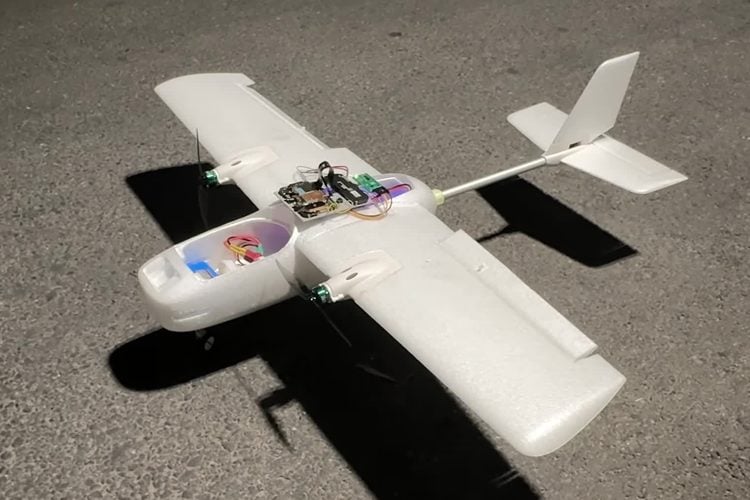
Most RC planes lose their link a few kilometres out, because a normal 2.4 GHz radio only reaches so far. Mountain DS Lab took a different route: an 8-year-old Xiaomi Mi 8, bought used for $23 with a cracked back and a damaged screen, stripped down to its motherboard and fitted inside a foam RC plane. The phone's own LTE modem now carries both the live FPV video and the control commands over the cellular network, so the range is set by mobile coverage, not by a radio in your hand. The build video passed 190,000 views in about two days.
Making a phone boot without its screen
The stock Xiaomi software was replaced with LineageOS 17 (Android 10), which is lighter and easier to modify. The tricky part was the missing display: Android checks for the panel at boot and can stall without it. The fix was to disable the display node in the device tree, the hardware description the Linux kernel reads at start-up, by editing the phone's boot.img.
From phone to flight controller
A custom PCB with a CH340 USB-to-UART chip connects the phone's USB port to a standard flight controller, which drives the motor and servos. A custom Android app streams video from the phone's front camera, which is extended on a cable, and passes commands from a web-based control page to the flight controller. A 3D-printed bracket holds the board inside the fuselage, with a DC-DC step-down converter powering it from the flight battery.
Key details
- Phone: Xiaomi Mi 8, bought used for $23, LineageOS 17 (Android 10)
- Link: 4G LTE for both FPV video and control
- Interface: custom CH340 USB-to-UART PCB to the flight controller
- Software: custom Android app plus a web control interface
- Status: ground and taxi tests done; the maiden flight is planned at an approved flying field
Our take
A used phone is a very cheap bundle of a modem, a camera, a fast processor, GPS and sensors, and this build shows how little extra hardware it takes to turn one into a long-range link. Cellular control has real limits, such as latency, coverage gaps and local drone rules, which is exactly why the creator is waiting for an approved field before flying. We will be watching for the flight video.
Image credit: Mountain DS Lab, frame from the YouTube video, cropped and resized.
About the author: Aswinth Raj is an electronics engineer and the editor of CircuitDigest, where he has published more than 150 hands-on projects and tutorials across Arduino, PIC, ESP32, Raspberry Pi and EV battery systems. He selects the stories on this page for what engineers and makers can actually learn or build from. Connect on LinkedIn

Add a comment
No account needed. Your comment appears once a moderator has reviewed it.