

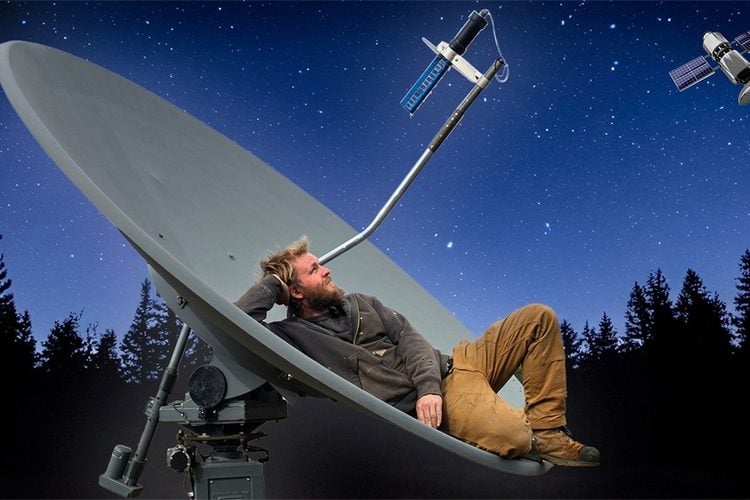
Big satellite dishes from the 80s and 90s still sit in fields everywhere, usually rusting. YouTuber and fabricator Cranktown City found an eight-foot one and turned it into a working satellite ground station on his new plot of land, with a Raspberry Pi doing the aiming and the decoding. The build video has passed 220,000 views.
Pointing an eight-foot dish
The dish was not in great shape, but that matters less than you might think: a dish only has to keep its parabolic shape, which collects a weak signal spread over a large area and reflects it onto a single point, the focus. What it really needed was a way to point at the sky. The dish came with a motorised mount for elevation (tilting up and down), so Cranktown City fabricated a rotating base for azimuth (turning left and right), driven by a wheelchair motor that already had a worm gear on it. Magnetic encoders report the actual position of each axis.
The electronics chain
A Raspberry Pi drives both motors through heavy-duty driver modules. Because the station never moves, working out where to point is mostly maths: the Pi takes published satellite positions and uses the open-source Skyfield library to turn them into azimuth and elevation angles. At the focus sits a 3D-printed helical antenna, based on an L-band design by AZDave. Its signal goes through an amplifier into an RTL-SDR, a cheap USB software-defined radio, and back to the Pi, which runs SatDump to decode satellite transmissions.
Key details
- Dish: eight-foot parabolic dish with motorised elevation
- Azimuth drive: wheelchair motor with built-in worm gear, magnetic encoders
- Control: Raspberry Pi with motor drivers, Skyfield for pointing
- Receiver: 3D-printed L-band helical antenna, amplifier, RTL-SDR
- Decoding: SatDump on the Pi
Our take
Every part of this chain is something a maker can buy or print, from the RTL-SDR to the antenna, and the dish was free scrap. The same setup also opens the door to radio astronomy, which is why big old dishes are worth rescuing before they go to the scrapyard.
Image credit: Cranktown City, YouTube video thumbnail, cropped and resized.
About the author: Aswinth Raj is an electronics engineer and the editor of CircuitDigest, where he has published more than 150 hands-on projects and tutorials across Arduino, PIC, ESP32, Raspberry Pi and EV battery systems. He selects the stories on this page for what engineers and makers can actually learn or build from. Connect on LinkedIn

Add a comment
No account needed. Your comment appears once a moderator has reviewed it.