
Electronics projects based on ATmega8 microcontroller of AVR series. These ATmega8 projects and tutorials are explained with the help of schematics, source codes and videos.

Making our projects Wireless always makes it to look cool and also extends the range in which it can be controlled. Starting from using a normal IR LED for short distance wireless control till an ESP8266 for worldwide HTTP control, there are lots of ways to control something wirelessly. In this project we learn how to build wireless projects using a 433 MHz RF module…
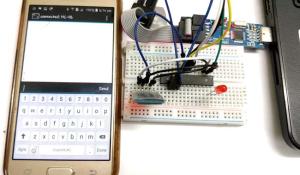
In this tutorial let us learn How to interface HC-05 Bluetooth Module with AVR ATmega8 microcontroller. We will establish communication between Android mobile and Atmega8 through Bluetooth module which takes place through UART serial communication protocol. In this project we will control a LED using Bluetooth of our smartphone.
…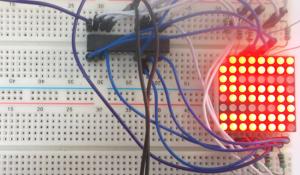
In this session we are going to design an 8x8 LED display with 8x8 LED matrix and ATmega8 microcontroller, which can show alphabets or names. A typical 8x8 led matrix is show below:
A 8x8 LED matrix contains 64 LED (Light Emitting Diodes) which are arranged in the form of a matrix, hence the name LED matrix.…
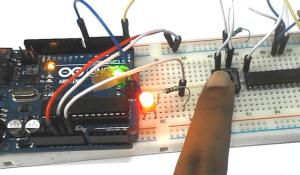
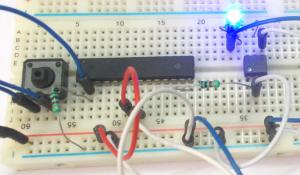
Here we are going to establish a communication between an ATmega8 microcontroller and Arduino Uno. The communication established here is UART (Universal Asynchronous Receiver Transmitter) type. It’s serial communication. By this serial communication data can be shared between two controllers, which is a required in various embedded system applications.
…
In this tutorial we are going to interface an Optocoupler with ATMEGA8 microcontroller. Octocouplers are fascinating devices used to isolate the electronic and electrical circuits. This simple device isolates the sensitive electronics from robust electronics like motors, yet keeping the load in control over the source.
…
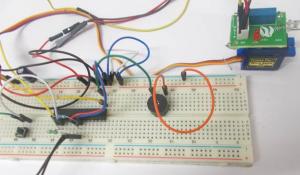
In this project, we are going to make a Fire Alert System using ATMEGA8 microcontroller and fire sensor. Fire sensor can be of any type, however we are using IR (Infrared) based Fire Sensor. Although IR based Fire Sensors have some disadvantages mostly of inaccuracy, it is the cheapest and easiest way to detect fire.
…
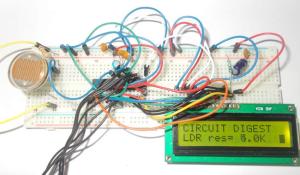
In this project we are going to interface LDR with ATMEGA8 microcontroller, and with this we can measure LIGHT INTENSITY in the area. In ATMEGA8, we are going to use 10bit ADC (Analog to Digital Conversion) feature to measure the light intensity.
Am LDR is a transducer which changes its resistance when…
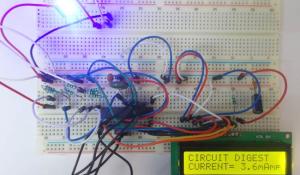
In this project we are going to make a low range ammeter using ATMEGA8 microcontroller. In ATMEGA8, we are going use 10bit ADC (Analog to Digital Conversion) feature to do this. Although we have few other ways to get the current parameter from a circuit, we are going to use resistive drop method, because it’s the easiest and simplest way to get current parameter.
…
In this tutorial we are going to establish a serial communication between two ATMEGA8 microcontrollers. The communication established here is UART (Universal Asynchronous Receiver Transmitter) type. By this serial communication data can be shared between two microcontrollers, which is required in various embedded systems.
…
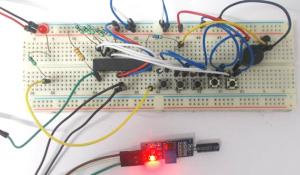
In this project we are going to make a vibration alert system with ATMEGA8 microcontroller. This can also be used as a theft alert system, for that we are going to interface tilt sensor with ATMEGA8. A tilt sensor is shown in below figure.
We can see there is a cylinder in the picture, in that cylinder there will…
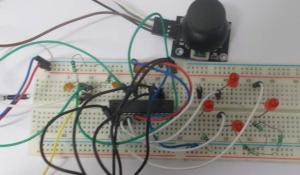
In this tutorial we are going to interface a joystick module with atmega8 microcontroller. A JOY STICK is an input module used for communication. It basically makes easy the user machine communication. A joystick is shown in below figure.
The joystick module has two axis - one is horizontal and other is…
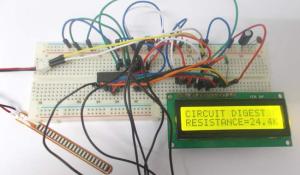
In this tutorial we are going to interface FLEX sensor with ATMEGA8 microcontroller. In ATMEGA8, we are going use 10bit ADC (Analog to Digital Conversion) feature to do this job. Now the ADC in ATMEGA cannot take a input more than +5V. We have also covered how to interface flex sensor with Arduino, you can also check out that tutorial if intrested.
…