

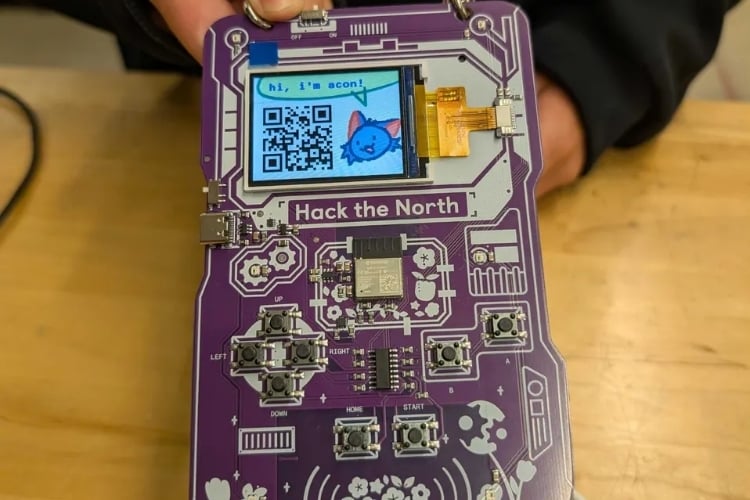
A simple event badge can do more than display a name. Nick Ficara designed and developed programmable electronic badges for Hack the North, a major student hackathon in Canada, after being approached by Alex, a project manager at the event. Unlike ordinary event badges that only display a name or event logo, this ESP32-powered hacker badge works as a small computer that participants can program, customize, and use to build their own applications. The custom PCB combines a display, buttons, LEDs, Bluetooth, and NFC-related features in a compact device. Its main uniqueness is that the badge is not limited to the functions chosen by its designer. Participants can create their own games, interactive tools, and wireless features, turning an event giveaway into a platform for learning electronics and software development.
The badge runs on an ESP32-based hardware platform with a Lua-based software environment and a browser-based editor for writing and testing programs. Users can build apps that show information on the screen, respond to button presses, control the LEDs, and use supported wireless features to interact with other devices. The project goes beyond simple animations and displays: participants developed custom games and other badge applications, including a networked version of Among Us that ran across multiple badges. According to Ficara's report, participants created 120 custom badge hacks during the event. The project also provides open-source hardware and software, allowing other makers to study the PCB design, explore the code, and adapt the platform for their own ideas. However, the badge cannot do literally everything; its capabilities depend on its hardware, available software, memory, and supported connections.
What makes the project especially interesting is the challenge of turning a programmable electronics design into 1,750 assembled devices ready for a real event. Ficara's build report describes practical engineering problems, including component selection mistakes, reversed components, battery polarity protection, screen assembly issues, and manufacturing delays. The reported cost was about $11.60 per assembled badge, excluding some additional expenses. Unlike a commercial development board designed mainly for prototyping, this badge combines custom hardware, a ready-to-use programming environment, and an event-wide community of people creating and sharing applications. It is still a specialised badge rather than a replacement for a laptop or a general-purpose computer, and producing it at scale requires careful PCB design, assembly, testing, and supply planning. By sharing the design and software, the project shows how an ESP32-based PCB can become an interactive, programmable device for gaming, wireless experiments, and hands-on embedded systems learning.

Add a comment
No account needed. Your comment appears once a moderator has reviewed it.