

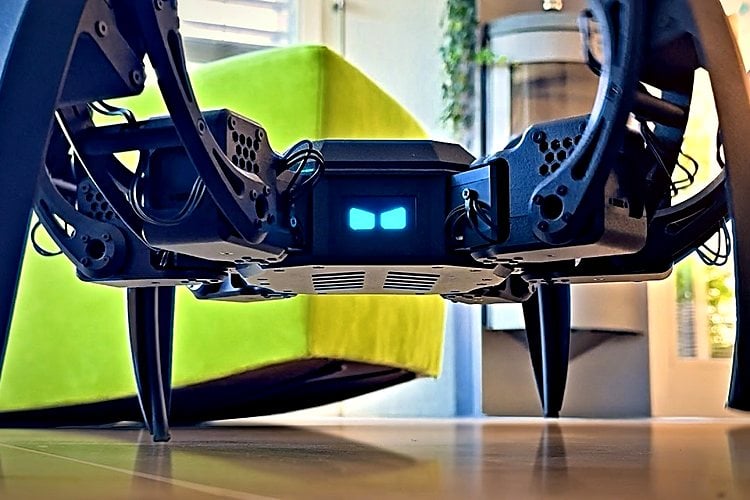
Most hobby hexapods walk by playing back a fixed sequence of leg moves, which is why switching gaits usually means stopping first. The hexapod built by ForgeVolt does not stop. It blends from a fast tripod walk into a tetrapod or ripple gait while it is still moving, leans into curves, and keeps its body level when the floor tilts under it. All of the leg math runs on one ESP32-S3, and the whole design, from firmware to PCB to STL files, is open source on GitHub under the MIT licence.
Why it can change gait mid-stride
The robot has 18 joints, three per leg, each a Dynamixel XC430 smart servo on a 4.5 Mbps TTL bus. Instead of stored poses, the ESP32-S3 works out every joint angle from where each foot should be, using inverse kinematics solved per leg 200 times a second. Inverse kinematics is the maths that turns a target foot position into the joint angles needed to reach it. Because nothing is pre-recorded, the controller can move from one gait pattern to another between steps, and it can also pose the body in place.
An MPU6050 gyro and accelerometer measures chassis tilt, which is how the robot stays level on a sloping surface. The eyes are a small OLED, and there are LEDs and an I2S speaker on a custom PCB.
A remote that knows nothing about legs
The handheld remote is another ESP32, linked over ESP-NOW. It only sends direction and mode requests. The robot itself tells the remote what each switch does, so the same transmitter could drive a completely different robot.
Key details
- Controller: ESP32-S3, inverse kinematics at 200 Hz per leg
- Actuators: 18 x Dynamixel XC430 servos
- Gaits: tripod, tetrapod and ripple, blended while walking
- Sensing: MPU6050 for self-levelling
- Link: ESP-NOW to an ESP32 remote (also open source)
Our take
The clever part is the split of jobs. Keeping all the gait logic on the robot and making the remote "dumb" is a clean design anyone building a walking robot can copy. Dynamixel servos are not cheap, but the IK and gait code is the real value here, and it will port to cheaper bus servos. Some time back we covered another open-source ESP32 hexapod; this one is the one to study for smooth walking.
Image credit: ForgeVolt (YouTube), cropped and resized.
About the author: Aswinth Raj is an electronics engineer and the editor of CircuitDigest, where he has published more than 150 hands-on projects and tutorials across Arduino, PIC, ESP32, Raspberry Pi and EV battery systems. He selects the stories on this page for what engineers and makers can actually learn or build from. Connect on LinkedIn

Add a comment
No account needed. Your comment appears once a moderator has reviewed it.