
Research
|
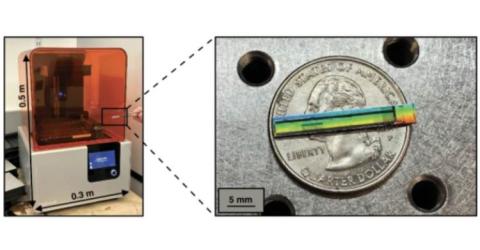
Future of 3D Printing: Researchers Demonstrate Tiny Chip-Based 3D Printer Researchers from MIT and the University of Texas at Austin have demonstrated the first chip-based 3D printer, potentially revolutionizing the 3D printing landscape. At present it is a novel device, small enough to fit in the palm of a hand, features a single millimeter-scale photonic chip that directs reconfigurable beams of light into a resin, which then cures into… |
|
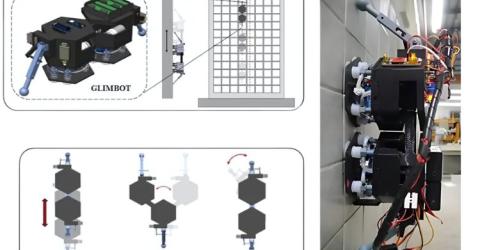
Meet GLEWBOT - an Arduino-based Bioinspired Climbing Robot Designed for Inspecting Wall Tiles! A research team from Taiwan has developed a remarkable climbing robot named GLEWBOT, specifically designed for inspecting wall tiles. This robot moves smoothly in any direction using two separate bodies connected by a linear servo motor, with feet equipped with suction cups for secure tile gripping. The robot's control center is managed by an Arduino Nano for basic… |
|
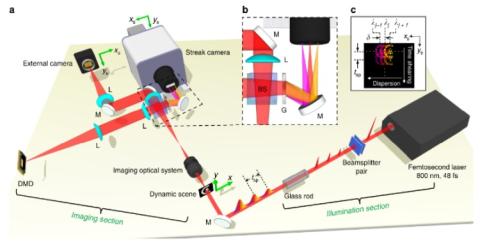
70 Trillion Frames Per Second: Compressed Ultrafast Spectral Photography (CUSP) A Research team at Caltech, California reached an astonishing development in the world of photography with their new project on Compressed Ultrafast Spectral Photography which can provide an output of 70 trillion Frames per second. Technically speaking this CUSP is a real-time multidimensional imaging technology that can find its applications in numerous fields in… |

|
EVM Trace – New tool for EVM Protocol research A new hacking, and research tools for EVM protocol analysis has been launched by Electronic Cats, the EMV Trace. This innovative device serves as an intermediary between an EMV card and a payment terminal, enabling the analysis and modification of communication traffic. With a USB-C interface, users can analyse the traffic on a PC, while… |

|
Researchers Build Four-Legged Swarm Robots Using 3D Printer Researchers in the US have built four-legged robots measuring 15 to 20 centimetres, using a 3D printer. Each robot is equipped with a lithium polymer battery, microcontroller and three sensors that enable them to connect to one another. The multi-legged robot is capable of maneuvering in challenging environments and accomplishing difficult tasks collectively,… |

|
Flexible Carbon Nanotube Fibers Woven into Fabric Can Monitor your EKG and Heart-Rate Wearable technology has opened the door to many exciting applications and has brought about the great technological revolution with much more advancement taking place at a fast pace. In the recent research conducted at Rice University, flexible carbon nanotube fibers have been developed to be woven into a fabric like t-shirt to keep gather accurate EKG… |

|
NVIDIA Launches AI Supercomputer for Healthcare Research NVIDIA has launched a $100 million powerful supercomputer, Cambridge-1 to enable UK healthcare experts, scientists, and researchers to accelerate the digital biology revolution making optimum use of the powerful combination of AI and simulation. Announced virtually by NVIDIA’s CEO and founder, Jensen Huang, this new system is dedicated to advancing the healthcare… |
|
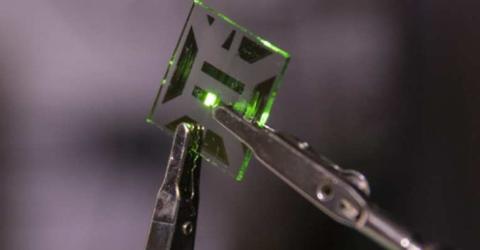
Ultra-thin Nanotech OLED Electrode Liberates 20% More Light Efficiently Engineers at the University of Michigan have developed a new ultra-thin silver film-based Nanotech OLED electrode that could free up 20% more light from the organic light-emitting diodes besides lowering down the display power consumption. This new electrode with a five-nanometer-thick layer of silver and copper outperforms conventional indium tin oxide without… |

|
Researchers Harvest Energy using Wi-Fi Band Signals to Power Small Electronics Wirelessly A team of researchers from the National University of Singapore (NUS) and Japan’s Tohoku University (TU) has harvested energy using Wi-Fi band signals to power small electronics without using any battery. The team has developed a technology that uses compact devices known as spin-torque oscillators (STOs) to harvest and convert wireless radio frequencies into energy to power… |
|
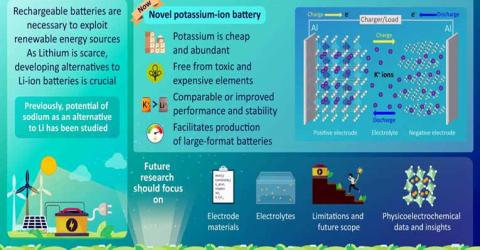
Replacing Lithium in Rechargeable Batteries with Potassium for Sustainable Environment Rechargeable Lithium batteries play a vital role in satisfying the worlds growing portable energy demands. These low cost, compact, and lightweight batteries are the primary choices for most portable electronic devices, Electric/Hybrid Vehicles, Solar Plants, etc. However, the availability of Lithium and Cobalt is limited on the earth’s crust and relying completely on these… |
|
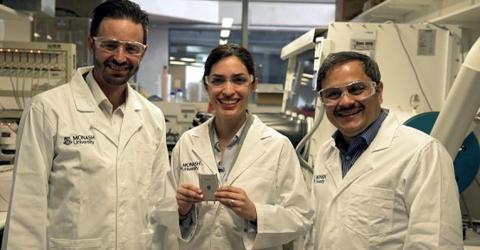
Researchers have Improved Lithium Sulphur Batteries to Drive EVs for more than 1000km on a Single Charge Researchers at Monash University have published a research article on how they have developed the world’s most efficient lithium-sulphur (Li-S) battery that could power a smartphone continuously for five days. The battery is suitable for applications like mass power storage and electric vehicles (which can travel 1,000 km without recharging). The ultra-high capacity Li-S… |