

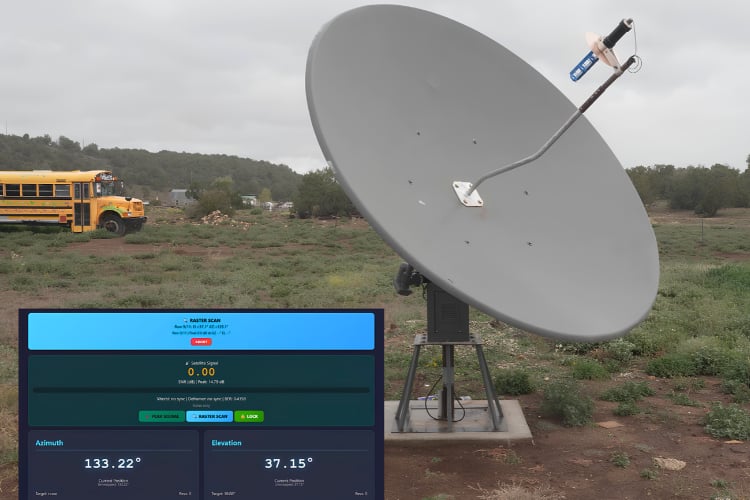
Cranktown City has built a DIY satellite ground station that uses an 8-foot satellite dish to follow satellites as they move across the sky and receive the radio signals they transmit. Unlike a manually operated dish, this system can calculate a satellite's position and automatically move the dish to follow it. One of the project's biggest achievements is receiving full-disk weather images from the GOES-19 weather satellite. The build combines a large dish, motors, sensors and a Raspberry Pi to create a working satellite reception system in a backyard. It also shows how computer software and electronics can work together to collect data transmitted from space.
At the heart of the system is a Raspberry Pi, which controls the motors and calculates satellite positions using orbital data from CelesTrak and the Skyfield Python library. The dish moves in two directions: azimuth turns it from side to side, while elevation tilts it up and down. A 24V wheelchair motor with a worm gear controls azimuth, while a linear actuator adjusts elevation. Two AS5600 magnetic encoders measure the mount's position, allowing the Raspberry Pi to compare the actual position with the target and correct the movement.
This Raspberry Pi satellite tracker can receive supported satellite transmissions, decode weather images and follow satellites during their passes across the sky. It also demonstrates how motor control, magnetic encoders, satellite orbit data and software-defined radio can work together, making it a useful learning project for electronics, programming and satellite communication. However, it cannot receive every satellite signal without suitable antenna hardware, a compatible receiver and the right decoding software. Tracking performance also depends on the mount's alignment and mechanical accuracy. The creator found that the elevation encoder can behave erratically in rain because its enclosure does not fully keep out water, and noted that the linear actuator may need replacing. Despite these limitations, the system has successfully received full-disk images from GOES-19 and data from a passing weather satellite. The creator plans to improve the system, try swappable antennas and explore more frequency bands, with radio astronomy remaining a future goal.

Add a comment
No account needed. Your comment appears once a moderator has reviewed it.