

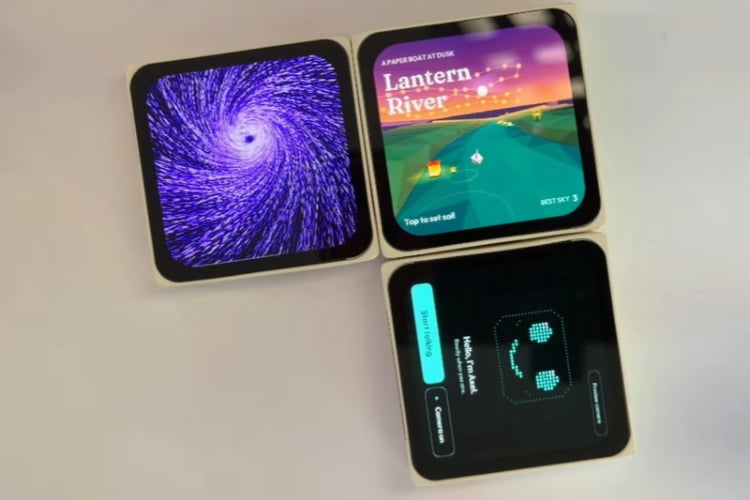
Maker Armağan Amcalar demonstrates how multiple ESP-Mosaico boards can work together to build a modular guitar effects system.ESP-Mosaico is a development platform based on the ESP32-S31 chip. In his demonstration, Amcalar uses ESP-NOW, a wireless communication method, to connect boards and run different guitar amplifier models at the same time. These models are software-based simulations that imitate the sound of real guitar amplifiers.The platform uses Espressif’s ESP32-S31 chip, which supports wireless communication and is designed for connected electronic projects.
To build the project, Amcalar uses multiple ESP-Mosaico boards and a software tool called GEA. Maker writes the application using TypeScript, JSX and CSS, and GEA converts the code into C++ that can run on the hardware. In the demonstration, he snaps additional boards together and gets two amplifier models working in parallel through ESP-NOW. This means the setup uses multiple connected boards rather than relying on a single board for everything. However, the demonstration does not provide measurements for sound quality or audio delay, so its performance compared with commercial guitar effects processors remains unknown.
The same modular approach could also inspire developers to build other connected electronic projects that need different features. To recreate this particular setup, users would need compatible ESP-Mosaico boards and access to the required software and build instructions. Its main idea is to explore how multiple boards can work together to build a system with more functions.

Add a comment
No account needed. Your comment appears once a moderator has reviewed it.