

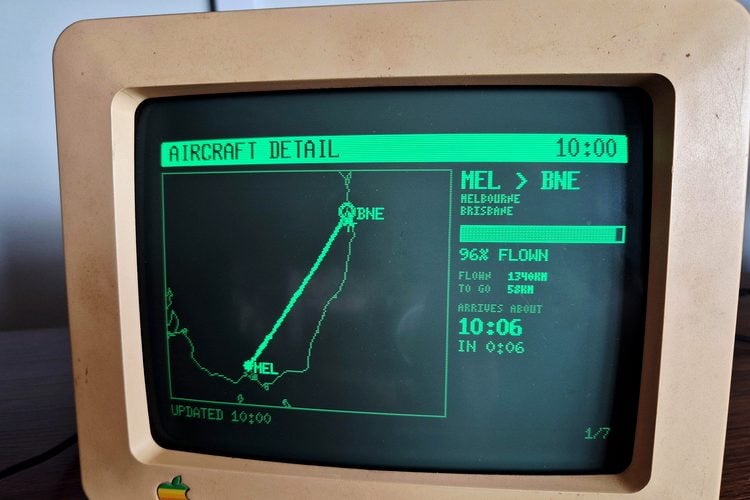
Most people who want a flight tracker on a desk reach for a Raspberry Pi and an HDMI screen. Reddit maker Virtual-Bet-4566 went the other way: a 1986 Apple II monochrome monitor, a classic ESP32-WROOM-32 and exactly two wires. The green phosphor CRT now shows a live radar view of the aircraft overhead, and no video converter sits in between.
Composite video straight from a DAC pin
The trick is the original ESP32's built-in 8-bit DAC. GPIO25 generates an analog composite video signal, sync pulses included, in software, and it is wired directly to the centre pin of the monitor's RCA input with a shared ground. There is no resistor network and no extra video chip. The maker points out that this only works on ESP32 variants that still have a DAC: the original ESP32 (GPIO25 and GPIO26) and, with different pins and software, the ESP32-S2. The S3 and C3 have no DAC, so they would need extra hardware.
A radar screen on a 40-year-old CRT
The firmware is built with PlatformIO on the Arduino-ESP32 framework, and a composite video driver renders a 320x200 frame. The ESP32 pulls live aircraft positions from online ADS-B feeds over Wi-Fi and fetches real aircraft photos from Planespotters.net. There are radar and map views, a flight detail page with route, altitude and speed, zoom controls and the option to lock onto one flight. Settings live in a small web interface served by the ESP32 itself.
The hard parts were the ones you would expect: fitting graphics buffers and live data into the ESP32's limited RAM, getting a clean picture out of a 40-year-old CRT, and keeping data updates from disturbing the video timing. The maker, who lives on a mountain where rescue flights are common, has since added rain radar, local weather and traffic pages. He says AI tools helped him get it built far faster than he could have from scratch.
Our take
This is a lovely reminder that the humble ESP32 DAC can do more than play beeps. Composite video needs almost no parts, and old CRTs and small car-reversing monitors still accept it. Some time back we covered an ESP32 e-paper frame that shows which airliner is flying overhead; this build takes the same idea back to the era of green screens.
Image credit: Virtual-Bet-4566 / Reddit, cropped and resized.
About the author: Aswinth Raj is an electronics engineer and the editor of CircuitDigest, where he has published more than 150 hands-on projects and tutorials across Arduino, PIC, ESP32, Raspberry Pi and EV battery systems. He selects the stories on this page for what engineers and makers can actually learn or build from. Connect on LinkedIn

Add a comment
No account needed. Your comment appears once a moderator has reviewed it.