

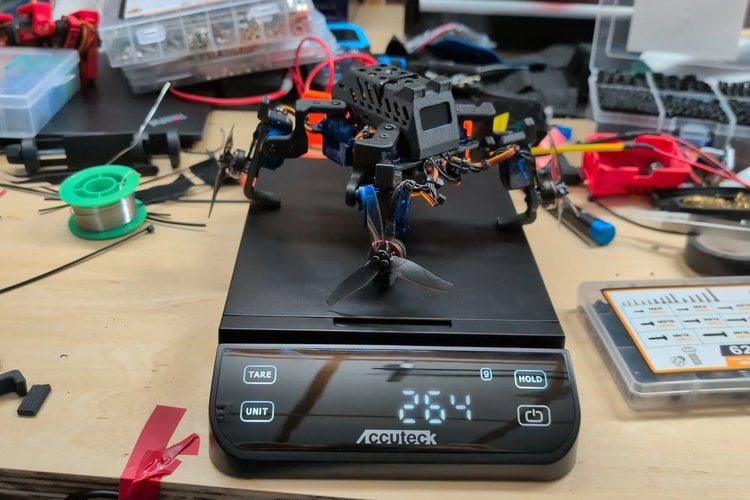
Earlier this year we covered Sesame, an open-source ESP32 quadruped you can build for about $50 to $60. Its maker, Dorian Todd, has now made it fly. Sesame Drone walks somewhere, folds its legs out flat into propeller arms, takes off, lands and walks away again.
Two brains with no link between them
The robot is really two machines sharing one 2S LiPo. A BETAFPV F4 all-in-one flight controller, with the receiver, IMU and four ESCs on one board, flies it as an ordinary quad and has no idea it has legs. A Lolin S2 Mini (ESP32-S2) runs the eight servos, the 128x64 OLED face and the Wi-Fi control page, just like a normal Sesame. They are deliberately not connected, so a brownout on one side does not take down the other. It also had to be that way: all eight LEDC PWM channels on the ESP32-S2 are already used by servos, and adding ESC outputs ran out of timers and broke the Wi-Fi captive portal.
Every gram counts
The target was 250 g; it came in at 264 g. Todd swapped the 13 g MG90S metal-gear servos for 9 g SG90s, saving about 35 g. Hover power rises with weight to the power of 1.5, so the heavier servos would have cost about 20% more power. Four 1104 brushless motors at 7,200 KV sit on the feet, spinning around 53,000 RPM unloaded on 2S. His estimate is 45 to 70 W from the battery just to hover, with thrust only a little above weight, which explains the wobbly, sinking hover in the test footage.
End stops carry the thrust, not the servos
The clever part is mechanical. Each motor puts only about 18 mNm on its knee servo, a tenth of an SG90's stall torque, so strength is not the problem; stiffness is. Servo dead band, plastic gear backlash and a 50 Hz update rate would let the arms droop and tilt their thrust. So each foot folds to 90 degrees against a printed one-sided end stop. Thrust only ever pushes up, which presses the foot into the stop and holds it rigid. The frame is PPA-CF (carbon-fibre nylon) on a CNC-cut carbon plate, and emotes that would swing a foot into a propeller were removed from the firmware.
Our take
The write-up is full of real numbers, from the hover-power maths to why small holes in a 3D print can add weight. It is a great read for anyone building drones or quadruped robots. Todd's own to-do list is honest too: move the flight interlock into the ESP32 firmware and find more thrust margin.
Image credit: Dorian Todd, cropped and resized.
About the author: Aswinth Raj is an electronics engineer and the editor of CircuitDigest, where he has published more than 150 hands-on projects and tutorials across Arduino, PIC, ESP32, Raspberry Pi and EV battery systems. He selects the stories on this page for what engineers and makers can actually learn or build from. Connect on LinkedIn

Add a comment
No account needed. Your comment appears once a moderator has reviewed it.