
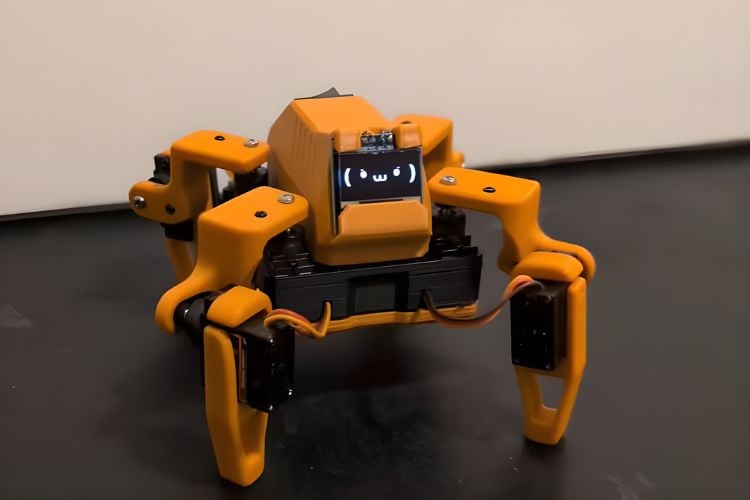
A new open-source quadruped robot called Sesame Robot is making legged robotics more affordable and accessible. Developed by Dorian Todd, Sesame is built using an ESP32 microcontroller, 3D-printed parts, and eight low-cost servos, keeping the total build cost around $50–60. With complete CAD files, firmware, and detailed assembly guides available on GitHub, users can easily build, customize, and experiment with their own four-legged robot using basic tools and a 3D printer.
What sets Sesame apart from many DIY bots is its fusion of affordable hardware and friendly, expressive features. Each of the robot’s four legs uses two servos to enable lifelike movement, while a built-in 128×64 OLED screen serves as an emotive face that reacts to actions like walking, dancing, and waving. The open-source firmware includes a web-based control interface hosted by the robot itself, so builders can manage movement and emotes from a phone or computer without complex pairing routines. Alongside this, Sesame Studio, a desktop animation composer, allows users to visually pose the robot and generate custom motion sequences, lowering the barrier to creative expression and easing animation design.
Beyond just a fun gadget, Sesame is designed as a modular robotics platform that invites experimentation and community contribution. Its well-documented Bill of Materials, wiring and assembly guides, and permissive open license encourage makers to tweak, upgrade, and expand the robot’s capabilities, whether adding sensors, experimenting with new gaits, or integrating additional compute like AI modules. The project’s open ethos reflects a broader trend toward accessible robotics, empowering a new wave of builders to learn, innovate, and contribute to an expanding ecosystem of DIY legged robots.

Add a comment
No account needed. Your comment appears once a moderator has reviewed it.