

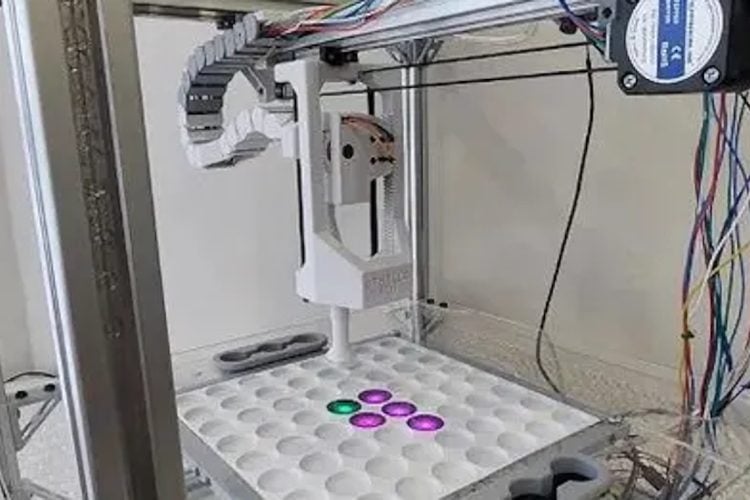
In Grade 11, maker Jeneus tried to write an Othello program in C++. It ended up buggy and the computer could only play random moves. Years later, with mechatronics skills, he turned that failure into Othellobot: a gantry robot that watches the board with a camera, picks its move and places clear tokens with a suction cup. The smart part is that it never flips a disc. Every cell has its own LED underneath, so a captured piece simply changes colour.
How it plays
The frame is built like a 3D printer, with 2020 aluminium extrusion, linear rails and two NEMA 17 steppers on GT2 belts. The end effector carries a TPU suction cup on a vacuum pump with a solenoid valve and a pressure sensor, plus a servo with an AS5600 magnetic encoder. The board is four 4x4 LED matrix PCBs daisy-chained into the 8x8 grid, and legal moves blink so a beginner knows where they can play.
An Arduino Nano runs the motor drivers and sensors, while a Raspberry Pi is meant to handle the camera and choose the next move. Jeneus fried his Pi during development, so for now the robot runs from his laptop.
Key details
- Motion: 3-axis gantry, NEMA 17 steppers, limit-switch homing
- Pick and place: vacuum suction cup with pressure sensing
- Board: 64 LEDs on four custom LED matrix PCBs
- Electronics: custom main PCB, Arduino Nano, Raspberry Pi (laptop for now)
- Files: KiCad projects, interactive BOMs, STL and SVG files in the 29-step guide
Our take
Replacing the hardest mechanical job, flipping a disc, with an LED is a great piece of engineering judgement. If you want to try a smaller version, our Raspberry Pi chess board project is a good place to start.
Image credit: Jeneus (Othellobot), as featured on Hackaday, cropped and resized.
About the author: Aswinth Raj is an electronics engineer and the editor of CircuitDigest, where he has published more than 150 hands-on projects and tutorials across Arduino, PIC, ESP32, Raspberry Pi and EV battery systems. He selects the stories on this page for what engineers and makers can actually learn or build from. Connect on LinkedIn

Add a comment
No account needed. Your comment appears once a moderator has reviewed it.