
Test and Measurement
|
Design Techniques for Reducing EMI in SMPS Circuits In my previous article on EMI, we examined how the intentional/unintentional nature of EMI sources and how they affect the performance of other Electrical/Electronic devices (victims) around them. The article was followed by another one on Electro Magnetic Compatibility (EMC) which provided insights into the dangers of EMI and offered some context to how poor EMI… |

|
150MHz Battery Powered Portable Oscilloscope with 70Mpts memory and 1GSa/s Sampling Rate Saelig has introduced Micsig STO1000E PLUS, a series of 2/4 channel battery-powered portable oscilloscopes that provide bandwidths up to 150MHz with 70Mpts memory, 1GSa/s sampling (single channel) 130,000wfm/s refresh rate, and a 7.5Ah Li-battery for extended field use. The series includes three models: STO1102E PLUS 2-channel 100MHz, STO1152E PLUS 150MHz 2-channel, and… |

|
Calibration of Ammeter, Voltmeter, and Wattmeter using Potentiometer We know that voltage, current, and power are measured in volts, amps and, watts and voltmeter, ammeter, and wattmeter are used to measure these parameters. Though these measuring instruments are manufactured with the care they may still give error readings at the customer end. So these instruments are calibrated to minimize the error. Here in this article, we will explain… |

|
Understanding Z-Wave Protocol and its Role in Smart Home Automation Solutions As applications based around Wireless Sensor Networks, Home Automation, and IoT increased, the need for alternative communication protocol asides the regular Bluetooth, Wi-Fi, and GSM protocols was becoming obvious. Several technologies like Zigbee and Bluetooth Low Energy (BLE) were developed as alternatives but one standout technology, developed to specifically serve home… |
|
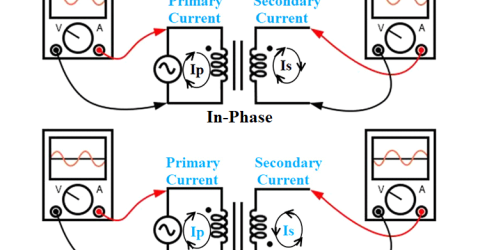
Understanding Dot Convention in Transformers From large power stations to compact SMPS circuits, transformers can be found almost everywhere. Though there are many types of transformers and their exact working differs based on the application, the basic working of the Transformer remains the same. When examining transformer circuit schematics, you'll notice "dot" symbols placed on transformer windings. These dots… |

|
EMC Testing Process and Requirements for EMC Compliance As mentioned in the last article where we discussed Electromagnetic Interference (EMI), almost all electronic products designed for commercial use and legal sales, are required to possess one or more certifications as a proof that the product complies with certain regulations/guidelines and has passed related tests. There are tonnes of regulations and they differ from place… |

|
Impulse Voltage Generator / Marx Generator – Circuit Diagram, Working Principle and Applications In electronics, surges are a very critical thing and it is a nightmare for every circuit designer. These surges are commonly referred to as impulse which can be defined as a high voltage, typically in a few kV which exists for a short duration of time. The characteristics of an impulse voltage can be noticed with a High or Low fall time followed by a very high rise time of… |

|
Solar Radiation Measurement Methods using Pyrheliometer and Pyranometer We all know that life is sustained on earth because of the sun as it provides sufficient heat energy to keep the earth warm. This energy is delivered by the sun in the form of Electromagnetic radiation which is usually called solar radiation. Some of the radiation is beneficial to humans while another radiation is harmful to all life. … |

|
A Basic Introduction to Grid Dip Meter The Grid Dip Meter (GDM) or the Grid Dip Oscillator (GDO) is an electronic instrument used in measurement and testing of radio frequency circuits. It is basically an oscillator with an exposed coil and oscillation amplitude readout. It has three main functions: Measuring the resonant frequency of an LC resonant circuit, a Crystal/Ceramic resonator, or an Antenna,… |

|
Electrical Enclosures - 10 Important Factors to Consider Before Selecting One Modern electronic circuits are becoming more powerful than ever. Consequently, the needs and requirements of electronic components have changed significantly in the past few years. When designing an electronic circuit, engineers need to take into consideration various factors such as power consumption, heat dissipation, and other electronic specifications, to ensure the… |

|
Don't use your Numerical Relay like Electromechanical Relay With the experience of working in more than 500 Plants with various types of Electrical services, I have come to know about the different problems Engineers face during Maintenance and Breakdown. Instead of keeping the exposure limited to me I decided to share it with my fellow engineers here by writing case studies. One such case study is as follows. … |

|
What could cause repeated relay failures in a chemical plant? Just like the previous case studies, we bring to you one more actual incident that happened in one of the Chemical / Process Industry. We thought it was important and must be brought to notice to all concerned people working in O&M or Project in chemical industries to take due note of it as it may help other industries who doesn’t know about it. Repeated… |
