
PWM

|
Robotic Arm Control using PIC Microcontroller From the assembly line of automobile manufacturing industries to the telesurgery robots in space, Robotic Arms are to be found everywhere. The mechanisms of these robots are similar to a human which can be programmed for similar function and increased capabilities. They can be used to perform repeated actions faster and accurate than humans or can be used in harsh… |

|
What is VFD Drive Circuit: Its Operation, Types and Applications There are lots of factories and plants in the world which use a different type of high power motors. Due to the high power consumption, the factories and plants end up paying a high amount of energy bills. To overcome the high power consumption and to increase the efficiency, VFD was introduced four decades ago but the circuitry was not strong enough. … |

|
Introduction to Different Types of Inverters Power inverters are fundamental devices for power electronics that convert DC (Direct Current) into AC (Alternating Current). There are many types of power inverters specific for use in residential, commercial, and industrial systems. It is important to understand the types of power inverters in power electronics to make the appropriate decision about the type of power inverter you would like… |

|
Interfacing Servo Motor with ARM7-LPC2148 In our previous tutorial, we have interfaced stepper motor with ARM7-LPC2148. In this tutorial, we will control Servo Motor with ARM7-LPC2148. Servo motor has low power consumption advantage over stepper motor. A servo motor stops its power consumption when the desired position is reached but the stepper motor continuous to consume power to lock up the shaft in desired… |

|
ARM7-LPC2148 PWM Tutorial: Controlling Brightness of LED As we know microcontrollers take analog input from analog sensors and use ADC (Analog to Digital converter) to process those signals. But what if a microcontroller want to produce an analog signal to control analog operated devices like a Servo motor, DC motor etc? Microcontrollers don’t produce output voltage like 1V, 5V instead they use a technique called PWM for operating… |

|
Generating PWM signals on GPIO pins of PIC Microcontroller PWM signal generation is a vital tool in every embedded engineers arsenal, they come in very handy for lot of applications like controlling the position of servo motor, switching few power electronic ICs in converters/invertors and even for a simple LED brightness control. In PIC microcontrollers PWM signals can be generated using the Compare, Capture and PWM (CCP) modules… |

|
What is PWM: Pulse Width Modulation Inverters, Converters, SMPS circuits and Speed controllers.... One thing that is common in all these circuits is that it consists of many electronic switches inside it. These switches are nothing but Power electronic devices like MOSFET, IGBT, TRIAC etc. In order to control such power electronic switches we commonly use something called PWM signals (Pulse Width Modulation).… |

|
Pulse width Modulation (PWM) in STM32F103C8: Controlling Speed of DC Fan In previous article we have seen about ADC conversion using STM32. In this tutorial, we will learn about PWM (Pulse Width Modulation) in STM32 and how can we control brightness of LED or speed of DC fan using PWM technique. We know that there are two types of signal: Analog and Digital. Analog signals have voltages like (3V, 1V...etc) and digital… |

|
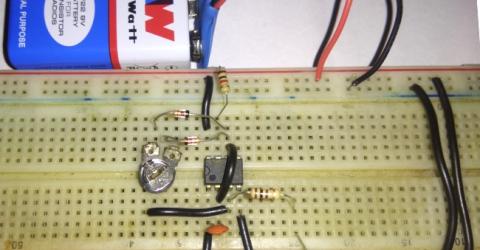
Pulse width Modulation (PWM) using MSP430G2: Controlling Brightness of LED This tutorial is a part of series of MSP430G2 LaunchPad tutorials in which we are learning to use the MSP430G2 LaunchPad from Texas Instruments. So far we have learnt the basics of the board and have covered how to read analog voltage, interface LCD with MSP430G2 etc. Now we proceed with the next step of learning about PWM in MSP430G2. We will do that by controlling the… |
|
Generate Pulse Width Modulation (PWM) Signal using 555 Timer IC Pulse Width Modulation using 555 timer is an important feature of today’s microcontroller due to its requirement for controlling many devices in almost every field of Electronics. PWM is widely used for motor control, lighting control, etc. Sometimes we do not use a microcontroller in our applications, and if we need to generate PWM without a microcontroller, then we prefer… |

|
Interfacing Servo Motor with PIC Microcontroller using MPLAB and XC8 This is our 11th tutorial of Learning PIC microcontrollers using MPLAB and XC8. In this tutorial we will learn How to control Servo Motor with PIC Microcontroller. If you have already worked with Servo motors you can skip the first half of this tutorial but if you are new to servo motor itself then continue reading. Till now, we have covered many… |

|
Generating PWM using PIC Microcontroller with MPLAB and XC8 This is our 10th tutorial of Learning PIC microcontrollers using MPLAB and XC8. Till now, we have covered many basic tutorials like LED blinking with PIC, Timers in PIC, interfacing LCD, interfacing 7-segment, ADC using PIC etc. If you are an absolute beginner, then please visit the complete list of PIC tutorials here and start… |
