
PWM

|
PWM Signal on Nuvoton N76E003 Microcontroller - LED Dimming using Duty Cycle Control Pulse Width Modulation (PWM) is a commonly used technique in microcontrollers to produce a continuous pulse signal with a defined frequency and duty cycle. In short, PWM is about changing the width of a pulse while the frequency is constant. A PWM signal is mostly used in controlling a servo motor or brightness of an LED. Also, since… |

|
Pure Sine Wave Inverter Using Arduino Inverter circuits are often needed where it is not possible to get AC supply from the grid. An inverter circuit is used to convert DC power to AC power and it can be divided into two types that is Pure Sine Wave Inverters or Modified Square Wave Inverters. These pure sine wave inverters are very expensive, where the modified square wave inverters are inexpensive. Learn more… |

|
ESP32 PWM Tutorial: Controlling the Brightness of LED Pulse Width Modulation (PWM) is a technique that varies the width of a pulse while keeping the wave frequency constant. The PWM technique mainly used to control the brightness of the LED, speed of DC motor, controlling a servo motor, or in other cases, where have to generate an analog signal using a digital source. We explained the PWM in detail in the previous article.… |
|
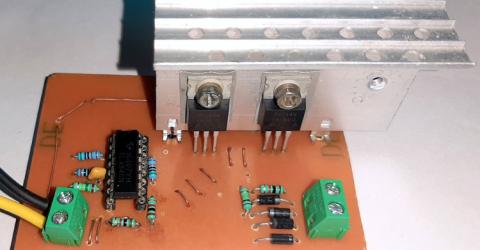
PWM Inverter Circuit using TL494 An inverter is a circuit that converts Direct Current (DC) to Alternating Current (AC). A PWM inverter is a type of circuit that uses modified square waves to simulate the effects of Alternating Current (AC), which is suitable for powering most of your household appliances. I say most-of because there generally exist two types of inverters, the first type is the so-called a… |
|
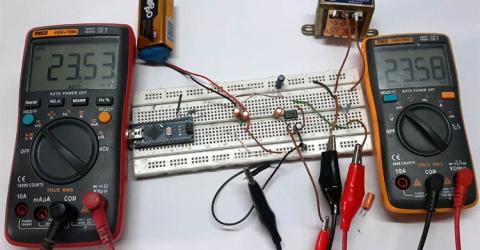
Designing a True RMS to DC Converter using IC AD736 A True-RMS or TRMS is a type of converter which converts RMS value to equivalent DC value. Here in this tutorial, we will learn about true RMS to DC converter, how it works and how measurement methods can affect displayed results. What is RMS?RMS is the abbreviation of Root Mean Square. By definition, for alternating electric current, the RMS value… |

|
AC Fan Speed Control using Arduino and TRIAC WARNING!! The circuit diagram discussed in this project is only for educational purposes. Be advised that working with 220V AC mains voltage requires extreme precaution and safety procedures should be followed. Do not touch any of the components or wires when the circuit is in operation.
It is easy to turn… |

|
DIY Pick and Place Robotic Arm using ARM7-LPC2148 ARM Microcontroller Robotic Arms, are one of the fascinating engineering creations and it is always fascinating to watch these things tilt and pan to get complex things done just like a human arm would. These robotic arms can be commonly found in industries at the assembly line performing intense mechanical work like welding, drilling, painting etc, recently advanced robotic arms with high… |

|
Bootstrap Amplifier Circuit using Transistors Amplifiers are integral part of Electronics which are used to amplify low amplitude signals. Amplifier plays a very important role to boost the signal, specially in Audio and power electronics. We previously built many types of amplifiers including audio amplifiers, power amplifiers, operational amplifiers etc. Apart from them you can learn many other commonly used… |

|
Simple H-Bridge Motor Driver Circuit using MOSFET At the outset, driving a motor might seem like an easy task – just hook the motor up to the appropriate voltage rail and it will start rotating. But this is not the perfect way to drive a motor, especially when there are other components involved in the circuit. Here, we will discuss one of the most commonly used and efficient ways to drive DC motors, the H-Bridge circuit.… |

|
Understanding Pulse width Modulation (PWM) in Atmega16/32 AVR Microcontrollers Pulse Width Modulation (PWM) is a powerful technique where width of the pulse is changed by keeping the frequency constant. The technique is used in many control systems today. The application of PWM is not limited and it is used in wide range of applications such as motor speed control, measurement, power control and communication etc. In PWM technique, one can easily… |

|
Flyback Converter Circuit In electronics, a regulator is a device or mechanism which can regulate the power output constantly. There are different kinds of regulators available in the power supply domain. But mainly, in the case of DC to DC conversion, there are two types of regulators available: Linear or Switching. A linear regulator regulates the output using a resistive… |

|
Interfacing Servo Motor with AVR Microcontroller Atmega16 Servo Motors are widely used where precise control is required such as robots, Automated Machineries, robotic arm etc. However, the scope of the servo motor is not limited to this much and can be used in many applications. To know more about the basics, theory and working principle of servo motor follow the link. We previously… |
