
Power

|
Frequency to Voltage Converter Circuit Frequency to voltage converter converts the frequencies or pulses to the proportional electrical output such as voltage or current. It is an important tool for electromechanical measurements where repeated events are occurring. So, when we provide a frequency across a frequency to voltage converter circuit, it will provide a proportional DC output. Here we are using KA331 IC… |

|
TI’s smart AC/DC linear regulator achieves breakthrough in efficiency and power density Texas Instruments expanded its broad portfolio of over 500 linear regulators by introducing a first-of-its-kind smart AC/DC linear regulator. With 75 percent higher efficiency and two times the power density of other linear regulators, this device achieves the best balance between high efficiency and ultra-low noise while shrinking power-supply size. The fully integrated… |

|
How to Modify the Clock Frequency to Reduce Microcontroller Power Consumption Developers always have challenge delivering high levels of functionality and performance while simultaneously maximizing battery life. Also when it comes to electronic products, the most important feature is the battery consumption. It should be as less as possible to increase the device operation time. The power management is very critical in portable and battery-powered… |

|
Isolated gate drivers with integrated sensing for IGBTs and SiC MOSFETs save energy and protect high-voltage systems Texas Instruments introduced several new isolated gate drivers that provide unparalleled levels of monitoring and protection for high-voltage systems. The UCC21710-Q1 and UCC21732-Q1 and UCC21750 enable designers to create smaller, more efficient and higher-performing designs in traction inverters, onboard chargers, solar inverters and motor drives. … |

|
Littelfuse SIDACtor Protection Thyristor Safeguards CVBS Signal Lines Against Damaging Overvoltage Transients Littelfuse released the first PxxxxS4xLRP Series SIDACtor Protection Thyristor. The new Thyristor is touted as a robust solution for protecting Composite Video Blanking Sync (CVBS) signal lines and ports from damaging overvoltage transients. The combination of 6V operating voltage and 100A 5/310µs surge peak current capability and a low junction capacitance rating make the… |

|
New Optocouplers feature static dV/dt of 1000 V/μs in DIP-6 and SMD-6 Packages Vishay Intertechnology has released two new optocouplers which will be add-on to its optocoupler family with phototriac output in compact DIP-6 and SMD-6 packages. The optocouplers VOT8026A and VOT8123A deliver high robustness and noise isolation for home appliances, industrial application with features such as high off-state voltage of 800 V and static dV/dt of 1000 V/… |

|
Hartley Oscillator In simple terms, the oscillator is a circuit which converts DC power from the supply source to the AC power to the Load. Oscillator system is built using both active and passive components and it is used for the production of sinusoidal or any other repetitive waveforms at the output without any application of an external input signal. We discussed few oscillators in our… |
|
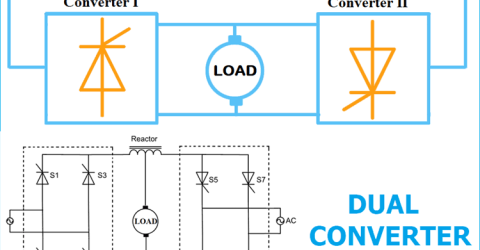
An Overview of Dual Converters In the previous tutorial, we saw how a Dual Power Supply Circuit is designed. Now, we learn about Dual Converters, which can convert AC to DC and DC to AC at the same time. As the name suggests, Dual Converter has two converters, one converter works as a rectifier (Converts AC to DC) and the other converter works as an inverter (converts DC into AC). Both converters are… |

|
Colpitts Oscillator An oscillator is a mechanical or electronic construction which produces oscillation depending on few variables. We all have devices which need oscillators like a traditional clock or a wristwatch. Various types of metal detectors, computers where microcontroller and microprocessors are involved use oscillators, especially electronics oscillator which produces periodic… |

|
Minimizing Power Consumption in Microcontrollers Just as gas (petrol/diesel) is important for bikes, trucks and cars (yeah, excluding Teslas!) to move, so is electric power for most of the electronics applications and more so, for embedded system based applications which are usually battery (limited energy) powered, from the regular mobile phones to smart home devices amongst others. … |

|
What is JFET: Its Construction, Working and Biasing Techniques JFET is a Junction gate field-effect transistor. A normal transistor is a current-controlled device which needs current for biasing, whereas a JFET is a voltage-controlled device. Similar to MOSFETs, as we have seen in our previous tutorial, JFET has three terminals: Gate, Drain, and Source. JFET is an essential component for precision-level voltage… |

|
What is MOSFET: Its Construction, Types and Working MOSFET is basically a transistor which uses field effect. MOSFET stands for Metal Oxide Field Effect Transistor, which has a gate. The gate voltage determines the conductivity of the device. Depending on this gate voltage we can change the conductivity and thus we can use it as a switch or as an amplifier like we use Transistor as a switch or as an amplifier. … |
