

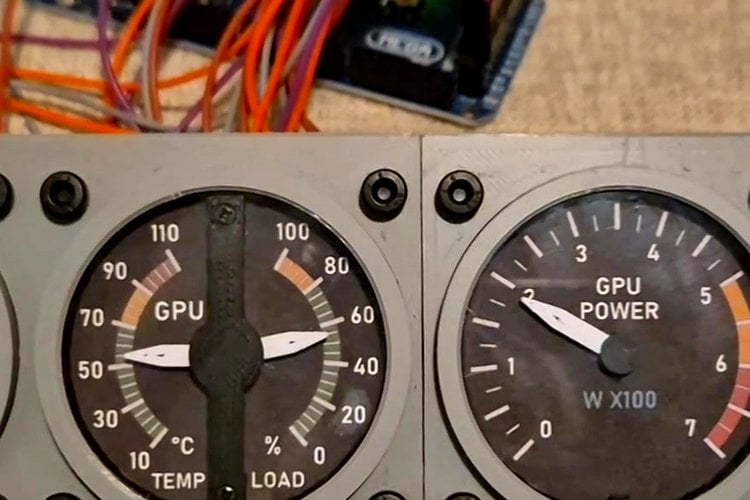
Old aircraft panels still look better than any flat graph on a monitor. Reddit maker Night-Caps put that look on his desk: four aircraft-style gauges driven by an Arduino that reads live PC hardware data from HWiNFO over serial. The needles move with CPU and GPU temperature, load, GPU power and RAM, and the post landed near the top of r/arduino with about 750 upvotes.
Switec steppers instead of meters
The needles are not salvaged aircraft instruments. They are Switec stepper motors of the kind used in car instrument clusters: X40 dual-needle units for the temperature/load dials and X27 single-needle units for GPU power and RAM. Switecs are small bipolar steppers that many makers drive straight from microcontroller pins, with no separate stepper driver board. Night-Caps bought them cheaply on AliExpress, mounted them behind acrylic covers, and printed the dial faces on photo paper with a normal inkjet printer. Behind the acrylic they look like proper gauges.
From HWiNFO shared memory to serial
A small PC-side program reads HWiNFO's shared-memory sensor values and ships them over USB serial to the Arduino. The firmware parses each packet into variables and maps those values onto stepper angles so the needles track temperature, load, power and memory use. The catch he calls out: HWiNFO's shared-memory feature needs a paid licence. Free tools such as Open Hardware Monitor can feed the same idea if you write the bridge yourself.
Our take
This is a clean telemetry build: one serial stream in, four mechanical outputs out, and a panel that you can read at a glance without opening Task Manager. The dual-needle X40 dials are the clever part, because they pack two metrics into one aircraft-looking instrument. If you want a first step into driving a needle from an Arduino, our Arduino analog speedometer project shows the same idea with a bipolar stepper behind a printed dial.
Image credit: Night-Caps (Reddit), cropped and resized.
About the author: Aswinth Raj is an electronics engineer and the editor of CircuitDigest, where he has published more than 150 hands-on projects and tutorials across Arduino, PIC, ESP32, Raspberry Pi and EV battery systems. He selects the stories on this page for what engineers and makers can actually learn or build from. Connect on LinkedIn

Add a comment
No account needed. Your comment appears once a moderator has reviewed it.