

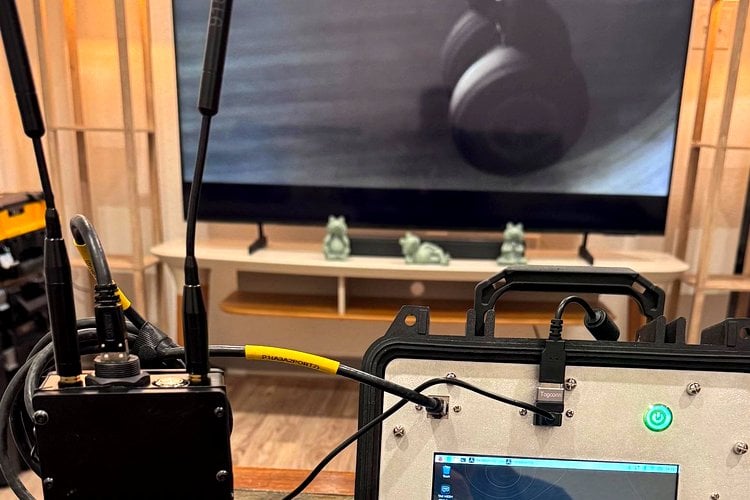
Phones on this mesh need no cell signal of their own. Reddit maker EaseAlert5864 built a Raspberry Pi 4 cyberdeck that sits as the only uplink for an off-grid Wi-Fi HaLow mesh running OpenMANET. ATAK and iTAK clients join the mesh for chat, video and location, while the deck bridges traffic to a TAK server over Tailscale. If the uplink drops, the mesh keeps working on its own and the deck holds chats until the link returns. The radio shell is his own CNC aluminium design, and the work is public on GitHub as TakMeshTOC.
OpenMANET nodes on Pi 4B
Each mesh node is a Raspberry Pi 4B running OpenMANET. Wi-Fi HaLow (IEEE 802.11ah) is long-range, low-power Wi-Fi in sub-GHz bands, which is why phones on the mesh can stay linked without cellular data. Voice uses OpenMANET talkgroups bridged to a Mumble server on a home Pi, with PTT through ATAK plugins and headset controls. Anyone with access to that Mumble instance can hear and talk as well.
The cyberdeck itself is a field TOC: screen and keyboard in a hard case, green power button on a metal panel, and the HaLow radio in the CNC shell with dual antennas. The deck is the only box that needs a hotspot or Wi-Fi uplink; everything else stays on the mesh.
Our take
The useful architecture lesson is the bridge, not the casework. Keep the mesh self-sufficient, put one durable uplink at the edge, and queue traffic when that uplink fails. That pattern works for trail teams, campus drills and any group that cannot depend on a carrier. For background on the radio standard itself, see our Wi-Fi HaLow overview, and for a lighter open mesh stack on ESP32 hardware look at our Meshtastic coverage.
Image credit: EaseAlert5864 (Reddit), cropped and resized.
About the author: Aswinth Raj is an electronics engineer and the editor of CircuitDigest, where he has published more than 150 hands-on projects and tutorials across Arduino, PIC, ESP32, Raspberry Pi and EV battery systems. He selects the stories on this page for what engineers and makers can actually learn or build from. Connect on LinkedIn

Add a comment
No account needed. Your comment appears once a moderator has reviewed it.