

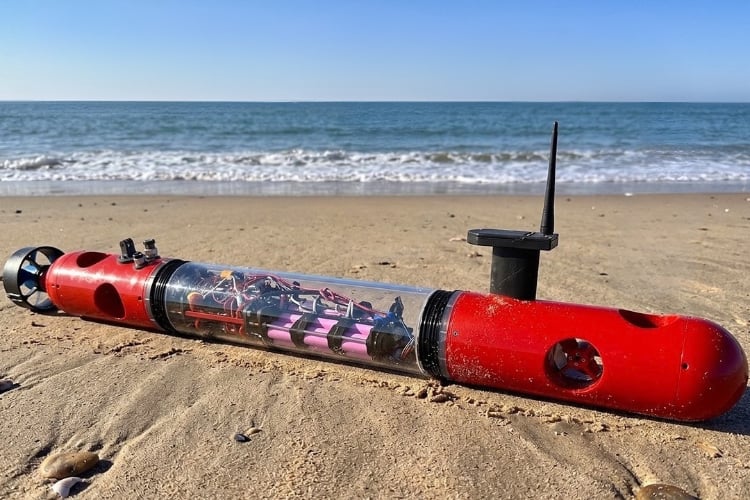
CPSdrone is building a DIY autonomous submarine to explore shipwrecks without needing GPS while underwater. Since GPS signals cannot reach the submarine underwater, the team added a Doppler Velocity Log (DVL) to help it navigate. The DVL sends sound waves toward the seafloor and listens for the signals that bounce back. By measuring how the sound changes as the submarine moves, it can calculate the submarine’s speed and direction. The system then uses this information with a compass and dead reckoning to estimate where the submarine has moved from its starting point.
The submarine still uses GPS and a long-range radio, but only when it comes back to the surface. A GPS antenna on a small mast gets its location, which is then used to correct errors that build up during underwater travel. The team tested the radio system up to 7 km before installing it on the submarine. They also added two rear motors, giving the submarine four motors in total so it can move forward, sideways, and up and down. The team tested the navigation and control software in a computer simulation before using it on the real submarine.
During the first autonomous test in a lake, the submarine slowly moved away from its planned path because of a navigation error. The team compared its DVL data with GPS data and found a roughly 7-degree heading error, which they corrected in the software. They then removed the safety string and ran the submarine on its own. It was programmed to surface at certain points, get a new GPS location, correct its position, and dive again. The submarine successfully completed the test, showing how sound-based navigation, GPS correction, sensors, motors, and software can work together to control an autonomous submarine underwater.

Add a comment
No account needed. Your comment appears once a moderator has reviewed it.