

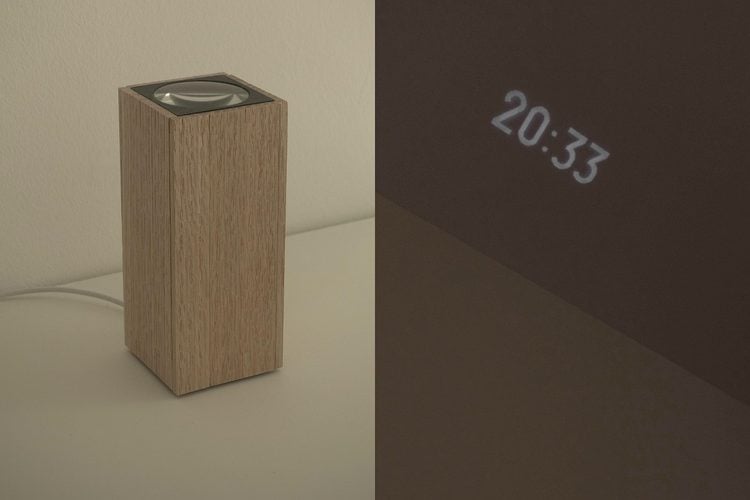
Most bedside clocks are either too bright to sleep next to or too dim to read. Reddit maker udota wanted a soft white clock that does not light up the whole nightstand, so he skipped the LEDs entirely. His build throws the time onto the ceiling using nothing more than a 1.3 inch OLED, an ESP32-C3 and a single glass lens.
The OLED is the light source
Commercial projector clocks usually pair a small LCD or segment mask with a separate bright LED and a lens. Here the self-lit OLED does both jobs. Each lit pixel is its own light source, so a plain convex lens with a 130 mm focal length and a 50 mm diameter forms an enlarged image of the digits on the ceiling. There is no backlight, no extra LED and no separation between a display and a light source to design around.
The maker picked the lens with the standard thin-lens equation: he measured the distance to the ceiling, decided how large the digits should appear, and worked back to the display-to-lens spacing. He recommends a long focal length, because it gives a brighter image. The ESP32-C3 keeps the time and drives the OLED, and the screen only runs at night to save its lifetime.
A 3D-printed body with oak strips
The lens and electronics sit in a 3D-printed case that is clad in oak wood strips, so it looks like a small wooden block on the nightstand. The printed part holding the ESP32 and the OLED is a tight sliding fit, and focusing is done by hand by sliding it closer to or further from the lens. As expected, the time is only readable in a dark room, which was exactly the goal.
He lists two things to improve. Even with matte PLA, light scattering inside the case still reaches the lens and shows up faintly on the ceiling, and a proper focusing mechanism would make setup easier. He also suggests a 7-segment display as a swap if you only want numbers.
Our take
This is a neat bit of first-year optics turned into a useful gadget: one lens, one equation and an OLED you probably already have in a drawer. If you want to try it, our guide to interfacing an OLED display and our ESP32 internet clock project cover the display and timekeeping side. The interesting part is the lens maths.
Image credit: udota / Reddit, cropped and resized.
About the author: Aswinth Raj is an electronics engineer and the editor of CircuitDigest, where he has published more than 150 hands-on projects and tutorials across Arduino, PIC, ESP32, Raspberry Pi and EV battery systems. He selects the stories on this page for what engineers and makers can actually learn or build from. Connect on LinkedIn

Add a comment
No account needed. Your comment appears once a moderator has reviewed it.