

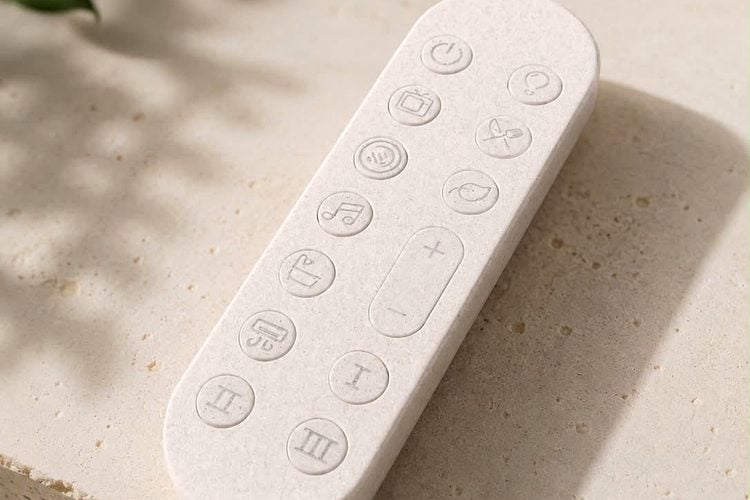
A wall-mounted tablet can run the whole house, but sometimes you just want a button. Reddit maker Zweetkonijn built his own Home Assistant remote control with a custom PCB, a 3D-printed case that looks a lot like a Google TV remote, and an ESP32-H2 that talks Zigbee. Total material cost was about 40 euros, and the post passed 900 upvotes on r/homeassistant in half a day.
Why the ESP32-H2
The ESP32-H2 has no Wi-Fi. Instead it has an IEEE 802.15.4 radio for Zigbee and Thread, plus Bluetooth LE, and it supports deep sleep. That makes it a good fit for a battery remote: it sleeps between presses and joins the existing Zigbee network instead of reconnecting to Wi-Fi every time. The maker used an ESP32-H2 SuperMini board and a 1,200 mAh LiPo cell.
In the comments he shared real numbers. The remote currently draws 0.42 mA in standby, which works out to about four months on a full charge. He is still tuning the H2 for lower sleep current and hopes to get close to a year.
One press, many automations
Each button triggers a Home Assistant automation rather than a single device. One press can start the robot vacuum, switch light scenes, change the HVAC temperature or fan speed, start music or adjust volume. The case is printed in two colours on a 0.4 mm nozzle, and the PCB was made by a Chinese fab. The maker calls it a great beginner project and says he learned a lot from it.
The community also caught a real issue. One commenter pointed out that the LiPo should go through a proper USB-C charge and protection board. The maker had assumed the TP4054 charger on his board offered full protection, checked the datasheet, found it does not, and is now adding it.
Our take
Custom Zigbee buttons are one of the most practical things you can build for a smart home, and the ESP32-H2 makes them much easier than rolling your own radio stack. We covered the chip at launch in our ESP32-H2 news story; this remote shows what it is good at. The battery protection lesson applies to any LiPo project.
Image credit: Zweetkonijn / Reddit, cropped and resized.
About the author: Aswinth Raj is an electronics engineer and the editor of CircuitDigest, where he has published more than 150 hands-on projects and tutorials across Arduino, PIC, ESP32, Raspberry Pi and EV battery systems. He selects the stories on this page for what engineers and makers can actually learn or build from. Connect on LinkedIn

Add a comment
No account needed. Your comment appears once a moderator has reviewed it.