
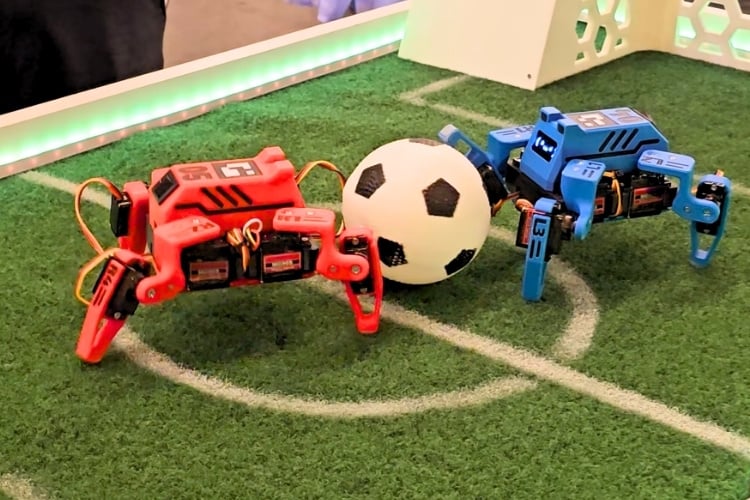
A maker built a miniature soccer environment for Sesame, a small quadruped robot, and demonstrated the system at the 2026 Open Sauce maker event. The build includes a scaled down soccer pitch sized for the robot, along with 3D printed goals and structural components. Multiple Sesame units are controlled wirelessly using the ESP-NOW protocol, with ESP32 chips on each robot communicating with a central board that sends out commands, supporting up to four controllers connected at the same time. To produce and broadcast matches without a dedicated crew, the creator built a camera and software stack referred to as Autoproducer, using two pan-tilt cameras that follow the action and one fixed overhead camera with a 120 degree field of view to track robot and ball positions using fiducial markers.
One design decision involves the pan-tilt cameras' aiming logic. Rather than using the overhead camera to steer them, which was more accurate on average, the creator found that its data introduced enough jitter to cause visible twitching in camera movement. Using the onboard camera's own ball detection instead, despite it being described as the less accurate of the two, produced smoother and more stable aiming. A similar tradeoff appeared in the system's homography calibration, used to map the field's coordinates. Heavy smoothing is applied to the four static corner markers, while the ball's position is left unsmoothed, since the ball is expected to move unpredictably and smoothing it introduced lag and caused false "kick" detections.
For ball detection, an initial color and shape based filter proved unreliable across different lighting conditions. The creator addressed this by manually labeling roughly 180 images and training a custom YOLO based vision model. After returning from the event, the creator added a basic autonomy mode, allowing Sesame units to orient toward the ball and move independently without a human controller.