

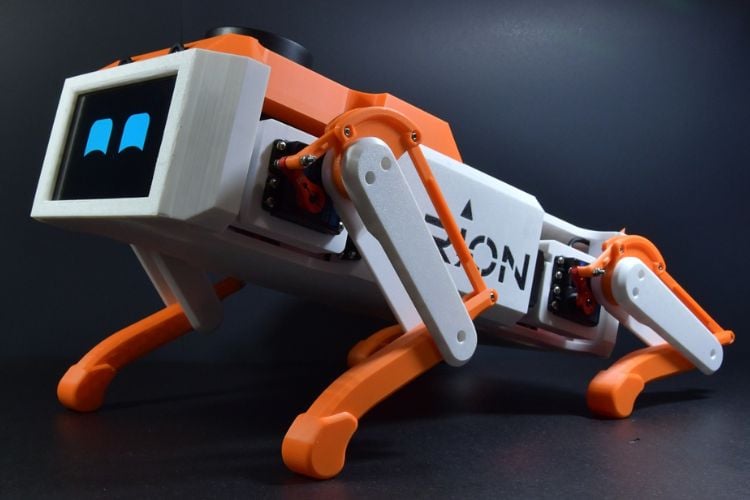
Ashish Agrahari, a Mechatronics Engineering student at the University of Waterloo, has recently built Orion, a 12-DOF quadruped robot dog designed and programmed from scratch over eight months, combining ROS 2 autonomy with custom embedded electronics. The system is split into two layers: a Jetson Orin Nano for high-level perception and planning, and custom STM32-based PCBs for deterministic, real-time leg control.
The Jetson Orin Nano runs ROS 2 Humble with Isaac ROS containers and TensorRT-accelerated neural networks, enabling stereo vision (SGBM, MiDaS), 2D LiDAR SLAM, and Nav2-based path planning with point-and-click navigation. This compute module handles everything that needs serious CPU/GPU power: depth estimation, obstacle avoidance, and even reinforcement-learning policies for adaptive locomotion.
Below that, the STM32 boards run FreeRTOS firmware that executes inverse kinematics, gait generation, and high-frequency servo loops while interfacing with IMUs and encoders. By offloading these hard real-time tasks to dedicated microcontrollers, Orion keeps its legs stable and responsive even while the Jetson is busy with heavy perception and AI workloads, making it a strong reference design for ROS 2 quadrupeds in research and advanced maker projects.

Add a comment
No account needed. Your comment appears once a moderator has reviewed it.