
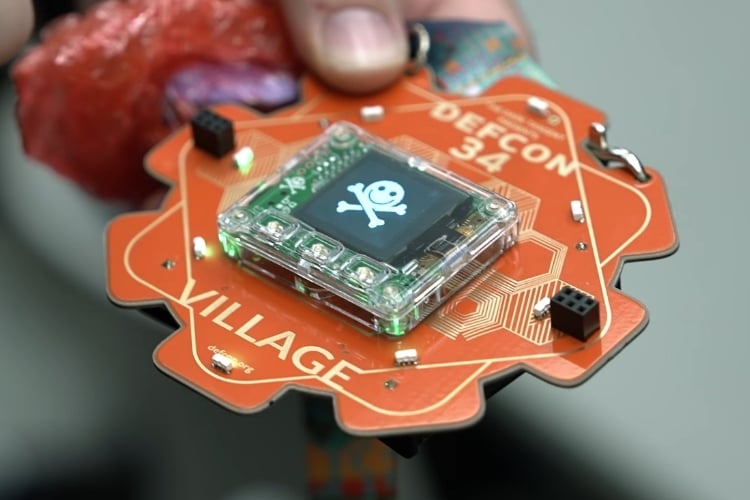
Every year, DEFCON's electronic badge becomes one of the most talked-about pieces of hardware in the security world, and the DEFCON 34 badge, handed out to roughly 27,000 attendees at the Las Vegas Convention Center from August 6 to 9, 2026, pushed that tradition further than ever. The badge was designed by renowned hardware hacker Andrew "bunnie" Huang alongside the CHEESO team, and organizers built it around this year's theme of agency, the idea that technology should give people more control rather than less the chip forms part of a removable module that adds a display and camera to the carrier board. At its core sits the Baochip-1x, a mostly open source system-on-chip built on a RISC-V architecture, combining a 350MHz VexRiscv processor core with four PicoRV32 input-output cores, 2MB of on-chip SRAM, and 4MB of ReRAM, a memory type similar to flash storage The DEFCON 34 badge is built around Andrew 'bunnie' Huang's Baochip-1x, an open-source system-on-chip that doubles as a hardware security token, password manager and HSM, pairing a 350 MHz Vexriscv RISC-V core with 4MB of ReRAM, 2MB SRAM, and hardware secure elements including a key store and true random number generator, fabricated on TSMC's 22nm process. What sets this chip apart from typical conference hardware is genuine physical transparency: the chip package is engineered for what's called IRIS, or Infra-Red In-Situ inspection, letting badge owners non-destructively look through the silicon itself with infrared light and confirm the transistor layout matches the publicly released design files The package is engineered for Infra-Red In-Situ (IRIS) inspection, letting owners non-destructively view the silicon and check that transistor patterns match the published RTL.
On the software side, the badge's core module runs Xous OS, an embedded microkernel operating system written in Rust and purpose-built for high-assurance applications. Xous gives every running process its own protected memory space and keeps system services running in userland rather than inside the kernel, which shrinks the attack surface considerably. Combined with onboard cryptography accelerators, a true random number generator, secure key storage, and glitch sensors that flag tampering attempts, this software and hardware pairing turns the badge into a genuine, working security tool rather than a one-off novelty. DEFCON organizers themselves called it a device with real "security token, password manager, HSM, pretty light generator" functions It's the creation of hardware superstar Bunnie Huang, and it features his open-source, fully inspectable Baochip. DEFCON 34 badgeholders will be the first to get their hands on a radically transparent device with all kinds of powerful possibilities - security token, password manager, HSM, pretty light generator, and unlike DEFCON 32's badge which ran on Raspberry Pi's RP2350 microcontroller at DEF CON 32, the badge was powered by Raspberry Pi's second-generation RP2350 microcontroller, this year's chip was custom designed from the ground up specifically for the con. Physically, the badge connects through USB-C, includes two SAO ports for community-built hardware add-ons, and carries a deliberately low-resolution, black-and-white camera meant only for scanning QR codes rather than taking photos, reflecting DEFCON's long-standing privacy culture. Output runs through a small 128x128 black-and-white OLED screen, and the badge draws power from two AA batteries good for roughly three days of light use. Once separated from the badge body, the transparent core module keeps working entirely on its own as a standalone FIDO2 and TOTP-compatible hardware security key, giving attendees a genuinely useful tool to keep long after the conference ends. DEFCON
The badge also carries real symbolic weight for the hacker community. This year marks twenty years since Joe Grand, known by the handle Kingpin, built DEFCON's first-ever electronic badge back in 2006, and the DEFCON 34 badge pays direct tribute to that milestone through its backside artwork. Following DEFCON's long-standing tradition of separate badge tiers for different attendee types general attendees, staff, speakers, vendors, and press this year's badges come in two main builds: a two-layer matte black and copper "HUMAN" badge with a silver-inlay peacock design meant for general attendees, and a four-layer, color-coded version with a gold inlay for other badge holder groups. The artwork draws from solarpunk design and Peranakan styling, a callback to DEFCON's first-ever Singapore event, and hides a white peacock symbolizing protection and courage that only becomes visible once the core module is removed. A playful social feature rounds out the experience: pressing the badge's middle button reveals a QR code that other attendees can scan to trade encrypted light patterns, letting badge holders collect and swap unique light shows from each other, alongside deeper hidden challenges tied to the badge's secure boot keys for those willing to dig further. Independently covered by Wired, Hackster.io, and multiple hardware security outlets The badges for DEFCON 34 feature an open source security chip designed by renowned hardware hacker Andrew "bunnie" Huang. The implementation marks a significant step in bringing transparency to security-critical hardware components, allowing conference attendees to examine and verify the security mechanisms built into the devices they carry, the DEFCON 34 badge stands as one of the clearest examples yet of a simple event credential doubling as a serious, community-built piece of open hardware.