
This section covers basic electronics tutorials in various electronics domains. If you are an absolute beginner, this section is the starting point to learn the basic electronics concepts. Once you are the done with understanding the basic concepts, head towards the electronics circuits section and try your hands on few circuits.
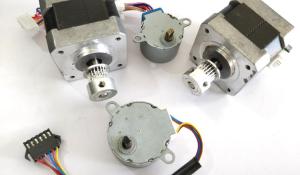
From a simple DVD player or printer in your home to a highly sophisticated CNC machine or Robotic Arm, Stepper motors are to be found almost everywhere. Its ability to make electronically controlled precise movements have made these motors find application in many felids like surveillance cameras, Hard disk, CNC machines, 3D Printers, Robotics, Assembly robots, Laser cutters…
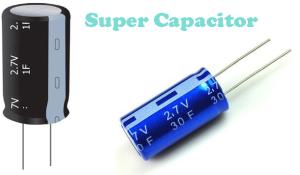
The capacitor is a two-terminal passive component, which is widely used in electronics. Almost, every circuit we find in electronics, use one or more capacitors for various usage. Capacitors are the most used electronics component after resistors. They have a special ability to store energy. There are different types of capacitors available in the market, but one which is…

Inverters, Converters, SMPS circuits and Speed controllers.... One thing that is common in all these circuits is that it consists of many electronic switches inside it. These switches are nothing but Power electronic devices like MOSFET, IGBT, TRIAC etc. In order to control such power electronic switches we commonly use something called PWM signals (Pulse Width Modulation).…
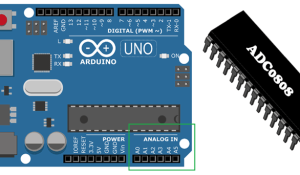
Few years back the entire electronics devices that we use today like phones, computers, Televisions etc were analog in nature. Then slowly the landline phones were replaced by modern mobile phones, CRT Televisions and monitors were replaced by LED displays, computers with vacuum tubes evolved to be more powerful with microprocessors…
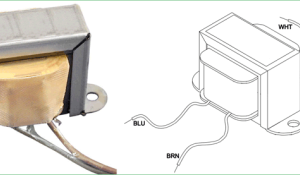
A transformer is a static electrical device that transfers energy between two or more circuits through electromagnetic induction. The transformer can Step up or Step down signal voltage. The transformer has no direct connection between the primary and secondary windings, the electrical energy transferred using electromagnetic induction. Due to this…
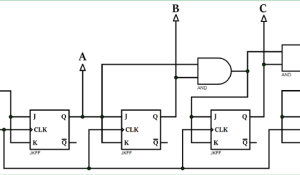
A counter is a device which can count any particular event on the basis of how many times the particular event(s) is occurred. In a digital logic system or computers, this counter can count and store the number of time any particular event or process have occurred, depending on a clock signal. Most common type of counter is sequential digital logic circuit…

An asynchronous counter (or ripple counter) is a sequential digital circuit in which the outputs of flip-flops are connected in series, so that the output of one flip-flop serves as the clock input to the next stage. Not all flip-flops may change state at the same time as synchronous counters, so asynchronous counters are easier to design but may experience propagation delays.
Table of…
In electronics, a regulator is a device or mechanism which can regulate power output constantly. There are different kinds of regulators available in the power supply domain. But mainly, in the case of DC to DC conversion, there are two types of regulators available: Linear or Switching.
A linear regulator regulates the output using a resistive…
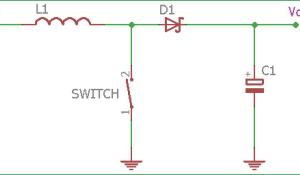
In electronics, a regulator is a device or mechanism which can regulate power output constantly. There are different kinds of regulators available in the power supply domain. But mainly, in the case of DC to DC conversion, there are two types of regulators available: Linear or Switching.
A linear regulator regulates the output using a resistive…

Op-Amp (Operational Amplifier) is the backbone of Analog electronics. An operational amplifier is a DC-coupled electronic component which amplifies Voltage from a differential input using resistor feedback. Op-Amps are popular for its versatility as they can be configured in many ways and can be used in different aspects. An op-amp circuit consists of few…

Op-Amp, short for operational amplifier is the backbone of Analog electronics. An operational amplifier is a DC-coupled electronic component which amplifies Voltage from a differential input using resistor feedback. Op-Amps are popular for its versatility as they can be configured in many ways and can be used in different aspects. An op-amp circuit consists of…

Power electronic switches like BJT, SCR, IGBT, MOSFET, and TRIAC are very important components when it comes to switching circuits like DC-DC converters, Motor Speed Controllers, Motor Drivers, and Frequency Controllers etc. Each device has its own unique property and thus they have their own specific applications. In this tutorial we will learn about the TRIAC, which is a…
