

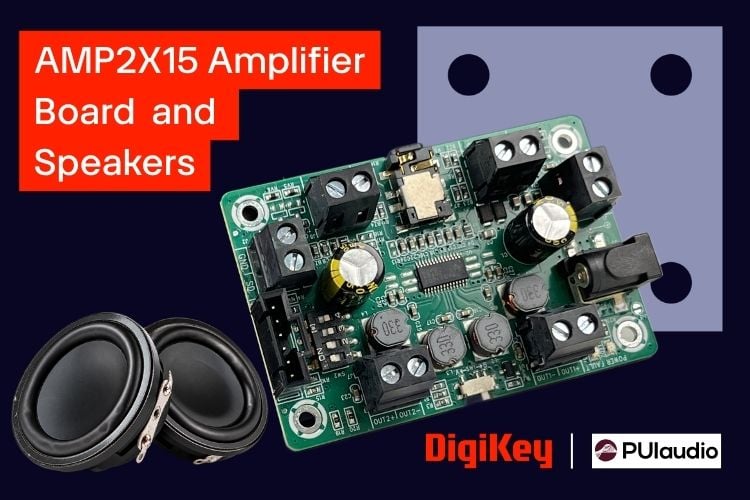
Adding a speaker to an embedded project is not always as simple as connecting it directly to a microcontroller or single-board computer. Most audio sources provide a relatively low-level signal, while a speaker needs more power to produce useful sound output. This is where an audio amplifier becomes important. The PUI Audio AMP2X15 is designed to bridge this gap, providing a compact two-channel amplification solution for driving speakers from a low-level audio source. It can be used with microcontrollers, single-board computers, and other embedded platforms where clear and sufficiently powerful audio output is required. When paired with suitable speakers, the board provides a convenient way to add audio playback to prototypes and embedded products without designing the amplifier stage from scratch.
In this tutorial, we will look at the PUI AMP2X15 audio amplifier board and pair it with two PUI AS04004MR-N50-WP-2-R speakers to build a simple stereo audio system. We will first look at the hardware, specifications, connections, and operating modes, and then connect the amplifier to a suitable audio source for practical testing.
CircuitDigest presents Learn, Build & Win by DigiKey. Submit your innovative embedded or electronics project idea for a chance to receive the AMP2X15 audio amplifier board and AS04004MR-N50-WP-2-R from PUI Audio and bring your project to life.
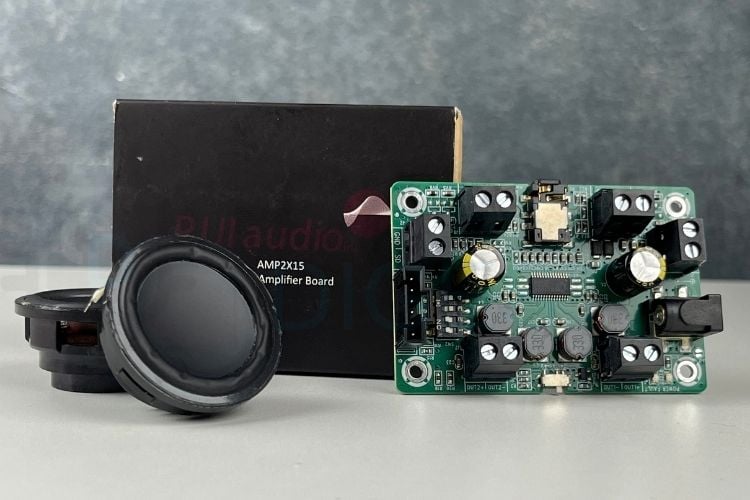
PUI Audio AMP2X15 Audio Amplifier
The PUI Audio AMP2X15 is a compact audio amplifier board based on the Texas Instruments TPA3110D2 Class-D amplifier. The AMP2X15 is designed for prototyping audio solutions and supports single-ended and differential inputs, along with stereo BTL and mono PBTL output configurations. For a two-speaker stereo system, we will use the stereo BTL configuration. In this mode, one amplifier channel drives each speaker. For our setup, the board is configured in stereo BTL mode, with one amplifier channel dedicated to each speaker. This allows us to connect the two PUI Audio AS04004MR-N50-WP-2-R speakers directly to the amplifier board and create a simple two-channel audio system. The board also includes screw-terminal connections for the speaker outputs and power input, making it convenient to connect and test the complete setup during prototyping.
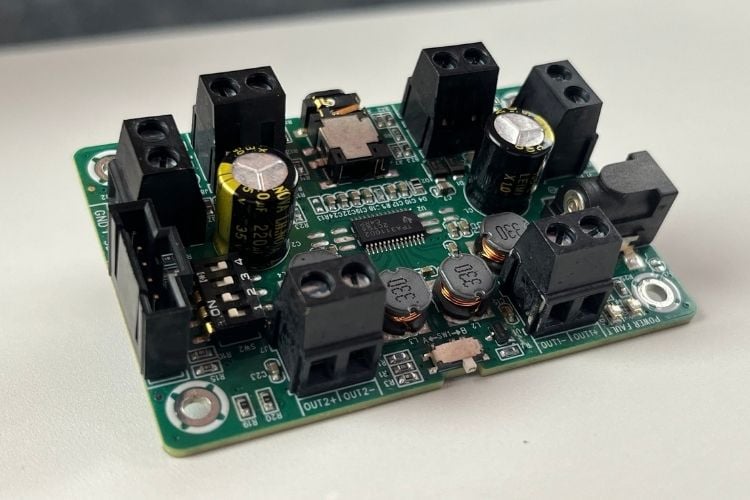
AMP2X15 Key Specifications
The key specifications of the AMP2X15 audio amplifier board are summarized below, highlighting its amplification capability, supported input and output configurations, and operating characteristics.
| Parameter | Specification |
| Amplifier IC | Texas Instruments TPA3110D2 |
| Supply voltage | 9.5V to 20V |
| Typical supply | 12V |
| Gain | 26 dB |
| Input impedance | 30 kΩ |
| Frequency response | 20 Hz to 20 kHz (±3 dB) |
| Output power, 4Ω | 6W/channel at 0.1% THD+N, 12V |
| Output power, 8Ω | 15W/channel at 10% THD+N, 16V |
| Minimum resistive load | 3.2Ω |
| Quiescent current | 20mA typical at 12V |
The recommended power supply for the AMP2X15 board is a 12 V, 2 A DC supply, providing sufficient power for the amplifier during typical two-channel operation. A stable supply is recommended to ensure consistent audio output and minimize the possibility of distortion or performance issues, particularly when driving both speakers at higher output levels.
AMP2X15 Hardware Overview
The amplifier board provides several ways to connect an audio source. A 3.5mm stereo audio jack is provided for common consumer audio sources such as computers and other audio devices. Additional terminal-block and Molex connections are available for other input configurations. Here are the main features of the AMP2X15.
● Small form factor- 76.2mm x 50.8mm x 20mm
● Wide +9.5V to +20V DC input range
● Three different input connections: stereo 3.5mm jack, terminal blocks, six-circuit Molex SL 70543 connector
● Audiophile-grade sound quality
● Single-ended and differential inputs; stereo or mono output
● Built-in over-current and over-temperature protection
● Power and fault indication LEDs
AMP2X15 Mode Selection
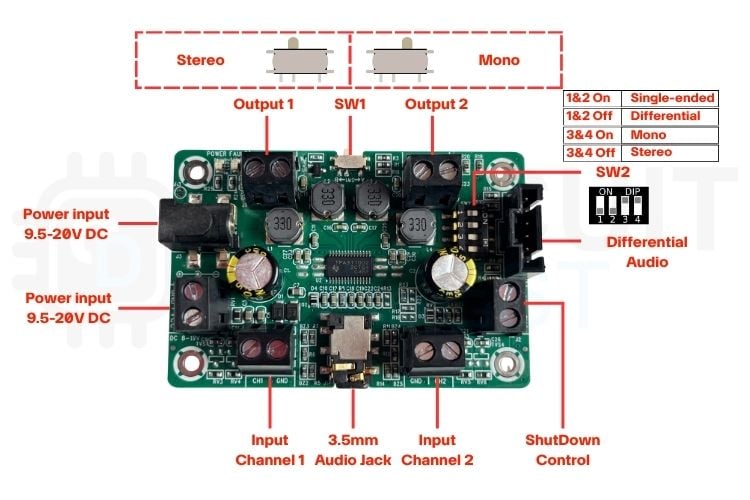
One of the useful features of the AMP2X15 is its selectable input and output configuration. The board can operate in stereo BTL mode or mono PBTL mode. The input can be configured for single-ended or differential signals. By default, the board is configured to use stereo BTL mode. The single-ended input configuration is appropriate for most audio sources. The amplifier gain is fixed at 26dB, so the source device's volume control can be used to adjust the audio level.
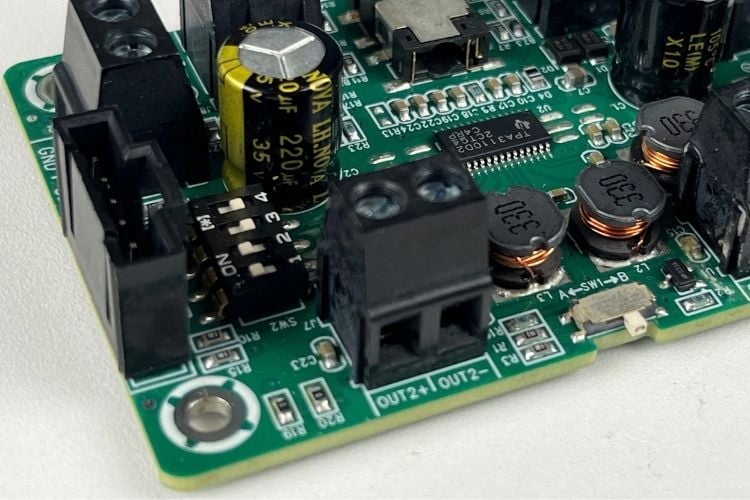
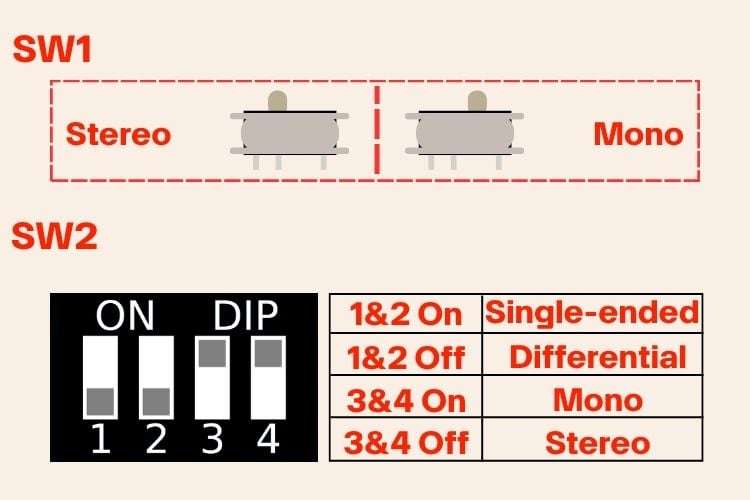
The input and output modes of the AMP2X15 board can be easily configured using the onboard SW1 and SW2 switches. SW1 selects the overall output configuration between Stereo (BTL) and Mono (PBTL) operation, while SW2 is used to select the input type and output mode. For the input, setting DIP switches 1 and 2 to ON selects single-ended input, while setting them OFF selects differential input. For the output, DIP switches 3 and 4 must be set to ON for Mono (PBTL) operation and OFF for Stereo (BTL) operation. In addition, SW1 should be set to position B for Stereo mode and position A for Mono mode. For our two-speaker setup, we use SW1 in position B and DIP switches 3 and 4 in the OFF position, enabling stereo BTL operation with one amplifier channel driving each speaker.
PUI Audio AS04004MR-N50-WP-2-R Speaker
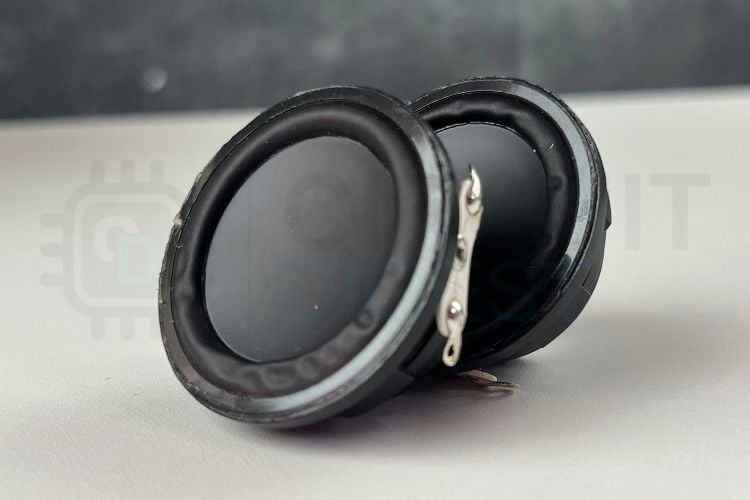
The AS04004MR-N50-WP-2-R is a compact 40mm speaker designed for applications requiring a small audio transducer. The supplied datasheet specifies a 5W rated input power and a 6W maximum input power. Its nominal impedance is 4Ω.
The speaker has a specified sensitivity of 84 ±3dBA at 1W/50cm and a frequency range of 100Hz to 20kHz. It uses an NdFeB magnet and an ABS housing, and it features an IP65 ingress protection rating.
Here are the detailed specifications for the PUI Audio AS04004MR-N50-WP-2-R speakers
| Parameter | Specification |
| Rated input power | 5W |
| Maximum input power | 6W |
| Impedance | 4Ω ±15% |
| Sensitivity | 84 ±3dBA @ 1W/50cm |
| Distortion | <5% max @ 1W, 1kHz |
| Resonant frequency | 180 ±20% Hz |
| Frequency range | 100Hz to 20kHz |
| Housing material | ABS |
| Magnet material | NdFeB |
| Weight | 21.5g |
| Ingress protection | IP65 |
| Operating temperature | −30°C to +85°C |
The speaker has a nominal 40mm circular frame and has a maximum overall depth of approximately 21.5mm.
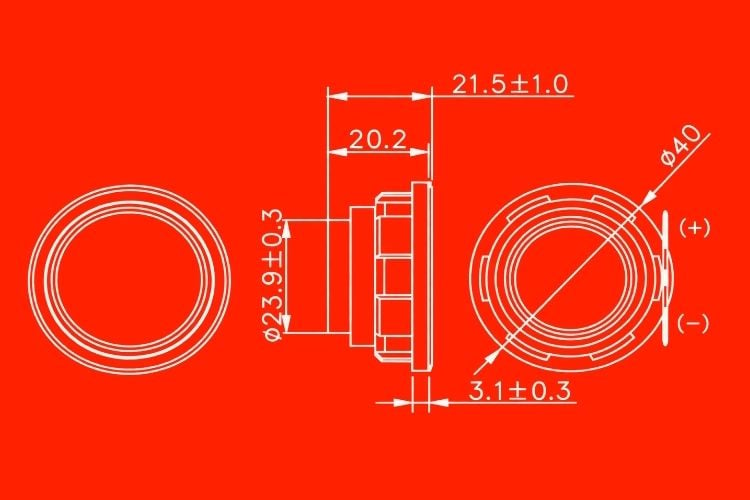
The speaker does have polarity: applying a positive voltage to the positive terminal moves the diaphragm outward. Correct polarity is important when using two speakers because reversing one speaker relative to the other can affect the stereo system's bass response.
Connecting the Two Speakers
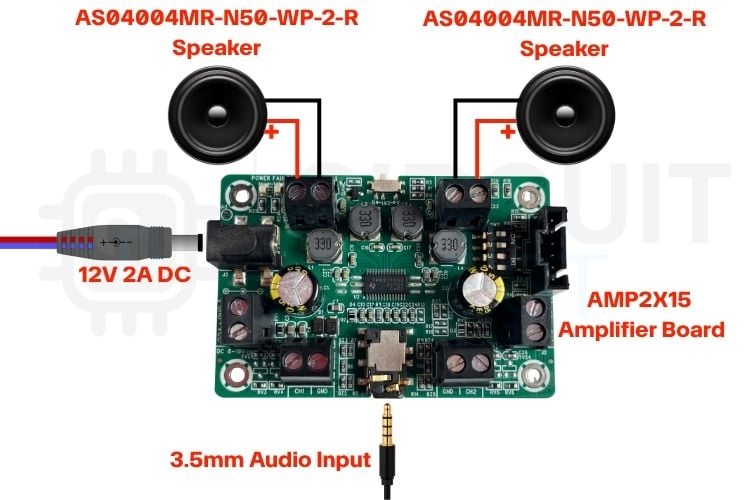
For our demonstration, we will configure the AMP2X15 for stereo BTL operation, with one AS04004MR-N50-WP-2-R speaker connected to the left output and the second speaker connected to the right output. The amplifier will be set to stereo BTL mode with the input configured for single-ended operation. The left speaker will be connected to its corresponding OUT+ and OUT− terminals, while the right speaker will be connected to its respective OUT+ and OUT− terminals, with the polarity of each speaker observed during connection. A 12 V power supply will then be connected to the amplifier's DC input. Before powering the amplifier, the audio source volume should be kept low to avoid sudden high-level output to the speakers. Since the AMP2X15 uses bridge-tied-load (BTL) outputs, each speaker must be connected directly across its corresponding positive and negative output terminals; the negative output terminal should not be treated as a ground connection or shared between the two speakers.
3D-Printed Enclosure
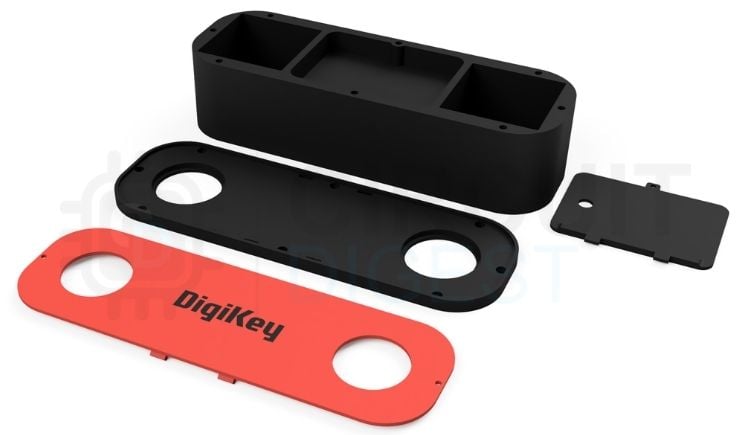
We designed a simple 3D-printed enclosure, and it gives the setup a more compact form and allows the amplifier and speakers to be assembled as a single unit for testing. The enclosure is made using PLA and assembled with screws and heat-set inserts. It provides space for the AMP2X15 amplifier and the two AS04004MR-N50-WP-2-R speakers while keeping the main connections accessible for the demonstrations. The STL file is given for reference.
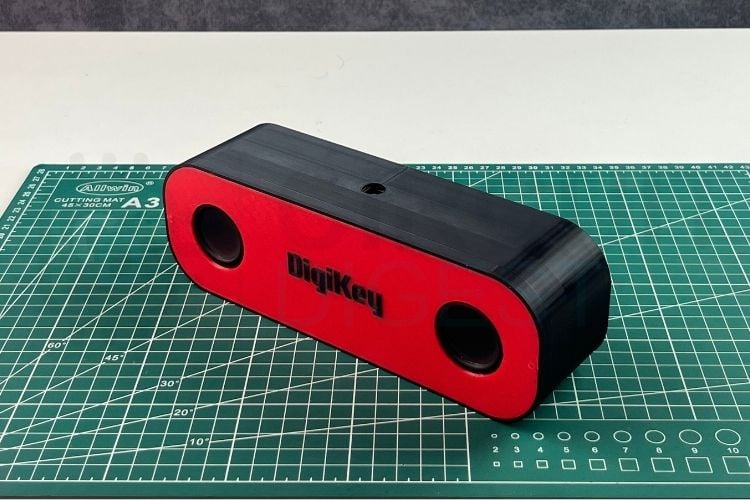
Here is the fully assembled speaker.
AMP2X15 Audio Test
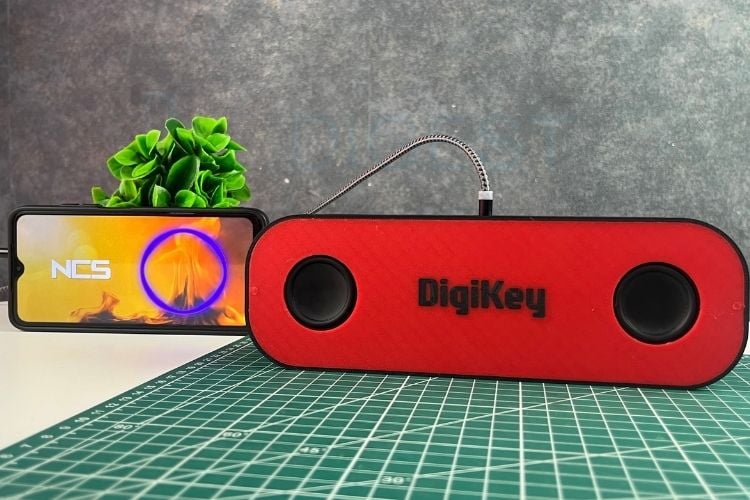
For testing our portable speaker made with the PUI Audio AMP2X15 audio amplifier and speakers, we have used a smartphone as the audio source. The smartphone provides the simplest way to test the amplifier because it can supply a conventional stereo audio signal via its 3.5mm audio jack.
Protection and Fault Indication
The AMP2X15 includes protection features for over-current and over-temperature conditions. A fault indication LED is provided on the board. According to the supplied user guide, an incorrectly configured input/output mode or an over-current condition can cause the fault LED to illuminate and amplifier operation to stop. If this happens, power should be removed, the wiring and switch configuration checked, and power reapplied after correcting the problem.
_0.jpg)
Important Precautions
- Use a stable DC power supply within the specified 9.5V to 20V range.
- Do not connect the amplifier outputs directly to ground.
- Observe speaker polarity.
- Use only one group of audio inputs at a time.
- Keep the audio source volume low when powering the amplifier.
- Do not connect a pre-amplifier to the AMP2X15 input.
- If the fault LED turns on, remove power before troubleshooting.
Applications
The AMP2X15 amplifier board and compact AS04004MR-N50-WP-2-R speakers can be useful when a small embedded system needs a more powerful audio output stage. Possible applications include Raspberry Pi audio projects, embedded multimedia systems, IoT devices, small speaker systems, smart appliances, audio indicators, and prototype consumer electronics.
The speaker's compact size, ABS housing, IP65 rating, and specified −30°C to +85°C operating temperature also make it suitable for applications where a small and more environmentally resistant speaker is useful.
Conclusion
The PUI Audio AMP2X15 provides a straightforward way to add a stereo Class-D audio output to a project. Its multiple input options, selectable stereo and mono configurations, fixed 26dB gain, and built-in protection features make it useful for audio prototyping. Paired with two AS04004MR-N50-WP-2-R 5W, 4Ω speakers, it can form a compact stereo audio system without requiring a custom amplifier circuit. The combination is particularly useful for makers and embedded developers who need a simple, ready-to-use audio output stage for a prototype or project.

Add a comment
No account needed. Your comment appears once a moderator has reviewed it.