

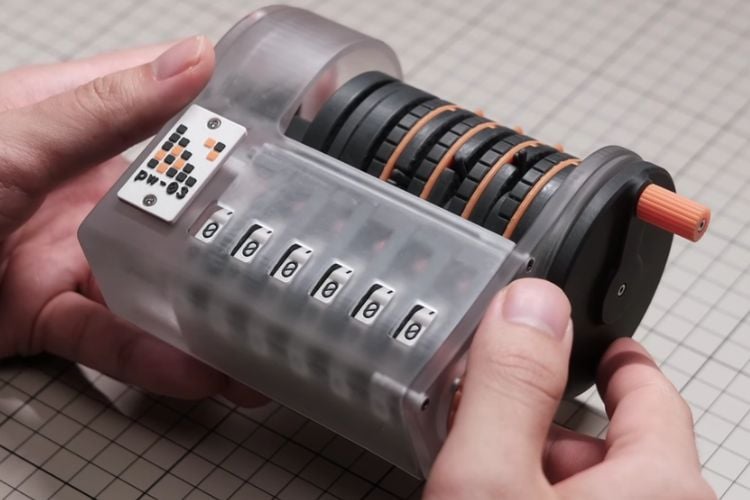
A maker has built a calculator out of some 3D-Printed parts that can perform up to six-digit addition, subtraction, multiplication, and division that too without any complicated electronics. The machine is made from more than 130 custom designed parts and works entirely through gears, pins, levers, springs, and a hand crank. Its design is inspired by historic mechanical calculators, especially the pinwheel mechanism developed by Willgodt Odhner in the 19th century. By setting movable pins from 0 to 9, the user can choose a number and turn the crank to add it to the display; turning the crank backwards performs subtraction.
One of the most difficult parts of the project was creating a reliable carry mechanism. In a normal calculation, adding 2 to 9 should produce 11, so the calculator needs to reset the first digit from 9 to 0 while increasing the next digit by 1. The creator tested more than 30 versions of this mechanism before redesigning it with ball springs and smoother moving surfaces. High-precision resin 3D printing helped solve many reliability problems, as the small moving pins could otherwise catch on FDM print layer lines and cause jams. Tough resin was used for parts that repeatedly flex or transmit force, while clear and coloured resins gave the calculator its distinctive futuristic look.
The finished calculator includes six output digits, four adjustable input pinwheels, a reset system, and a turns counter that helps with multiplication and division. Addition and subtraction are performed directly by rotating the crank, while multiplication uses repeated addition; the pinwheel assembly can slide to different digit positions to multiply by tens or hundreds more efficiently. Division works through repeated subtraction, with the turns counter showing the quotient and the display retaining any remainder. The result is a striking example of how old mathematical computing ideas can be recreated with modern 3D-printing tools, proving that a complex calculator can still work using nothing more than carefully designed 3D Printed parts.

Add a comment
No account needed. Your comment appears once a moderator has reviewed it.