

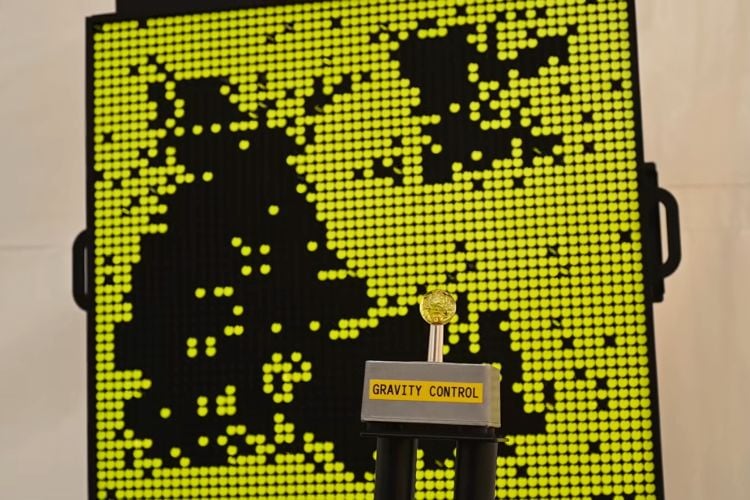
Maker Tim Alex Jacobs has turned nearly 3,000 old electromechanical flip dots into an unusual real-time fluid simulation display. Instead of using an LCD or LED panel, the project uses eight salvaged flip-dot panels, where every pixel is a small magnetic disk that physically flips between two positions. which is black and yellow. The result is a display that not only shows the movement of the simulated fluid but also produces the characteristic clicking and swishing sounds of the mechanical dots. The installation was built for EMF 2026 and measures roughly one square metre.
Getting the old panels to work at the required speed was the main electronics challenge. Their original matrix-driving electronics were too slow for a fluid simulation, so the maker developed custom driver boards that work with the existing panels. The new design uses inexpensive H-bridge driver ICs and a capacitor-based approach to control the flip-dot coils, reducing the amount of modification needed on the original boards. Because each dot requires a short, high-current pulse to flip, the display also uses a large amount of electrolytic capacitance to handle the peak power demand. The panels communicate with the main controller over RS485, while SPI is used within the panel electronics.
At the centre of the system is an STM32H7R3 running at 600 MHz, which handles the fluid simulation and controls the display. A joystick lets visitors change the direction of simulated gravity, while an accelerometer also allows the system to respond when the display is moved. The final installation was reduced from an original plan for 18 panels to eight panels with just under 3,000 dots, making the project more practical to build before EMF 2026. It then ran continuously for four days at the event, turning an obsolete display technology once used for transport signs into an interactive mechanical fluid simulator.

Add a comment
No account needed. Your comment appears once a moderator has reviewed it.