

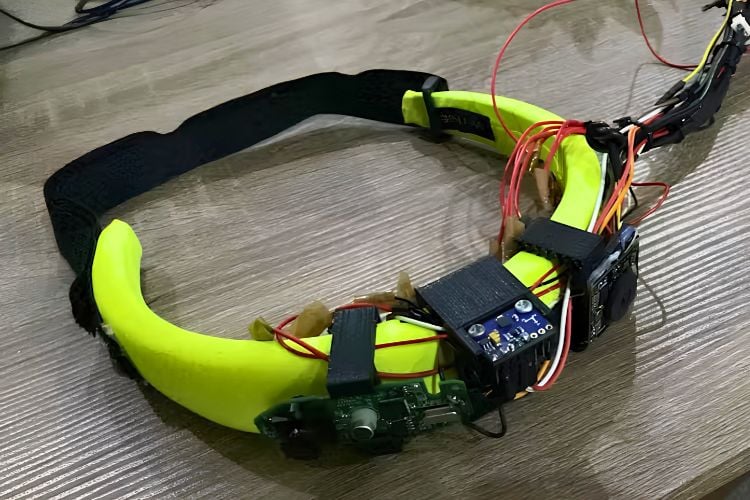
Maker pasquale887 has developed HaloSense V1, a wearable haptic headband that helps users sense the direction of people and objects through vibrations instead of looking at a screen. The headband has 13 small vibration motors arranged around the forehead. When a person or target is detected in a particular direction, the motor in the corresponding position vibrates, helping the wearer understand where it is. It also has a compass mode that uses vibrations to indicate magnetic north. The project explores how touch can be used to share spatial information and could be useful for experimenting with screen-free directional awareness, indoor orientation, and assistive technology.
At the center of HaloSense is an Arduino UNO Q, which processes information from the cameras and sensors and controls the vibration motors. Two USB webcams capture images for detecting people and tracking visual markers, while an LSM303DLHC magnetometer and accelerometer provide compass and motion data. The system uses YOLOX-Nano for person detection and OpenCV ArUco markers for target tracking. A PCA9685 16-channel PWM driver controls the motor signals, with two ULN2803A driver arrays used to drive the 13 vibration motors. A separate ESP32-based controller connects wirelessly to the headband and allows the user to switch modes and send commands.
HaloSense has three modes: COMPASS, PERSON, and TARGET. In COMPASS mode, vibrations indicate magnetic north. In PERSON mode, the cameras detect a person and estimate their horizontal position, while in TARGET mode, the camera detects a special black-and-white ArUco marker and uses its position to determine which direction to vibrate. However, the prototype has some limitations: TARGET mode covers about a 120° front field of view, camera-based detection can depend on the camera view and surroundings, and the wearer needs to learn the vibration patterns. The headband also contains several motors, cameras, wiring, and electronics, making it an experimental prototype rather than a compact everyday device. It is not a clinically validated accessibility or navigation system, but it demonstrates an interesting approach to converting visual and sensor information into something a person can feel.

Add a comment
No account needed. Your comment appears once a moderator has reviewed it.