

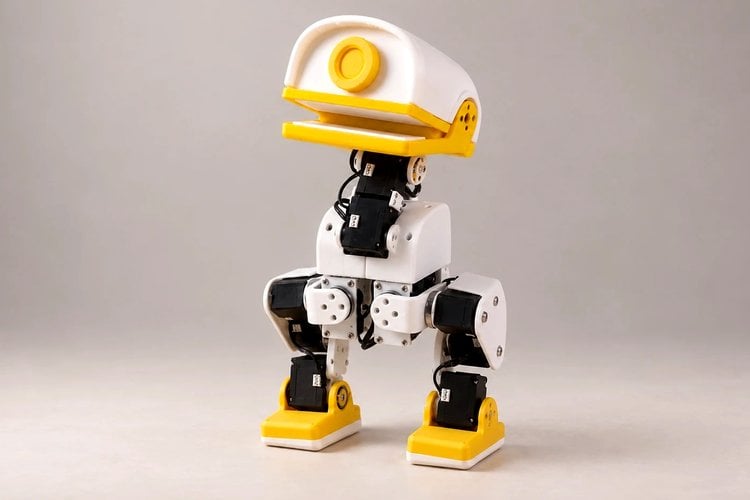
Most small walking robots replay hand-tuned servo sequences. XGO-Duck, an open-source biped from Luwu Dynamics, the team behind the XGO robot dogs, walks on a neural network policy instead. The network runs on the Linux side of an Arduino UNO Q, while the board's STM32 microcontroller handles the 15 serial bus servos and the orientation feedback. This weekend the team posted a clip of the duck lining up and kicking a small ball, which became one of the top posts on r/arduino.
Built on Pollen Robotics' Microduck
XGO-Duck adapts Microduck and microduck_rl from Pollen Robotics, the Hugging Face robotics team behind Reachy Mini. Luwu added the Arduino UNO Q, Feetech servos, its own expansion board and a runtime with ready-made locomotion policies, so a first build does not require training a neural network. Everything is controlled from a browser page served by the robot: assigning servo IDs, calibrating each joint against a mechanical zero, and driving it with keyboard or joystick commands to walk, turn, get up, move the head and open the beak.
Key details
- Controller: Arduino UNO Q 2GB; neural network inference on the Linux processor, servo control and orientation feedback on the STM32
- Actuators: 15 Feetech HD1910M serial bus servos (10 in the legs, 4 in the head and neck, 1 for the beak)
- Body: 3D-printed rigid parts plus flexible TPU parts and foot pads, with bearings at the joints
- Power: 8.4 V 18650 battery pack, more than 2,500 mAh and over 3C discharge
- Open files: mechanical models, PCB designs, BOM and assembly guide on GitHub; a runtime repository with the supplied policies and browser tools
- Planned: camera, voice and ToF sensing are listed as future extensions
Our take
The interesting part is the split. A learned walking policy needs a real processor, while 15 servos and an IMU need hard real-time timing, and the UNO Q puts both on one board. For anyone curious about reinforcement-learning locomotion, a small duck with published files and a working policy is a far cheaper place to start than a humanoid. Luwu also sells an electronics kit through its XGO site if you do not want to source the parts.
Image credit: Luwu Dynamics (Arduino Project Hub), cropped and resized.
About the author: Aswinth Raj is an electronics engineer and the editor of CircuitDigest, where he has published more than 150 hands-on projects and tutorials across Arduino, PIC, ESP32, Raspberry Pi and EV battery systems. He selects the stories on this page for what engineers and makers can actually learn or build from. Connect on LinkedIn

Add a comment
No account needed. Your comment appears once a moderator has reviewed it.