
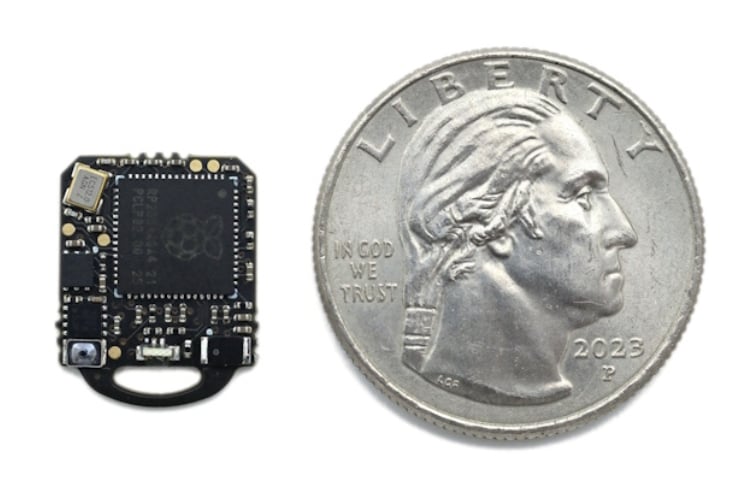
Bitmerse is preparing to launch Romu, a USB Type-A development board small enough to disappear almost entirely into the port it plugs into. The project is currently listed as "Coming Soon" on Crowd Supply. It's built around Raspberry Pi's RP2354A, a variant of the RP2350 chip that pairs a dual-core Arm Cortex-M33 running at 150 MHz with 2 MB of stacked onboard flash and 520 KB of SRAM. The board measures just 15.5 by 12 mm and ships with a preinstalled 3D-printed shim enclosure. It carries an RGB LED, a capacitive touch button, a boot button, and exposed test points for SWD and UART, and it supports MicroPython out of the box, with no external programmer or carrier board required.
Bitmerse is positioning Romu as a plug-and-forget tool rather than just a dev board. Suggested uses include a U2F hardware authentication key, a USB macro key for muting a mic or injecting passwords, a mouse jiggler, or a status light for unread notifications.
For users who need lower-level access, Bitmerse has also designed an optional Jig accessory. The board clamps into place via a rotating hood and spring-loaded pogo pins, which route the RP2354A's test points out to a USB Type-C port, a 20-pin JTAG connector for SWD debugging, and breakout pins for UART.
Bitmerse says it will publish schematics, PCB files, a bill of materials, enclosure and jig STL files, and example MicroPython scripts on GitHub before the board ships to backers, though no repository has surfaced publicly yet. The company previously brought WiSer, a multi-protocol hardware debugging tool, to Crowd Supply. Pricing, shipping estimates, and a firm launch date for Romu have not been announced.

Add a comment
No account needed. Your comment appears once a moderator has reviewed it.